




ADVERTISEMENT
Tribe Amrapali collaborates with The Palace Atelier for a collection inspired by Jaipur’s Pachranga flag
The collection reimagines heritage through colour, movement, and everyday wearability, blending centuries-old symbolism with a distinctly modern spirit.

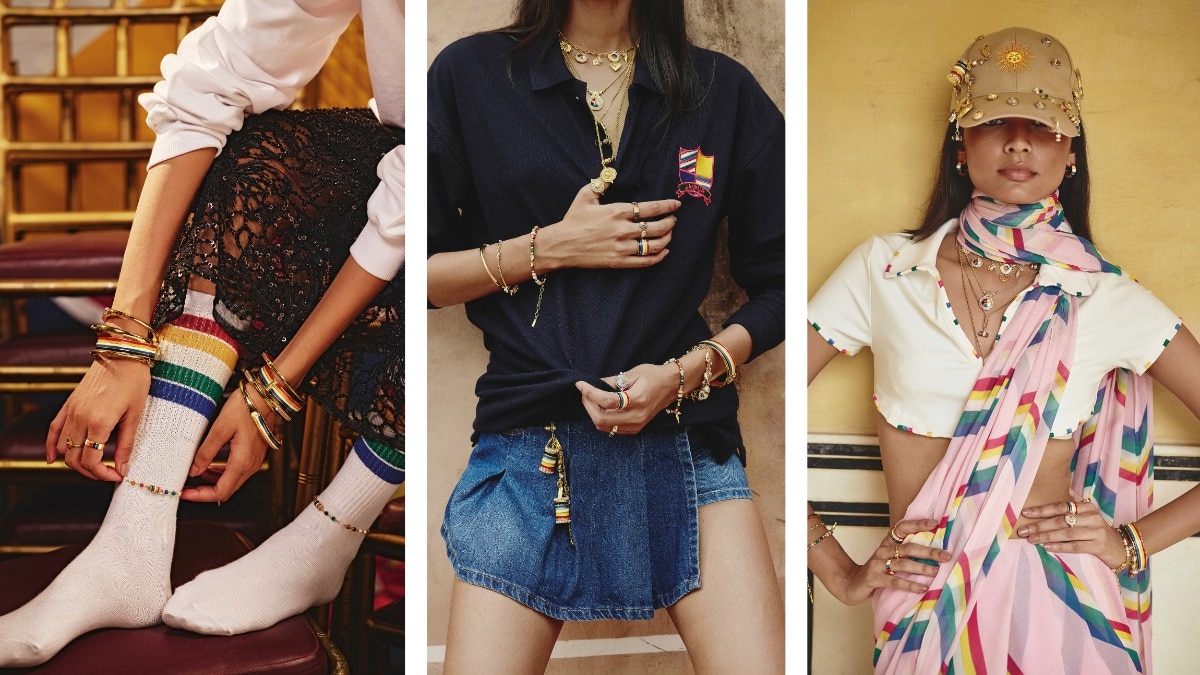
There is an almost ineffable pleasure in witnessing tradition evolve and emerge into something contemporary. Tribe Amrapali’s new collection sits precisely in this liminal space, taking the storied symbolism of Jaipur’s flag and allowing it to unfurl into jewellery that feels anchored in lineage and liberated by imagination.
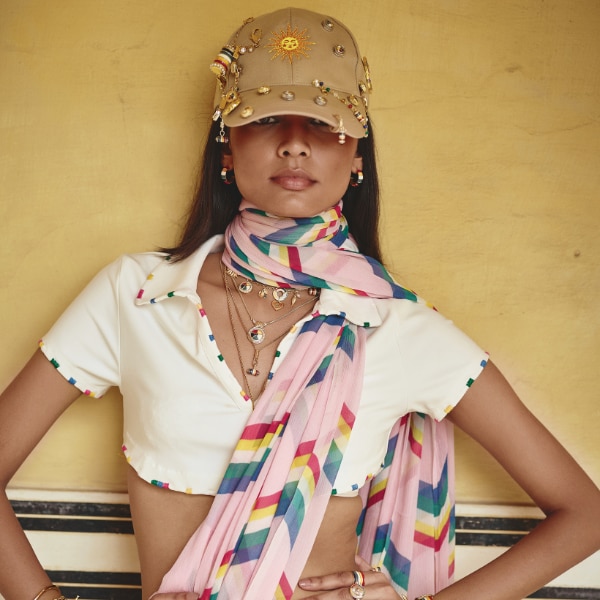
At the heart of this collection lies the Pachranga flag—a five-coloured royal emblem of the Kachwaha dynasty, first adopted by Raja Man Singh I in 1585 after his victory in Kabul—which still flutters above Chandra Mahal at the City Palace. Its stripes of red, white, yellow, green, and blue, representing earth, air, water, fire, and space, form the conceptual spine of the line. Yet the designers intentionally avoid a literal translation; instead, they interpret its vitality through colour, form, and rhythm, creating an aesthetic equilibrium that flows across the necklaces, earrings, bracelets, buttons, and rings.
Akanksha Arora, CEO, Tribe Amrapali, meets me amid trays glinting with enamel, repoussé medallions, charms shaped like miniature suns and lotus buds, and the unmistakable stripes of the iconic Pachranga flag. “We wanted a modern take on it,” she explains the genesis of this collaboration between Tribe Amrapali and The Palace Atelier.
“The subject itself is so inherently Indian, so deeply traditional, that I knew we had to approach it with a sense of lightness. I didn’t want to treat the Pachranga flag as a static emblem, but rather as a symbol that could be interpreted in multiple ways—dried down, distilled, almost reimagined—while still staying loyal to its original order, its exact colours, and everything they stand for.” She explains that while the five shades of the flag remained non-negotiable, the world around it offered endless inspiration. “Beyond the colours, we immersed ourselves in the surrounding visual language—the arches, the frescoes, the architecture of the palace, even the coat of arms. All these micro-details found their way back into the jewellery, so the pieces carry not just the flag but the entire cultural geography that exists around it.”
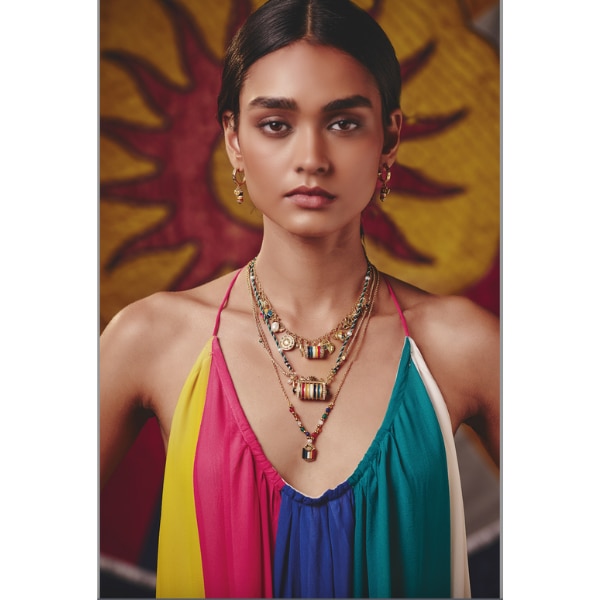
For Gauravi Kumari, the collaboration brought together two legacies—heritage craft and royal history. “I see the Pachranga flag every single morning, so seeing it reinterpreted in a more modern, joyful, creative way is fascinating. I had never seen Pachranga-inspired jewellery before, so the entire process felt entirely new—a fresh perspective on our family’s emblem.” Gauravi reveals that they pulled out archival imagery from the City Palace Museum.“It’s important for us to draw directly from the palace and the spirit of Jaipur,” she reminds me.
What Arora didn’t want, however, was for a collection to slip into over-ornamented nostalgia.“I wanted to create pieces that honour heritage but sit comfortably in the now, with a kind of lightness and clarity,” she adds. This pursuit of modernity reveals itself most playfully in the charms. “We approached them with a sense of fun,” she smiles. “Nothing overly serious—small, cute and delicate pieces. A little horseshoe that says ‘Jaipur’, a sun emblem recreated entirely through stones that match the Pachranga palette, a lotus rendered in soft enamel, leaves that move when you move. There is a lot of movement, a lot of layering, and that adds to the modernity.”
Wearability, she emphasises, was a key consideration. “I genuinely wanted people to be able to wear these pieces every single day,” she says. “Buy one necklace or two, stack them, layer them, keep them minimal—it should work whether you’re heading to work, stepping out casually, or even pairing it with a chiffon sari.” She gestures to the cultural precedent and recalls the elegantly pared-back styling of Rajput women. “The women in our culture often wear simple chiffon saris, and then a single strand of pearls—Maharani Gayatri Devi did this so effortlessly. I wanted that same spirit of ease, that same understatement.”
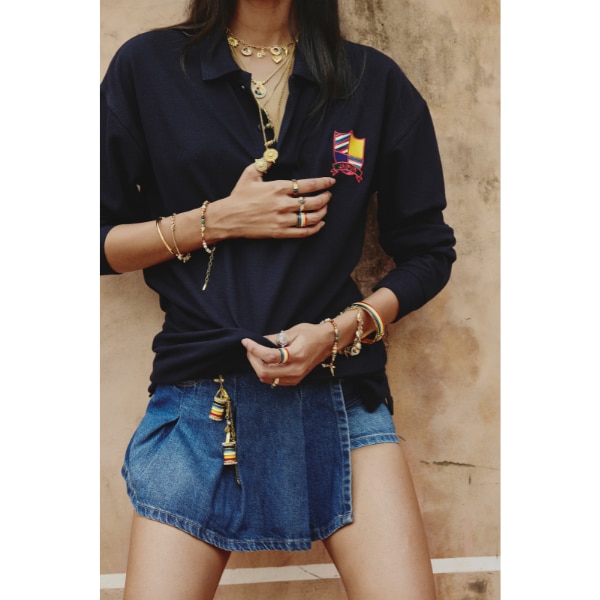
The men’s line, she adds, taps into another facet of Rajput aesthetics. “Rajput men take their jewellery seriously,” she smiles. “Our men’s line uses the Pachranga colours for buttons, lapel pins, brooches, bracelets. The men’s pieces are slightly more festive while the women’s pieces are more fun,” she adds. While speaking of craftsmanship, her tone becomes almost reverent.“ Hand enamelling runs through the entire line,” she explains. And as for the techniques, the collection honours the brand’s artisanal DNA while simultaneously expanding it.“We’ve used repoussé—what we call chitai in Hindi—where you beat the metal from one side so the design rises beautifully on the other. A lot of our pieces use that technique; the detail it creates is extraordinary.”
She adds that the brand embraced both tradition and technology. “Some charms were first sketched entirely by hand and then translated onto CAD, merging the softness of hand-drawing with the precision of digital structuring.” The collaboration wasn’t limited to jewellery but also extended into Pachranga-striped shirts, cotton patch dresses, saris, and even socks, tying the whole collection into one coherent edit. The result is a collection that reinterprets one of Rajasthan’s most distinctive symbols through a lens of modern simplicity, fluidity, and playfulness—heritage not as an anchor, but as a springboard for renewed imagination.
Image courtesy: Tribe Amrapali
This article first appeared in the December 2025 print issue of Harper's Bazaar India.
Also read: An intimate reading of Dior and Alaïa through cut, structure, and restraint
Also read: 6 fresh ways to style a cardigan and jeans, fashion's easiest way to look stylish right now
ADVERTISEMENT
Must Read




ADVERTISEMENT