




ADVERTISEMENT
The rise of South Asian artists and galleries in London's contemporary art scene
South Asian artists and galleries feature prominently across this year’s London Gallery Weekend.

There is a particular quality of light in London in early June. London Gallery Weekend arrives into it each year, turning the casual stroll across the city into something more deliberate.
This year, South Asian artists and galleries featured prominently across the weekend’s programme. Victoria Miro presented new works by Shahzia Sikander and NS Harsha; Sakshi Gallery marked its 40th anniversary with a group exhibition at Mall Galleries. At Cork Street, Project 88 made its London debut with Treeish, a group exhibition curated by Prajna Desai while Vadehra Art Gallery presented works by A Ramachandran. At the Hayward Gallery, Anish Kapoor and Kulpreet Singh presented major exhibitions.
Yet the South Asian art scene in London resists easy characterisation. The Gallery Weekend, from June 5 to June 7, brought that into focus: across Mayfair and Bloomsbury, in the rooms of Bonhams and Christie’s, and in the city’s more established presences.
THE CITY AS INTERLOCUTOR
For artist Shahzia Sikander, London has never been neutral ground. “The city is one I have circled for decades,” she says. Trained in the traditional practice of miniature painting, works that the city once collected, catalogued, and carried home, Sikander has returned to London many times over the course of a career whose subjects have always led back here. Her first London exhibition with Victoria Miro since the gallery announced her representation, coinciding with this year’s programme, felt like a reckoning long in the making.
“London is no longer simply a repository I visited,” she tells me. “It has become an interlocutor.”
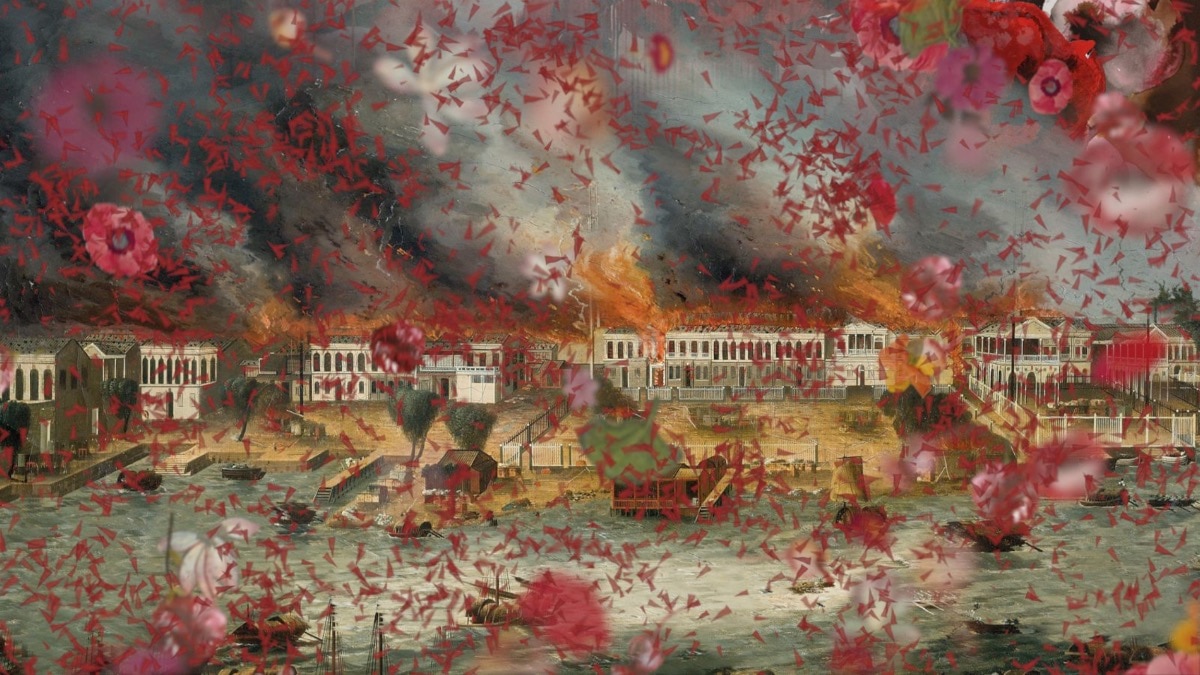
Her new animation, 3 to 12 Nautical Miles, considers the incremental expansion of territorial waters and the legal framing of sovereignty at sea. Sikander describes it as “a suggestion of collective presence held against all that extraction”. The work returns to questions of boundary-making: borders here are not fixed lines but ongoing conditions.
She is clear about what she hopes audiences take away: not the comfort of distance, not a history neatly finished and filed, but the unsettling recognition that they are standing inside its long afterlife.
That ambition, to refuse resolution and to insist on the live complexity of these histories, runs through much of what makes the London South Asian art scene distinctive right now.
Image: Courtesy Daniel Greer
BUILDING THE INFRASTRUCTURE
If artists like Sikander are doing the most urgent intellectual work, the gallerists are doing something equally important: building the infrastructure that makes sustained careers possible.
Roshini Vadehra of Vadehra Art Gallery, which has maintained an annual London presence at Cork Street and at Frieze London and Masters, speaks about the city’s particular advantages with the clarity of someone who has been watching it closely for years. London’s long-established South Asian diaspora provides a local collector base that is growing in sophistication; the summer months bring a travelling South Asian audience that creates, in her words, “a particularly special moment to do exhibitions.” And then there is the institutional shift: Serpentine, Tate, Royal Academy, and the Barbican are all presenting major solo and group exhibitions by South Asian artists, many of whom have been underrepresented in the UK or European context until very recently.
“A physical presence would enable us to create ambitious programming and deepen the engagement for our artists with the London audience,” Vadehra
shares, indicating that a permanent London space may be on the horizon. “This is something we hope to do in the near future.”
Sundaram Tagore, whose gallery has roots in New York and Hong Kong as well as London, frames the city’s importance in terms of a kind of connective tissue it uniquely provides. “London is where a collector from Mumbai, a curator from New York, a scholar from Oxford, and an artist from Dhaka or Lahore can find themselves in the same room,” Tagore insists. That cross-pollination, he argues, is not incidental to the health of the scene; it is the scene.
He is also aware of a generational shift in collecting. “Many are deeply engaged with their South Asian heritage, yet they approach art with a global outlook. They are as comfortable discussing a contemporary artist from Karachi or Colombo as they are a painter from Berlin or Los Angeles.” The boundaries, in other words, are dissolving, not into erasure, but into a more expansive sense of what South Asian art can contain.
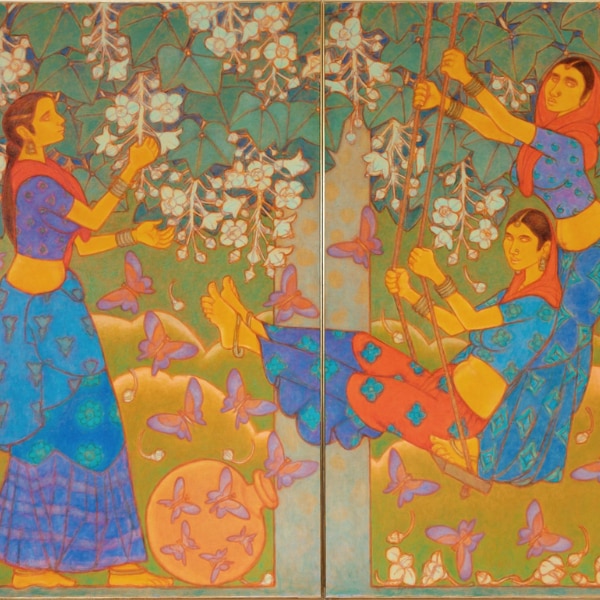
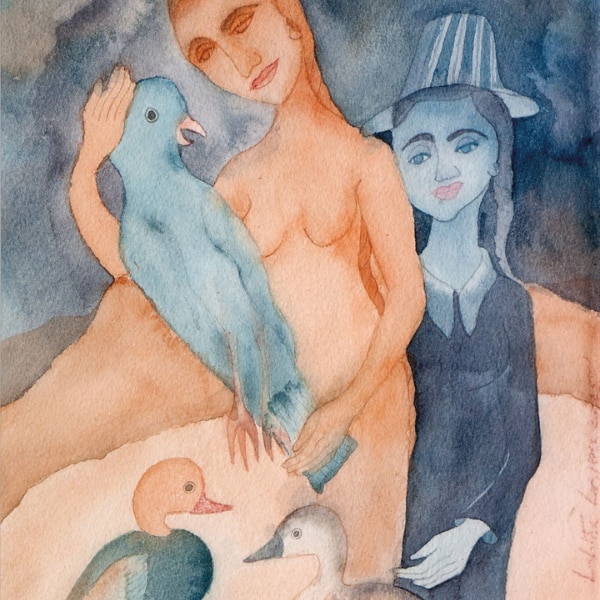
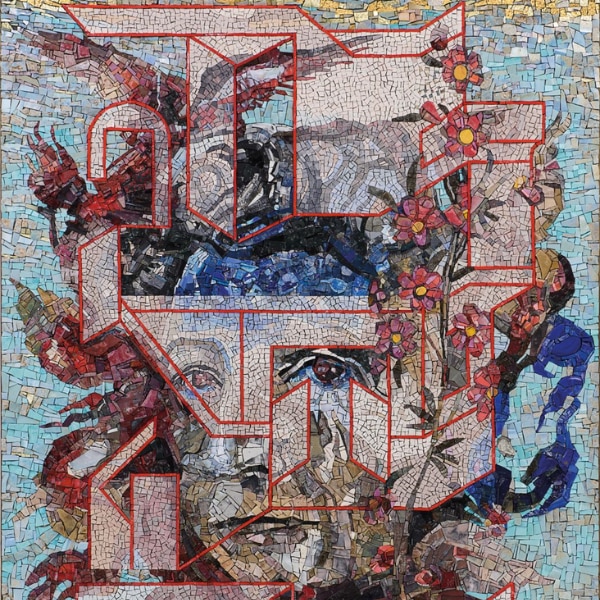
Images: Courtesy Shahzia Sikander, Victoria Miro, Indigo+Madder Gallery, and A Ramachandran and Vadhera Art Gallery
BEYOND LONDON
Not every voice in this conversation is based in the capital. Runjeet Singh Gallery, based in Royal Leamington Spa, takes a different approach: a focus on the diaspora communities of the Midlands, often overlooked by the art world’s metropolitan focus.
“It is our belief that the full diaspora story can only be told through a wider, more inclusive look at the cultural landscape of the UK,” Singh tells me. Birmingham, Leicester, and Coventry, cities with deep South Asian roots, are integral to how this story unfolds.
And yet Singh is also clear about London’s gravitational pull. Many clients are based there, as are the fairs, with institutional partnerships likely to follow. What the Midlands offers is not an alternative to London, but a correction to the idea that this culture is concentrated in one place.
"The South Asian art scene in London resists easy characterisation. The Gallery Weekend brought that into focus: across Mayfair and Bloomsbury, in the rooms of Bonhams and Christie’s, and in the city’s more established presences."
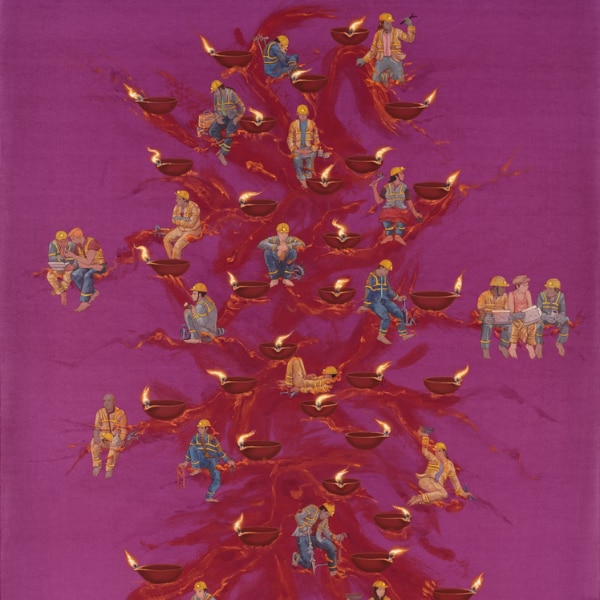
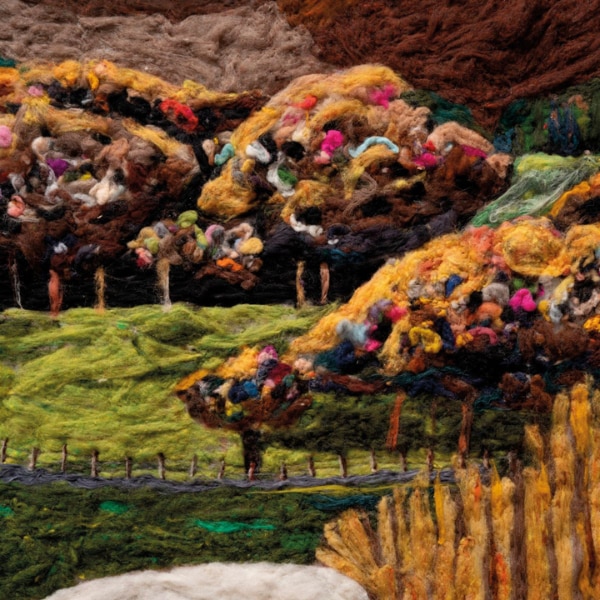
Image: Courtesy NS Harsha and Victoria Miro
THE WORK OF BELONGING
In Bloomsbury, Krittika Sharma of indigo+madder gallery has been thinking about belonging. She opened her current space in 2024, and the decision to invest in a larger physical presence in London was, she says, driven by a “real belief in the city’s cultural energy and in the growing interest in diverse contemporary art practices.”
She adds: “I’ve come to see belonging less as a fixed identity and more as something that is created through shared experiences and relationships. Every exhibition brings together different people, perspectives, and histories, and it’s often in those encounters that meaningful conversations emerge.”
That is perhaps the summary of what London Gallery Weekend offered this June: not a fixed identity, not a neatly bounded community, but a set of encounters. Artists, gallerists and institutions who have spent years making space for these conversations.
This July, Christie’s is set to collaborate with Kiran Nadar Museum of Art on The Meeting Ground: Scenes from the KNMA Collection, a non-selling exhibition of more than 200 objects drawn entirely from the museum’s collection, set to take place at the auction house’s King Street headquarters. It marks the first time Christie’s has dedicated its summer series exclusively to a South Asian institution.
London, as Sikander puts it, has become an interlocutor. The hum, at last, is happening in earnest.
This article originally appeared in Harper's Bazaar India's June-July 2026 print issue.
Lead image: 3 to 12 Nautical Miles by Shahzia Sikander; Co-commissioned by M+ and Art Basel; Image: Courtesy Shahzia Sikander
Also read: Your July guide to the best art and cultural events in India
Also read: The luxury of knowing: How fashion turned books and cultural capital into a trend
ADVERTISEMENT
Must Read









ADVERTISEMENT