




ADVERTISEMENT
Step into the layered worlds of Seema Kohli where memory and imagination flow across mediums
From the intimate to the expansive, Seema Kohli’s art invites viewers to explore, reflect, and inhabit stories both familiar and unexpected.

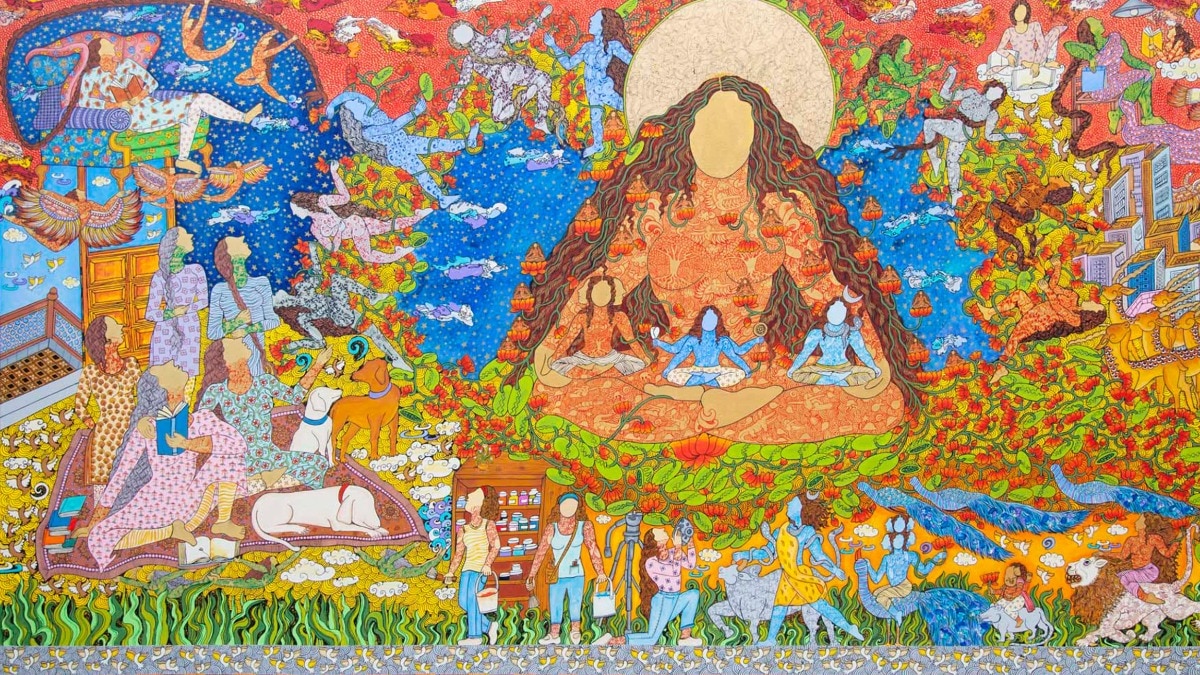
Delhi-based artist Seema Kohli is a recognised force in contemporary Indian art. Viewers look forward to her works, which weave together memory, mythology, and everyday life, presented across paintings, drawings, sculptures, installations, and multidimensional performances.
Her work moves fluidly between personal experience and symbolic form, exploring how imagination, history, and ritual intersect to create spaces that are at once intimate and expansive. For anyone stepping into her world, it’s easy to feel both grounded and transported, as if the works quietly invite you to linger.
This is what comes through in Kaal Netra, her latest artistic endeavour at the National Gallery of Modern Art, Bengaluru. The show brought together more than 150 works across mediums, not as a chronological survey but as a way to highlight recurring ideas in her practice. Spirals, womb-like forms, and layered surfaces appeared alongside female figures, birds, water, and celestial patterns. Placing works from different periods together, one will notice how motifs return, shift, and change over time. A small detail might catch your eye and linger in your mind long after.
The process
Kohli often says that her process often begins with quiet reflection, but her work does not follow strict planning. "I start with a prayer invoking the gods, because I feel that I have never dictated anything and I can’t dictate the canvas," she explains. This approach makes her compositions feel as if they are unfolding in real time, rather than being predetermined.
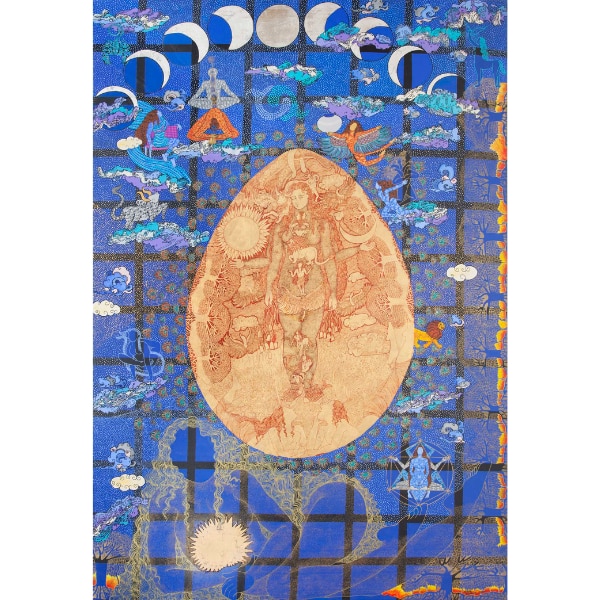
A motif that recurs across her work is the Hiranyagarbha, or Golden Womb, a Vedic symbol of origin. She uses it both as a visual anchor and as a structural form, exploring cycles, beginnings, and continuity. Around it, her figures—usually women—appear as symbolic presences rather than specific mythological characters.
They move through landscapes filled with trees, birds, water, and geometric patterns, inhabiting spaces that feel mythic but also rooted in memory and everyday experience. For someone standing in front of her work, these forms suggest stories you can almost step into.
Imagination meets memory
The connection between memory and imagination is especially clear in Khula Aasman, where Kohli works with family photographs tied to her family’s Partition history. Layers of paint, ink, and drawing create a past that acknowledges its gaps and distortions. The work shows how inherited histories are often felt more than recorded, and how imagination shapes the way stories live on.
In her Swayamsiddha series, Kohli revisits female archetypes from Indian mythology, focusing on self-realised women and their autonomy. Gold leaf, geometric forms, and references to Tantric diagrams appear across these works, not to assert spiritual authority but to show how traditional forms can be adapted to explore new meanings.
Across her practice, atmosphere and mood are central. Warm colours, fluid lines, and intricate detail encourage viewers to slow down and engage with the work. Meaning is left open, allowing each viewer to bring their own perspective to the images. You can’t help but feel part of the rhythm of her compositions, tracing the curves, the layers, and the gestures with your own gaze.
Taken together, her art reminds us that personal experience and imagination can dance together, inviting you to step in, take a closer look, and discover the extraordinary hiding in the everyday.
All images: Seema Kohli
Also read: A quiet guide to surviving New Year’s Eve as an introvert
Also read: 26 things we are manifesting for 2026
ADVERTISEMENT
Must Read



ADVERTISEMENT