Inside 'Masnavi', a cross-cultural journey through folklore and memory
Curator Khushboo Jain brings together artists across continents to explore how ancient lores continue to shape the stories we tell today.

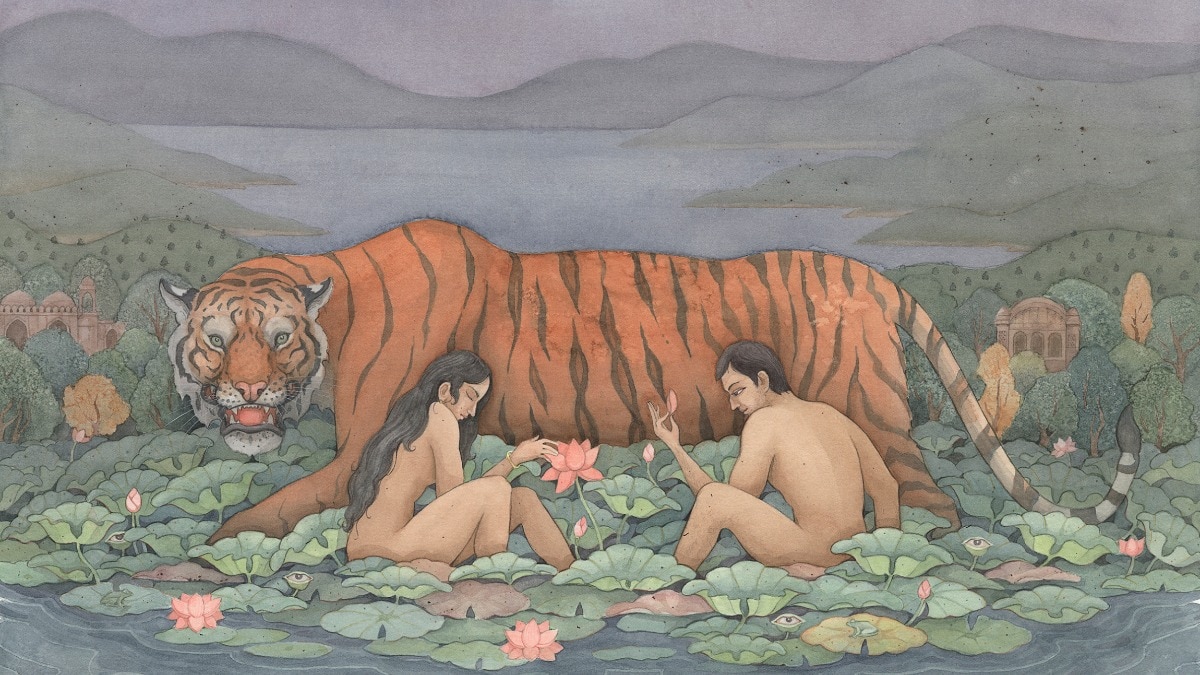
Folklore has always travelled gently across time through songs, verses, and stories. that are retold until they become part of who we are. Masnavi: Lores Across Lands, the new group exhibition at Ojas Art Gallery, New Delhi, draws from this rich, cross-cultural tradition. Borrowing its name from the classical Persian poetic form built on flowing couplets, the show brings together artists from India, Pakistan, Iran, Turkey, Taiwan, Australia, and the UK to explore how these shared narratives continue to shape our inner worlds. Using the language of musawwari (miniature painting), the exhibition reflects on how ancient tales, from the Panchatantra to Bulleh Shah, still echo in the ways we remember, question, and imagine.
At the heart of this exhibition is curator Khushboo Jain, who views folklore not as something fixed in the past, but as a living, evolving force. With Masnavi, she creates a space where personal memory meets collective history, and where today’s cultural and socio-political experiences slowly begin to form the lore of tomorrow. In an interview with Bazaar India, Jain reflects on the ideas that guided the show, the artists who shaped its visual language, and how storytelling continues to bind communities across geographies and generations.
Harper's Bazaar: In bringing together artists who draw from divergent folkloric lineages—Sufi, Persian, South Asian, Ottoman, and global mythologies—how did you navigate cultural specificity without flattening the histories each tradition carries?
Khushboo Jain: In curating Masnavi, my primary strategy centred on deep contextualisation and nuanced interpretation rather than broad thematic generalisation. I believe true cultural exchange does not emerge from blending traditions into a singular or harmonious narrative, but by illuminating their distinct characteristics and the profound ways they resonate with universal human experiences. The curatorial framework, therefore emphasised dialogue, inclusivity and equitable representation, actively challenging dominant narratives. At the heart of this approach was a foundational principle: a commitment to understanding and respecting the diverse cultural contexts from which the artworks and their originating folklore emerge. This involved extensive research into each tradition represented and, wherever possible, engagement with cultural practitioners and communities.
For instance, in presenting Elham Pourkhani’s interpretations of Hafez Shirazi, the curation sought to articulate the layered poetic and spiritual dimensions embedded within that lineage. Likewise, artists such as Murat Palta who reimagines popular culture through an Ottoman miniature lens, and Nusra Latif Qureshi whose work considers gender within folkloric frameworks—were positioned as contemporary interlocutors who actively engage with and transform inherited narratives.
HB: Miniature paintings historically functioned as a slow, intimate technology of storytelling. In a contemporary context saturated with rapid visual consumption, what curatorial strategies did you employ to ensure that viewers engage with these works at the pace the medium demands?
KJ: By mimicking the intimate, handheld nature of how these paintings were traditionally viewed, you encourage the close, personal interaction that the medium demands. This not only invites viewers to lean in and discover the intricate details but also subtly compels them to slow down, much like someone holding a personal object in their hands. It's a thoughtful way to bridge the gap between historical presentation and contemporary exhibition, fostering a more rooted and engaging experience for your audience. This physical engagement naturally slows the viewing process, compelling visitors to scrutinize the delicate brushwork and intricate narratives that are often missed in a cursory glance, thereby recreating the personal and immersive experience of historical viewership. My goal was to create an exhibition experience that not only showcased the beauty of these miniatures but also thoughtfully guided visitors towards a deeper, more prolonged appreciation of their historical context and artistic mastery.
HB: Some of the featured stories carry very old-fashioned gender ideas. When working with folklore originally framed through patriarchal lenses, how did you guide the exhibition toward more inclusive and updated readings of these narratives?
KJ: I deliberately selected artists whose works critically engaged with, reinterpreted, or subverted traditional narratives, rather than merely illustrating them. For instance, Nusra Latif Qureshi's focus on women served as a prime example of this strategy; her art directly challenged conventional portrayals by centering the representation of women within folklore, meticulously unearthing and amplifying narratives that have historically been marginalized or silenced. While Murat Palta's work reinterprets popular culture, the very act of placing contemporary figures into historical contexts can highlight the anachronism of past social norms.
Alongside the artworks, interpretive texts were carefully crafted to acknowledge the historical context of gender roles in the original folklore, while also offering contemporary critical perspectives. I ensured that any potentially problematic language in the original source material was discussed in the interpretative texts, prompting visitors to engage critically with the narratives. The exhibition also highlighted that folklore is not fixed but evolves over time, reflecting changing societal values, which allowed for a discussion of how narratives are shaped by their historical context and how contemporary artists engage in an ongoing dialogue with these traditions.
HB: Since Masnavi explores both material and metaphysical worlds, how did you organise the space to maintain that transition without merging the artworks’ different spiritual references into one?
KJ: The spatial design of Masnavi was conceived as a journey rather than a destination. Because the exhibition moves between material and metaphysical registers, the aim was not to collapse these spiritual references into a singular transcendental narrative, but to allow viewers to pass through different states of encounter.
Rather than creating thematic sections, we worked with atmospheric shifts. The exhibition begins with works rooted in the material—land, body, politics, memory—and gradually moves toward those that dissolve form into spirit. This progression is subtly supported through spatial pacing, lighting transitions, and scale adjustments: the earlier works are anchored and grounded, while later pieces are given more air, quieter light, and spatial stillness to allow for contemplative engagement.
HB: Folklore often evolves through misremembering, mutation, and oral distortion. In assembling artists who reinterpret canonical texts and myths, how did you negotiate the productive role of distortion as both an artistic strategy and a folkloric inevitability?
KJ: My approach was rooted in understanding that folklore is never static; it thrives on memory, mutation, and often so oral distortion, which are the very mechanisms through which it remains alive and relevant across generations. I sought to celebrate these transformations, seeing them as vital to the continuous stream of human storytelling.
I actively looked for artists who engaged with these processes, allowing their interpretations to illuminate how seemingly "distorted" narratives can generate new meanings and insights. For example, artists who subtly alter iconic imagery or narratives were chosen for their ability to highlight how original stories persist even as they are reshaped, much like the dynamic nature of oral traditions. Their work acts as a contemporary form of "re-telling," where a core narrative is re-told through a new lens, revealing fresh perspectives on enduring human experiences.
This curatorial lens allowed me to frame distortion not as a deviation from authenticity but as a testament to the resilience and adaptability of folklore, enriching the dialogue between past and present. Furthermore, the selection of artists who bring profound research and innovative interpretations to obscure folklore is crucial. Their artistic strength ensures these unfamiliar stories are presented with compelling visual and conceptual power. By highlighting universal themes that resonate across diverse traditions, the exhibition fosters an environment where every narrative can stand on its own merits and contribute equally to a rich, transnational dialogue.
HB: Some artists reinterpret widely recognised narratives (like Layla Majnun or Alice in Wonderland), while others excavate obscure or localised folklore. How do you curate the hierarchy of recognisability, ensuring that certain stories do not overshadow more marginal or esoteric ones?
KJ: I was conscious of the tension between recognisability and marginality. Rather than establishing a hierarchy based on familiarity, I approached each narrative through the depth of its cultural resonance and the integrity of its artistic interpretation. The aim was not to privilege well-known stories, but to place them in meaningful relation with lesser-known or highly localised folklore, so that visibility emerged through dialogue rather than dominance.
An important curatorial consideration was the acknowledgement of oral and locally transmitted folklore—stories that often exist outside documented literary canons. These narratives carry significant cultural value yet are frequently overshadowed by texts that have gained wider visibility through historic patronage, manuscript circulation or colonial archival practices. In Masnavi, such local oral traditions were not positioned as supplementary, but as vital sources of lived knowledge and collective memory.
By giving these stories equal curatorial attention, the exhibition sought to challenge inherited structures of cultural hierarchy. While widely recognised narratives like Layla Majnun or Alice in Wonderland acted as familiar points of entry, the oral tales and lesser-known local lore were presented as powerful repositories of nuanced wisdom, often closer to community experience and social memory. Rather than being contrasted against the famous, they were allowed to stand in their own integrity, illuminating the ways in which folklore survives through imagination, transmission, and communal voice.
HB: Since miniature art is rooted in precision but contemporary artists often introduce more fluid, surreal elements, how did you decide where to hold onto tradition and where to allow experimentation? And how would you define the miniature spirit in a modern context?
KJ: When navigating the delicate balance between tradition and experimentation in miniature art, the core challenge lies in honoring its historical essence while embracing contemporary artistic expressions. My approach focuses on maintaining the fundamental principles that define miniature art, even when artists introduce novel elements. I define the spirit of the artform through its intrinsic characteristics: precision, intimacy, meticulous detail, narrative depth, and the focused, contemplative engagement. These elements are the non-negotiable aspects of tradition that must be upheld. In a modern context, the miniature painting is defined by its ability to provide a unique and powerful artistic experience. It fosters a deep, personal connection, inviting viewers into a secluded world that demands close, prolonged observation, thus creating a profound sense of intimacy.
Ultimately, the artform acts as a meditative portal, compelling the viewer to slow down and immerse themselves in its intricate details. By condensing vast concepts into potent, digestible forms, often through surreal or abstract elements, they achieve a profound psychological or philosophical depth. This sustained engagement encourages reflective thought and active interpretation, offering a powerful antidote to the rapid consumption of visual information prevalent in contemporary society.
Lead image: The brand
Also read: Frieze 2025 proves London’s art energy isn’t gone—just evolving