




ADVERTISEMENT
Tilda Swinton untamed: A rare conversation with Cartier’s new ambassador
Few succeed in sparking the awe and adoration that’s reserved for Tilda Swinton. A career of genre defying roles and 40 years of devotion to cinema, craft, creativity, and collective practice have secured her irrefutable cult status. Yet the astonishing truth about Tilda is that she is both as superhuman and as supremely human as the characters she portrays. Alison Tay flies to Paris to explore the fantasy and realism of Cartier’s iconic new collaborator.

Mesmerising. Magnetic. Magical. Tilda Swinton is an artist who inspires endless admiration. The dramatic transformations in her repertoire, that somehow transcend the physical realm into the otherworldly, have irresistibly entwined her personal lore with the emblematic roles she’s brought to life.
Yet mere moments in her presence–in a light-filled garret in Paris atop Cartier’s Rue de la Paix flagship boutique–reveal that not only is the aura that surrounds her earned, but that it also doesn’t even come close to defining what makes her so compelling.
Her four-decade-strong career on stage and screen can be viewed through the lens of her longtime creative collaborations–from Derek Jarman, who directed her very first film, Caravaggio in 1996, to Pedro Almodóvar, who cast her in his first English-language feature, The Room Next Door in 2024, via Wes Anderson, Luca Guadagnino, Jim Jarmusch, and many more. And today, Tilda is adding Cartier to her trusted inner circle of co-conspirators, making her debut for the Maison for the Into The Wild collection. “I can’t quite believe that this relationship is now birthed,” she exclaims. “At the same time, it's so natural–like when someone says, ‘Oh, you know that friend? I’ve always wanted you to meet them, and I think you’d really get on.’ It was like that, and that’s how I start most of my relationships.”
The timing is serendipitous as the Oscar winner is about to make her return to the London stage while an exhibition dedicated to her collaborative craft prepares to open in Warsaw. “It’s very lovely for me to have a whole new journey start at this moment because I’m at a point of transition in my life where I’m being much more self-determining,” she explains. “I am making fewer feature films, and I’m creating more of my own work, and it’s this new dialogue that’s just evolved over the course of the last year that’s also in harmony with that work that I’m developing. It rings that the changes for me in a meaningful way, but it’s all built out of the same ballast."
On what it is about the Maison that resonates with her, she professes, “I am very inspired by a reliance on an archive and on a code of identity, and Cartier absolutely exemplifies that, and the fact it is such a modernist house–this feeling of flexibility and absolute dedication to excellence. There’s something so fluid, responsive, lively, and–to my most recent delight– =witty about the work in Cartier that is really thrilling me. It just feels like a really comfortable place for me to be.”
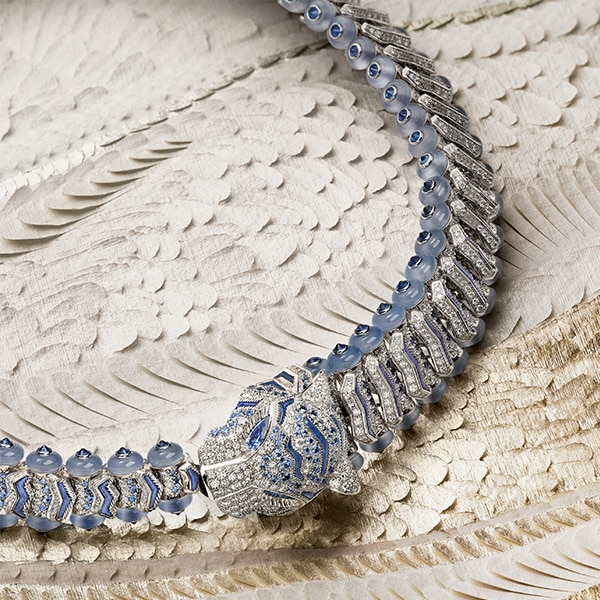
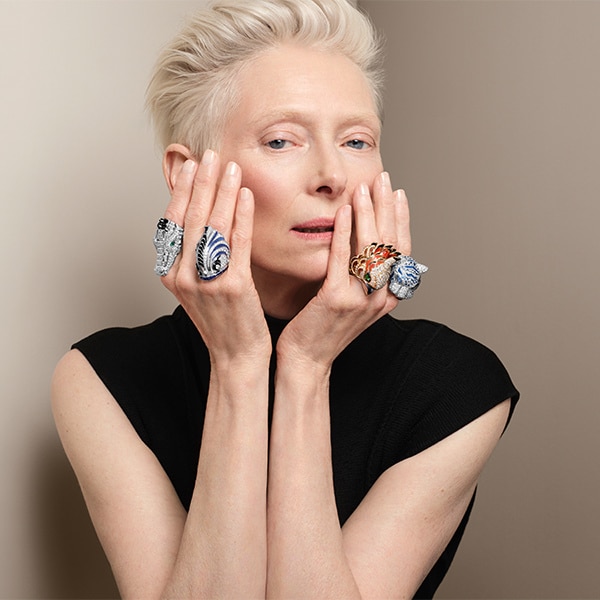
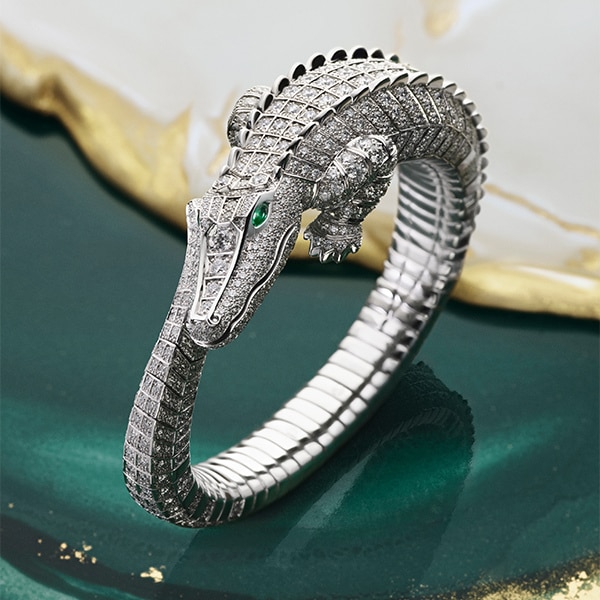
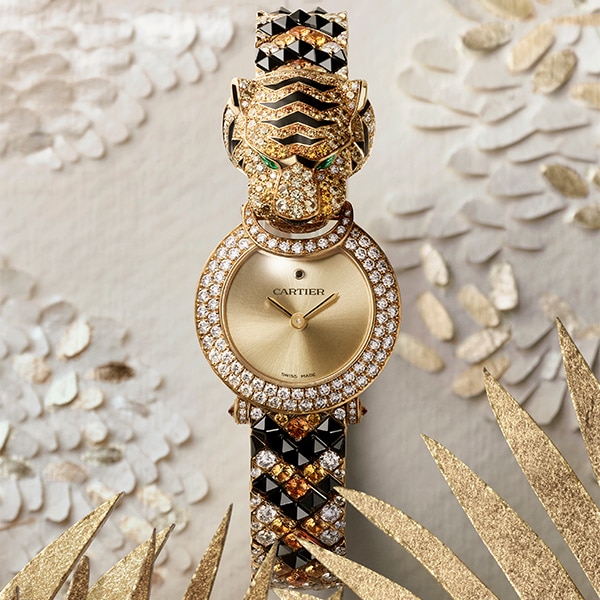
The Into The Wild Collection seeks to add new storytelling to the enduring symbolism and mythology of the legend of La Panthère de Cartier. Bold interpretations of a rhinoceros, tiger, parrot, carp, and crocodile have been intricately rendered life-like by artisans employing a suite of savoir faire techniques including paving, lapidary, and gem setting.
Among the menagerie are a playful new cast of five reimagined creatures comprising a Gallery of Animal Portraits. “When I look at the pieces, I’m so touched by their solitude. The solitariness of a white tiger, or the rareness of a white rhino or Mr Crocodile who’s just cool…” she observes, lowering her voice to an intriguing whisper worthy of one of her finest performances, “lying there alone… quiet… waiting…”
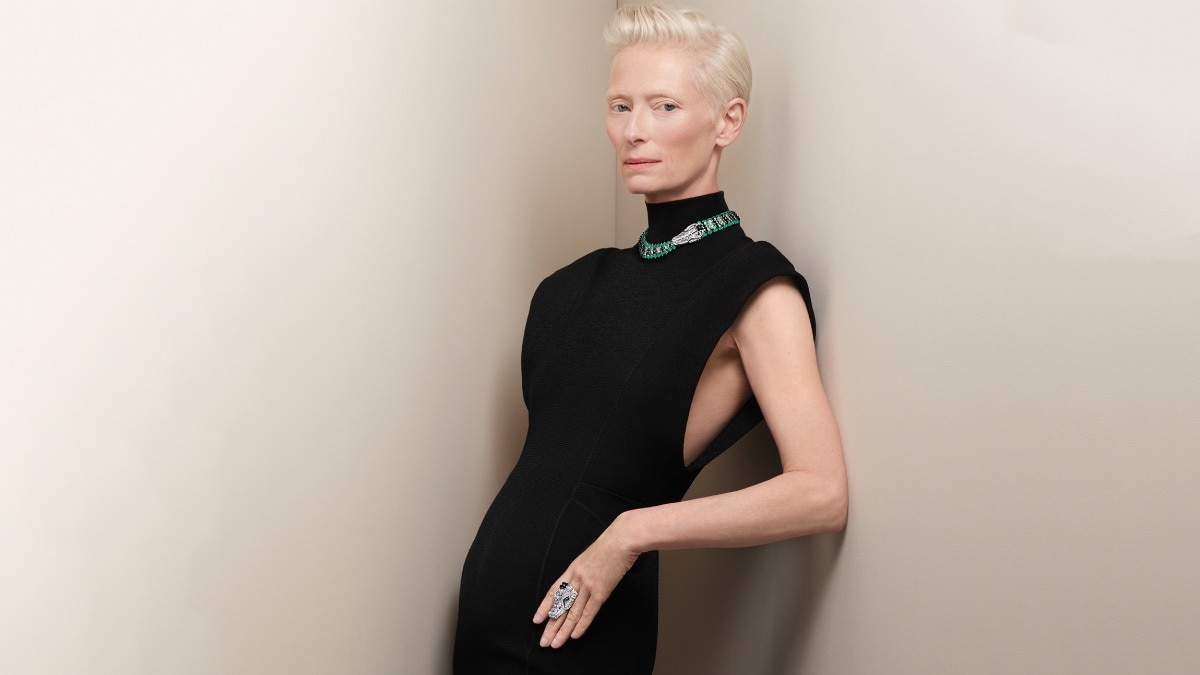
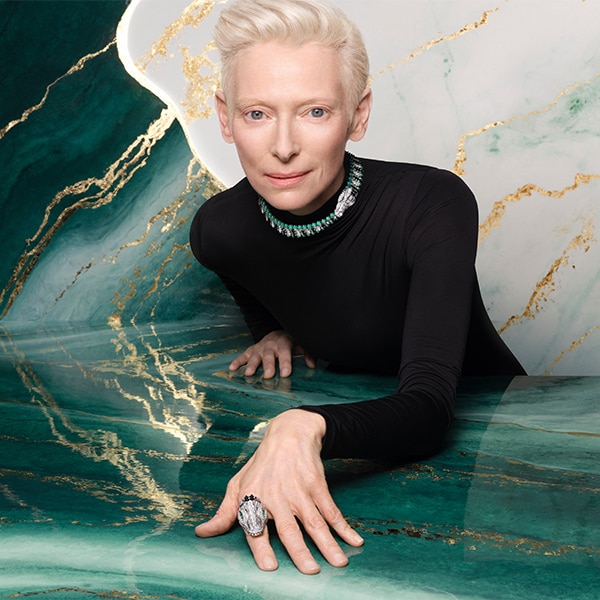
An idea that swirls around like a leitmotif when it comes to Tilda Swinton is the delicious dichotomy of fantasy and realism–“that old combo!” she smiles wryly. In a sartorial act that mirrors this paradox perfectly, Tilda is wearing a priceless showpiece–the transformable Faune & Flore de Cartier crocodile necklace–with a crisp, blue pinstriped shirt, navy tailored trousers, and black leather loafers on a sunny Tuesday afternoon in Paris.
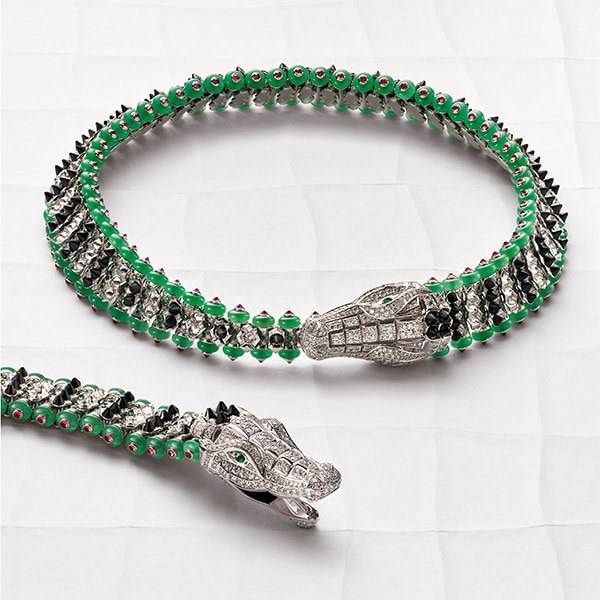
“So, you have this extraordinarily ornate design of a crocodile swallowing its tail that’s like a child’s drawing, then you realise, ‘Wow, it’s made from emeralds. Let’s get serious,’” she notes of the precious, fully articulated collar made from white gold, punctuated by onyx spines, that shimmers and slithers with chrysoprase, rubellite, tsavorite garnets, and diamonds. “It’s both real and delightful and stirs our childlike hearts when we see it, and at the same time it’s so elevated and so magnificent that it has this different kind of resonance. It’s like the children and the big boys all at once.”
With authorship and agency becoming increasingly central to her creative choices, Tilda also lends her voice to a series of short films celebrating artisans and their traditional crafts ranging from gold lacquer and marquetry to mosaic and paper bas-reliefs that set the stage for the Into The Wild collection reveal.
“We seem to talk the same language,” Tilda explains. “I think we have very symbiotic core principles: an interest in the long term is something that we share; a response to history; a curiosity and a determination to keep going forward; an investment in transformation; and fellowship–in that an enormous amount of hands go into every single piece.”
Making an unexpected analogy, she continues, “I’m a soldier’s daughter.” Indeed, her late father was Major-General Sir John Swinton, Lord Lieutenant of Berwickshire and the 7th Laird of Kimmerghame, a senior British Army officer who served as the Head of Queen Elizabeth II’s Household Division. “And one of the things I take from my beloved father and my forefathers because they’re all soldiers–there’s not much I take, but I do take this–is this absolute reverence for agreement and the idea of being in a cohort that agrees.” She elaborates, “You have an objective and your vision, you all agree on the path, and you do it. That I love and I sense that in this House. This House is just humming with it.”
And as a confessed “pack animal”, this community laid the foundation for her 40- year strong career. “Maybe it’s a little bit like being the House of Cartier?” she suggests. “Yes, this is the new collection, but there were other collections and there will be another collection. That feeling that the real focus is the relationship, the core, the people, the collective. And it means that the piece of work–in my case in those days, the films–were just the latest manifestations of our curiosity of the time.”
In her own story, the bohemian collection of creatives that formed the cast and crew of Tilda’s first foray into filmmaking became “the cohort that agrees.” She recalls, “What it came from is my experience of starting a working practice in a collective with Derek Jarman, and many other people, and us being devoted to our working practice first. That was what was really engaging us.”
This is perhaps where her point of view differs from filmmakers who frame the final cut as the reward. For Tilda, the process is the prize. She remembers, “The work would go out into the world, and then we would be sitting at the kitchen table and we’d talk about something else and we would come up with another idea and we would make another film, and that would go off into the world, and then we’d think of something else and we’d do that and that would go out into the world. What kept us going was the process. Keeping the engine running was the important thing.”
In our dopamine-driven, me-centric culture, a perspective that prioritises the evolution of collective understanding over individualistic instant gratification not only feels radical but might even be a blueprint for a long-forgotten way of being that society is aching to find its way back to–in facets of life that extend far beyond cinema.
“And the one film that we made–that’s a wonderful film and we can all go and see it in the cinematheque–but it’s finished, it’s done,” she states, referring to Caravaggio. “But the group, the people, the spirit lives on.”
Offering a glimpse behind the curtain of contemporary independent cinema, she continues, “Now the reason that I even mention any of this is because I have noticed that these days, certainly in terms of artistic practice, and filmmaking particularly, that this is quite a rarefied experience.” She clarifies, “What tends to happen now is: I say I want to make a film; I then have to go out; make a script; put together the group of people; raise the money; then I have to make the film. And then it all falls apart because it was all about the film, it wasn’t about the group. It was about that one project. And that’s not the way I roll. A lot of people do roll like that, and I’m sure it works on a certain level, but that’s not what I know and it’s not what I love.”
To prove her point she discloses, “I’m still working with people that I worked with since 1985. Simon Fisher-Turner, who did the music for Derek Jarman’s films, he and I were on the phone this morning and are making a project now. I mean, it goes on.”
The project in question is Man to Man; an ambitious revival of a 1987 play now showing to sold-out audiences at the Royal Court theatre in London’s Sloane Square until 24 October that spectacularly sees Tilda reprising her leading role alongside the production’s original creative cohort. It then travels to Edinburgh at the end of October with performances in Berlin and New York planned for in 2027.
Meanwhile, Tilda has quietly added the role of curator to her already extensive repertory. Tilda Swinton–Ongoing is an exhibition that examines her artistic practice as a continuous conversation that, if she had had her way, might never have existed.
“So, this is what happened,” she admits. “About seven years ago, the Eye Filmmuseum in Amsterdam asked me if I would do a show. I love that museum. It’s put on extraordinary exhibitions by people like Béla Tarr and filmmakers who I revere and when they asked me, I very quickly said no because I had a failure of imagination.”
This seems impossible to believe, but luckily the story doesn’t end there. “Well, I thought, ‘Is this going be some retrospective of just old clips of old films and me with old photographs and old posters?” she scoffed. “I wanted whatever it was to be useful, and I didn’t know how useful just a bunch of old stuff would be. So, then I had an idea. What I wanted was the collective experience. I thought to myself, ‘OK, what am I good for?’ I was formed as an artist in the ’80s. I am here to speak to that experience, and I am here to say, ‘Kids, it is possible to work this way. Forever. You don’t have to grow out of it. You can go on doing it for 40 years.’”
This realisation went on to become the beating heart of the exhibition. “So, I said to the Eye, ‘Can I do a show based on that? Can I do a show based on my collective practice? And can I choose a number of collaborators, and could I make new work with them?’”
The result sees Tilda creatively reunited with Derek Jarman, Johanna Hogg, Luca Guadagnino, Apichatpong Weerasethakul, Olivier Saillard, Jim Jarmusch, Tim Walker, and Pedro Almodóvar to share new or in the case of the late Derek Jarman, previously undiscovered work. “All I want is for people to leave this exhibition going, ‘Oh, is that all it takes? You just have to get together with your mates and do what you’re interested in?’”
She insists, “It doesn’t have to cost much money. I even have new work from Derek Jarman because I found these fragments on a Super 8 camera and Joey Apichatpong came to my family’s home and shot on a Bolex,” she recounts of the wonderfully analogue, hand-held feel of the work. And Luca Guadagnino, the director of her cinematic masterpiece of I Am Love “shot a little film on his iPhone,” Tilda divulges with great delight. “It’s all so lo-fi, and it’s also handmade. It’s all about the relationships. It’s not about millions of dollars, and it’s not about writing a massive script or putting together a huge crew.”
Having premiered at the Eye Filmmuseum in Amsterdam in September 2025, Tilda Swinton–Ongoing travelled to Onassis Ready, an art space in Athens in the summer of 2026, and opens at the Creative Industries Institute in Warsaw on 18 September 2026 until 17 January 2027. “Who knows? We may come your way,” she hints, alluding to the Gulf.
What makes Tilda so captivating is, in fact, her resolute humanity, her insistence that creative companionship is a privilege, and her determination to place shared artistic endeavour above all. “It’s all about friendship, it’s all about fellowship, and finding these wonderful partnerships,” she reflects. “How lucky am I?”
Lead image: Tilda Swinton
Also read: Tishani Doshi on poetry, beauty and the art of paying attention
Also read: Your first home deserves furniture that evolves with you—here’s what to look for
ADVERTISEMENT
Must Read

ADVERTISEMENT