




ADVERTISEMENT
How the centuries-old 'Dabu' craft is entering a new chapter in fashion
Aavaran's Sudarshan celebrates the understated luxury of a centuries-old craft, bringing the artistry of Dabu into a contemporary cultural conversation.

Certain things in life move from the present into history. Others remain timeless. A tradition, a way of living, a seemingly small ornament, or a centuries-old craft can offer a different measure of time altogether, one that exists beyond the passing of years.
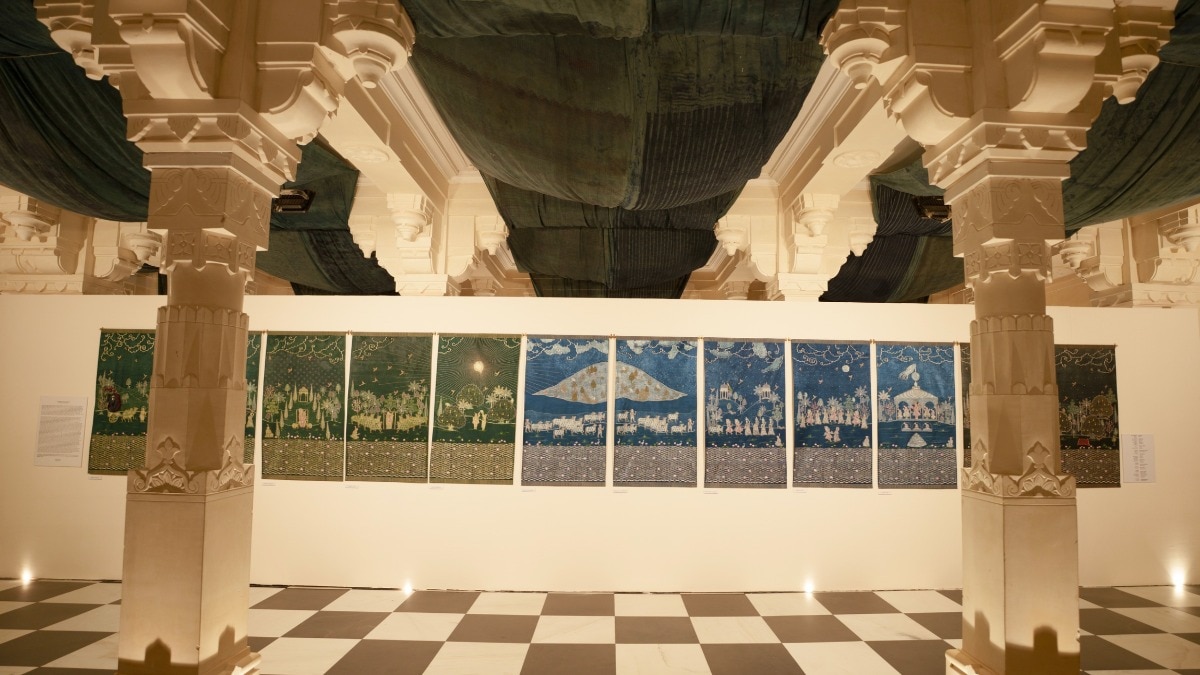
In Rajasthan's Nathdwara, time, or rather timelessness, is measured in darshana, ritual, and remembrance. In October 2026, that measure found expression at the City Palace Museum in Udaipur through Sudarshan: twelve panels, twenty-seven feet across, and 108 square feet of seva, created using indigo and mud-resist techniques.
The exhibition brought together two distinct custodians of Mewar's heritage. One is Alka Sharma, who began with a government project and a village of artisans before building Aavaran around a nearly forgotten craft. The other is Shriji Huzur Dr Lakshyaraj Singh Mewar, the 77th custodian of a royal house whose history spans fifteen centuries. Sudarshan is where their commitments to preserving Mewar's legacy find common ground.
The mud and the maker
In 2009, Alka Sharma took up the mission of reviving Dabu, the traditional mud-resist block printing technique of Akola in Chittorgarh, creating opportunities for the artisans practising it to find their footing in new markets.
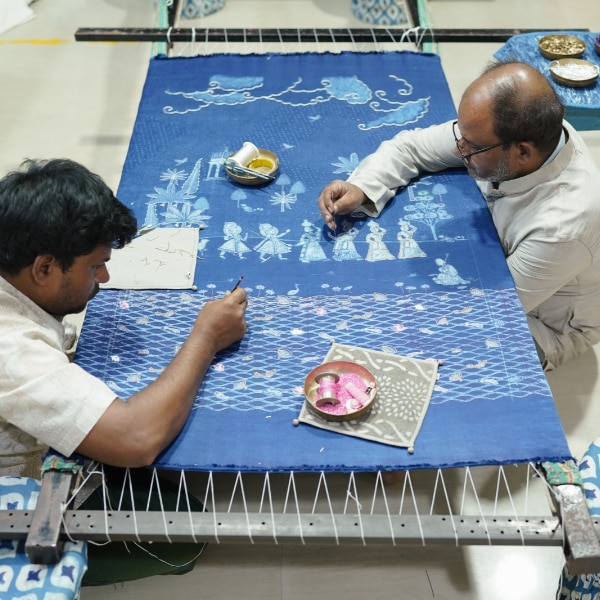
When asked what she saw in Dabu that promised a future beyond the village, Sharma points to the craft itself. "Dabu is a technique more than five hundred years old," she says. The acacia gum, she explains, is much like the gond used in gond ke laddu, and acts as the resist. The paste is labour-intensive to prepare, but the results are rich in texture. Once printed, the fabric is set aside to dry—cotton for four to five days and silk for nearly ten—before being immersed in indigo or another natural dye. The process is environmentally conscious, she says, and its aesthetic is remarkably contemporary.
"Dabu as a craft has tremendous potential today, and every day, as ‘a thing of beauty is a joy forever’. The overall look and feel of mud-resist quite definitely has global appeal as it is a piece of art. And everything is organic, taken from Mother Earth and given back to Mother Earth," she adds.
The custodian
Shriji Huzur Dr Lakshyaraj Singh Mewar is the custodian of the House of Mewar and the chairman and managing trustee of the Maharana of Mewar Charitable Foundation, under whose care the City Palace Museum, Udaipur, has operated since 1969. "As a child, the Palace was simply home, a place where history was woven into the rhythms of everyday life." With time came the understanding that the greatest inheritance is not merely what generations leave behind, but what they inspire us to become. To be the 77th custodian is to recognise that "we are each a chapter in a history far greater than ourselves," he says. He describes the museum as an open platform for organisations working towards the preservation, revival, and contemporary interpretation of Mewar's traditional arts and crafts.
Of the exhibition, he says, "What drew me to Sudarshan was the sensitivity with which Aavaran has brought together centuries of devotion, indigenous craftsmanship, and the rhythms of nature." He finds something profoundly moving in the ability of human hands to give tangible form to something as intangible as devotion. "To me, that is where art achieves its most enduring significance."
How Sudarshan Began
The collaboration, however, was years in the making. Following the pandemic, Aavaran had begun creating textile panels as works of art. Its first collection featured a backdrop of Lord Krishna, kept deliberately simple to foreground the Dabu process. Sudarshan grew from this initial exploration, becoming both an offering and an opportunity to test the depths of the craft.
Sharma approached Abhijeet Karwa, whose family follows Pushtimarg tradition, to help the team with the narratives and research. There were differences of opinion along the way, she admits, "but we had one similar faith." Her first words to him were that they had to create panels of Shrinathji and bring him to Mewar through Aavaran's process. According to Sharma, Shrinathji had not previously been interpreted through Dabu using indigo and other natural dyes, presenting an opportunity to explore a local craft through an entirely new lens.
Some panels demanded considerable technical precision. "Around the Kartik panel after Deepawali, where Annakut takes place, the team had to render different swaroops of Shrinathji, and in Dabu the nayan-naksh—the features of the face—kept getting lost. That's when we called in Rajaram Sharma ji, a Pichhwai master artist, to ensure we got all the finer details just right," Sharma says.
When asked what she was particularly proud of, her prompt response was “the rays of the sun,” which had to be rendered with precision, although she finds it difficult to choose a favourite among the twelve panels. However, the first, Magha, holds a special place, as does the concluding panel, depicting Krishna going to meet Radha.
Sharma hopes that visitors standing before the panels will feel "the devotion, faith, and passion" that went into their making. She wants them to experience something magical and divine.
For Dr Mewar, the significance of Sudarshan extends well beyond the exhibition itself. "I would hope that, fifty years from now, Sudarshan continues to speak of a civilisation whose relationship with beauty, nature, craftsmanship, and devotion has inspired generations." The privilege of our time, he says, is "to create something whose significance will continue to unfold long after our own chapter has been written."
When an ancient craft finds its place in fashion
While Sudarshan offers a new artistic expression of Dabu, the craft's journey into contemporary design began much closer to home. Its origins lie in the Phentiya, a skirt traditionally worn by women in Akola's farming community. What started with just eight to ten motifs gradually grew into an extensive print library, drawing inspiration from local flora and fauna, Pichhwai paintings, Rajasthan's floor art, the historic architecture of Udaipur's City Palace and the festival of Gangaur. Aavaran also looked to medicinal herbs and natural dyes such as manjishtha, neem, haldi and neel to develop its distinctive visual vocabulary.
Over time, the craft moved beyond skirts and found expression in sarees, dupattas, and stoles, eventually extending into womenswear, menswear, children's clothing and home furnishings. Even the off-cuts from its collections are put to use, with rural women transforming them into rugs, toys and accessories, ensuring the production process generates zero waste.
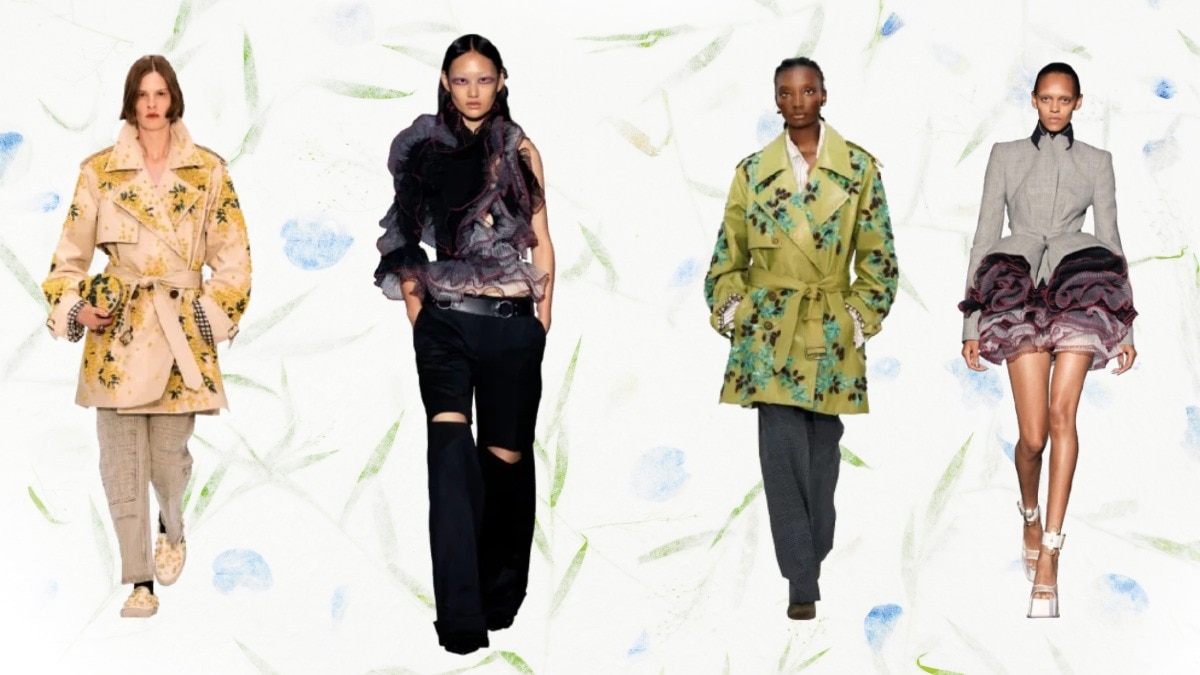
Aavaran's evolution into luxury came after nearly a decade of working with everyday clothing. "After ten years of making everyday wear, we treated Dabu as luxury and did the whole range with the best of our abilities," Sharma says. The collection brought together mulberry and Mashru silk with the Zardozi work of the Mewar region, in a palette of indigo, kashish, and ivory. Its collection Miniature Moon went on to feature at Lakmé Fashion Week, offering the label a break within the luxury market.
Yet Sharma is careful about how she positions the craft within the fashion landscape. "Dabu, I would say, is much above fashion," she says. For her, the intention is not simply to make a traditional technique relevant to contemporary wardrobes, but to ensure that those who wear Aavaran understand the history and legacy they carry. Indigo, she points out, is also connected to the story of the Champaran movement, giving the colour a significance that extends beyond its aesthetic appeal.
Today, Aavaran continues to bridge the distance between tradition and contemporary design, building a wider community of patrons for a craft that once had a relatively limited audience. It is an approach that finds an apt expression in Sudarshan, where Dabu moves beyond the familiar vocabulary of clothing to become a medium for devotion. And perhaps that is the distinction Sharma is trying to make. Fashion may give a craft visibility, but it is the history, skill, and generations of knowledge behind it that give it permanence.
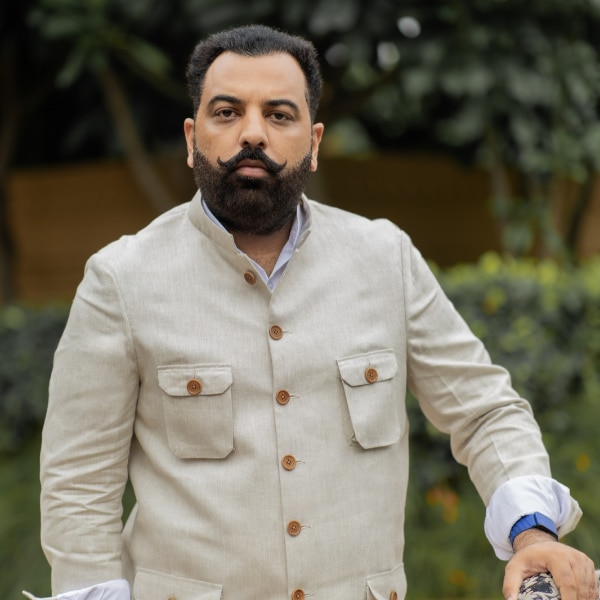
Lead image: The brand
Also read: 'Waist-maxxing' is in focus as fashion is having fun playing with proportions
Also read: The fashion labels defining the style conversation right now
ADVERTISEMENT
Must Read






ADVERTISEMENT