




ADVERTISEMENT
Tishani Doshi on poetry, beauty and the art of paying attention
Tishani Doshi talks on beauty, birds, memory, and the strange alchemy through which ordinary encounters become poems.


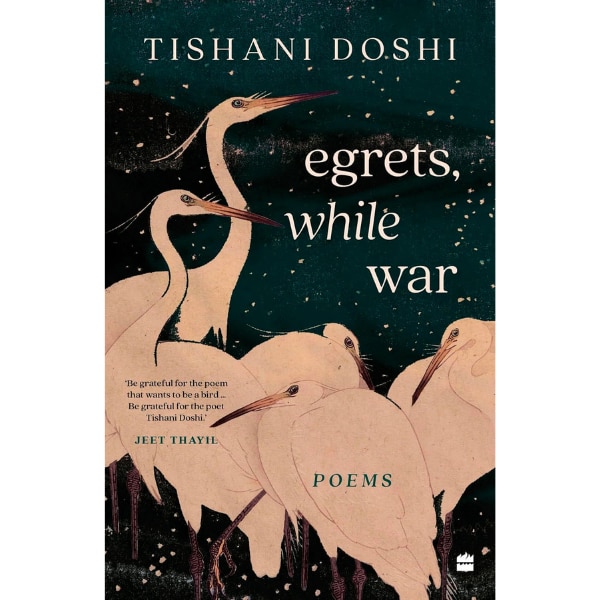
On a morning walk by the sea in Paramankeni, somewhere south of Chennai, Tishani Doshi saw what she thinks might have been the skeleton of a dolphin. Strange and large, with something like a spine running out of it. In all her years of walking the same wet blue edge of the world, she had never before seen anything like it.
Doshi was still thinking about this creature, now reduced to its most elemental lines, when we meet online to discuss her latest poetry collection, Egrets, While War. She is speaking to me through a phone held close to her face, her home internet just having thrown a tantrum. “The thing that I love about these walks I’ve made part of my day is that it’s never the same. [The sea] is constantly changing tide and there’s always different things. Right now, it’s a bit apocalyptic,” she says and proceeds to explain how the novelist in her notices the dogs, the strange cast of people, and the poet notices the jellyfish gone clear and limp in the sun, dead fish, goats, turtles, snakes, bottles, toothbrushes, and a lot of what the sea has collected and since lost interest in. “Mostly dead things,” she adds.
The conversation keeps returning, naturally, to animals. Dogs, mostly. Dukeekee, my own
dog, is asleep in the corner of the screen. Doshi spots her, says hello and though I never quite
see Doshi’s pet, an occasional distant bark has me imagining Frankie, Zelda, or Buggy nosing
around the room, appearing for a second in the small turn of her eyes. There are dogs everywhere, including the book I have placed beside the laptop, knowing I would want to show it to her: Small Days and Nights, her 2019 novel about Grace, a house by the sea, and a litter of puppies that keeps multiplying. I hold up the first page, to the little note I had written for my then-boyfriend. He is my husband now, and there is something cloyingly sweet about remembering how I once put her book in his hands, hoping he would understand what it means to build a life with someone who cannot see a stray dog, an abandoned cat, a wounded snail, without wanting to make room for it at home.
That little note feels, in retrospect, like an accidental introduction to her work, where the question of what we allow ourselves to love keeps returning in stranger, more beautiful forms. I joke that I went into the new collection expecting to pet dogs, only to find its pages patrolled by egrets, dodos, orioles, kingfishers, peacocks and pigeons.
Doshi has your average pair of black binoculars. She usually wears them with a harness, which she says makes her feel very professional. She also uses the Merlin app which identifies birds by their calls. “I have designed a course for my NYU Abu Dhabi students with a very good friend of mine, who is a conservationist and filmmaker, Shekhar Dattatri. The class is called Ecopoetics, and I constructed this course so that I could teach myself as well.” Despite all the equipment and the lessons, she remains a novice. She can learn the name of a bird and 10 days later, stand in her garden, or in her study see a bird perched on the top of palmyra, thinking, ‘wait, which one was this?’ She laughs and there is something in this admission that feels close to the way she describes writing. Doshi is less interested in arriving at an answer than in staying with the thing she does not understand.
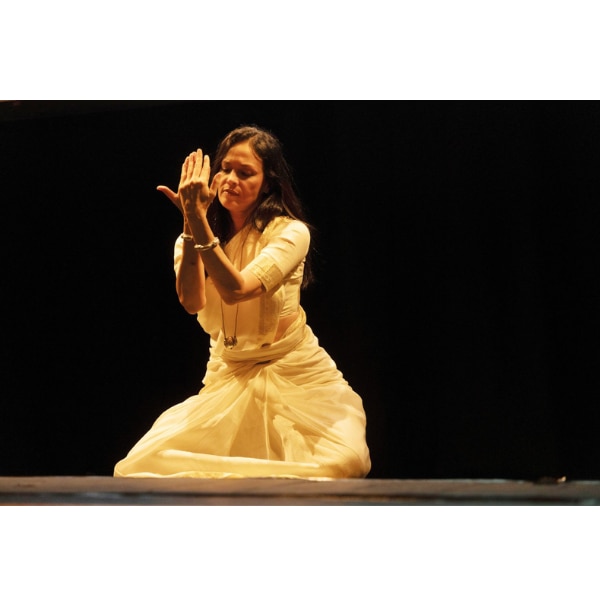
“I love the feeling where I know something is going to become a poem. It’s not there yet, but I know that in one day or two days or five days, this is going to become a poem.” She pauses over the pleasure of that knowledge. “It’s the feeling of creation, you know. Maybe some kind of God complex. I made something!” With a novel, that feeling can take years to arrive, buried under all the fumbling and the larger architecture; with a poem, she gets to experience it again and again.
Making something is one kind of astonishment. Seeing something, really seeing it, may be another. Our phones have made strange neighbours of everything: an advertisement for a bubble hem skirt beneath a photograph of a burning building, someone’s shakshuka arriving before the next piece of terrible news. I ask her about beauty and how to find it in a burning world. “If anything it’s become more important, maybe more necessary,” she says. “How we find it, how we recognise it, what we do with it. Especially now that we are moving towards some weird AI generation. This robotic sameness.” What she misses is surprise. “It’s always the unexpected thing that is most beautiful,” she says. Perhaps this is why the natural world keeps finding its way into the poems. A bird has no interest in looking beautiful. “What is it that we deem beautiful? I think partly, maybe in the poems, there’s this attempt at trying to catch some of that unexpectedness through the strange juxtapositions of other kinds of lives.”
A tube of Vicco Vajradanti in a bathroom in Port of Spain, for instance, is where one of the poems begins. Doshi had been talking to a woman whose family had not returned to India for three generations, and yet there it was: this unmistakably Indian object stranded among the objects of another country. From there, the poem travels home: to cousins outside a kitchen, grandparents chewing neem twigs, the ghosts that once moved through bedroom walls. “All this fear is meant to keep us vigilant,” she writes. Then the child disappears and the adult returns, still carrying all that fear. “It’s amazing to me how much is in the body and in the brain, layered in memory and experience, and how these things find voice,” she says, looking past the screen, into the distance. She leans against a white wall in her white shirt, a long, heavy silver necklace falling across her chest. Her hair comes loose around her face.
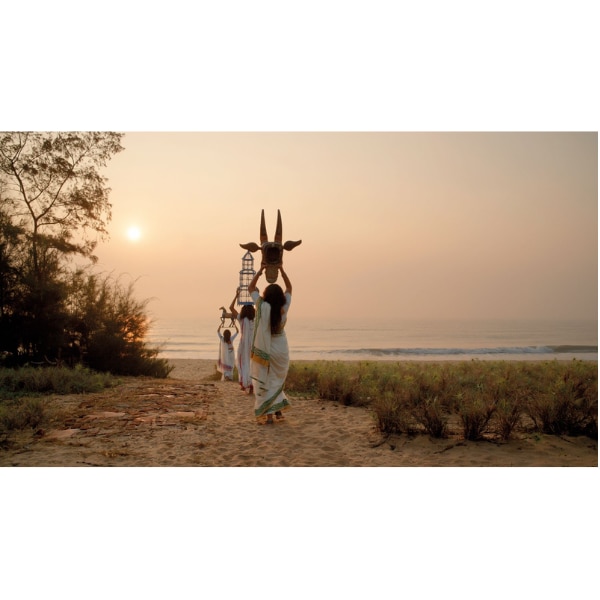
While she doesn’t always have a notebook, she records the occasional voice note but more than often she has what she calls a “strange camera” in her head. “Like I remember this pigeon that I found in my house. A few days later, my father collapsed and I read into that pigeon, certain omens or signs. I think it’s really interesting how it’s almost as though the poems or the experiences are all held inside the body like in some memory vault. These images connect with others and unlock something. And I think that’s where the poem starts.” She can write on a bed or at a desk, with Drupad playing or, more often, nothing at all; the only thing she really needs is a door she can close. Understandably so since she also does a lot of reading aloud of things for both fiction and poetry. “So the sonic is very important. I’m like the mad lady who is sort of reciting to herself all the time.” Her hands keep moving as she talks, regularly settling behind head and even in stillness, there is something gracefully choreographic about her.
Doshi is currently in the middle of creating two new movement pieces for the 26th Berlin International Literature Festival. She is panicking a little because they are still being made. She is also having fun. Her body is “achy in a good way”. After we finish speaking, she plans to make tea, eat some cookies, and go for another walk to see what the tide has left tangled in the sand this time.
This article originally appeared in Harper's Bazaar India's August-September 2026 print issue.
Image credits: Riccardo Vencato and Allen Kiely
Also read: Calm stacking is a simple way to add serenity to your day
Also read: This August, the most beautiful way to travel across India is through a book
ADVERTISEMENT
Must Read







ADVERTISEMENT