




ADVERTISEMENT
Inside Kalaa, the new Visakhapatnam store reimagining the sari
Spread across two floors, the store draws on the Kankatala family’s Andhra heritage and its long relationship with Indian textiles.

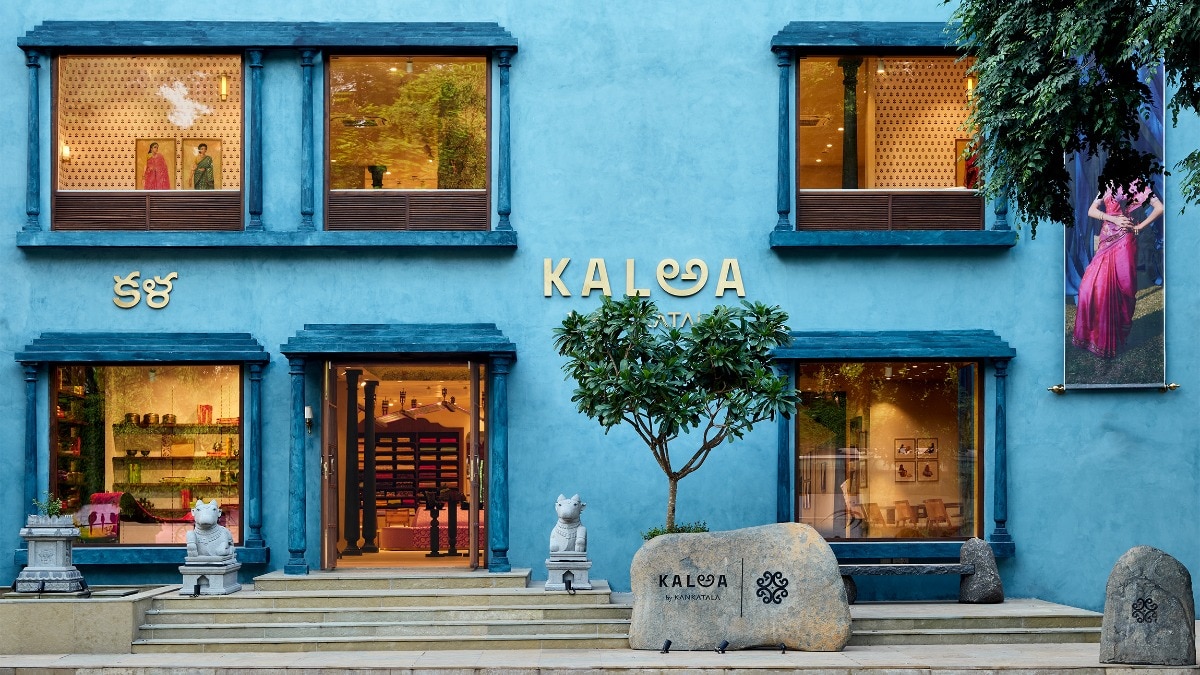
I am in Visakhapatnam for a sari brand. More specifically, I am here for Kalaa, the new store by the Kankatala family, whose association with Indian textiles goes back generations. The family has spent decades working with weavers and studying the craft, and Kalaa brings that relationship into a new space of its own.
Spread across 7,100 sq ft over two floors, the store draws on the family’s Andhra heritage and its long relationship with Indian textiles. Designed by experiential designer Devika Narain, it is less of a conventional retail space and more of an attempt to bring together the things that make up a family’s history: old objects, familiar rituals, architectural details and, of course, the sari.
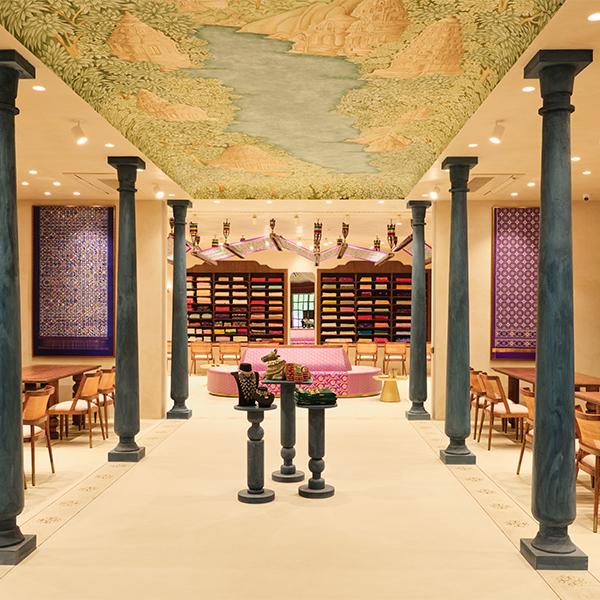
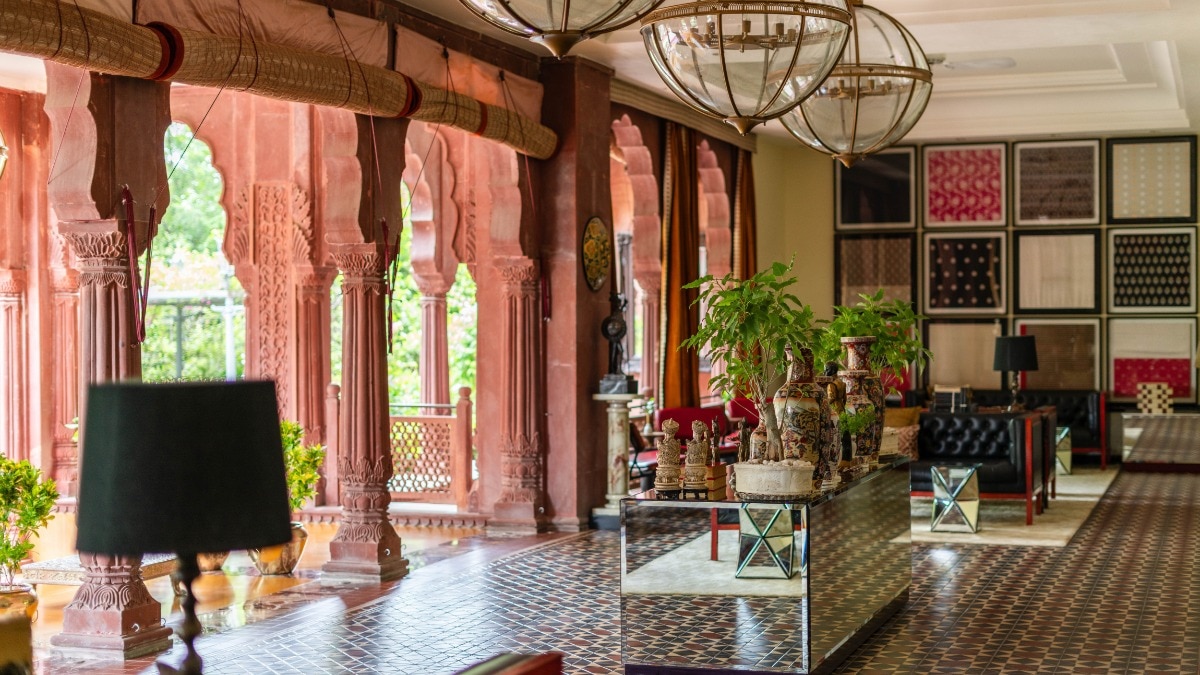
Walking through Kalaa, I find myself looking at the interiors as much as the clothes. There are courtyards and passages that open into different rooms, spaces lined with brass lamps, carved wood, and woven surfaces. The details are thoughtful without being overly elaborate, and the space has the familiarity of an old home, where you might notice something on a second visit that you had missed the first time around. That, Narain tells me, was precisely the idea. She wanted visitors to explore the store at their own pace, allowing the objects and details to reveal themselves rather than having everything presented to them at once.
The idea of a journey runs through the design, too. Stories of merchants travelling between places, meeting new people and bringing back unfamiliar materials have long appeared in texts ranging from the Panchatantra and Jataka tales to the Arabian Nights. At Kalaa, this sense of movement finds an expression in the textiles themselves. Saris from different parts of India sit alongside one another, inviting visitors to look beyond the region or technique with which they might ordinarily associate a particular weave.
I look upwards and the connection to Andhra becomes even more pronounced. A distinctive blue runs through the interiors, inspired by the weathered doors and painted columns of the Simhachalam Temple while a hand-painted depiction of the temple occupies one of the walls. Visiting Simhachalam during the trip gives the colour an entirely different resonance. Seeing the colour in its original setting, against the temple’s architecture, makes it feel less like an interior design choice and more like a piece of the landscape that has found its way into the store.
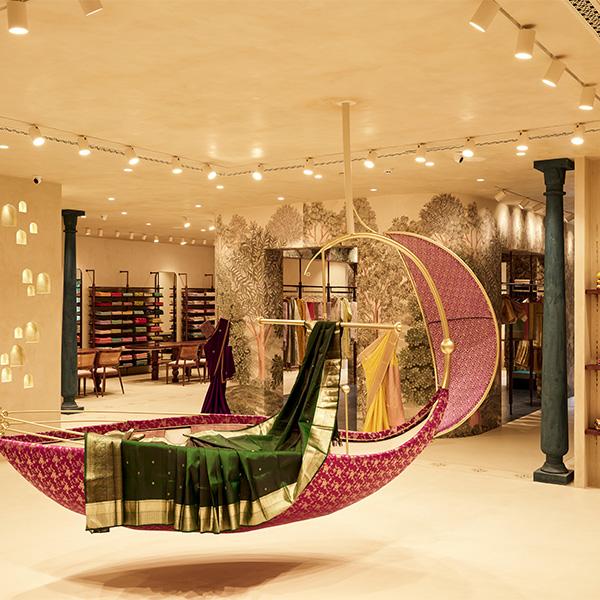
At the centre of the space stands a sculptural brass boat, covered in vivid magenta and gold brocade. It doubles up as a retail installation and an elevated loom, with an emerald-green silk sari, finished with an ornate zari border, draped across its central rail. For Narain, the boat has a memory attached to it. “My first time in Visakhapatnam, Anirudh came with a boat and that is one of my first memories of the place. Boat against the sunset,” she says. “The Kalaa store is the first of the stories of Kankatala legacy as well as our memories of Vizag.” It is a fitting centrepiece for a store that brings together the journeys of textiles and the memories people attach to them.
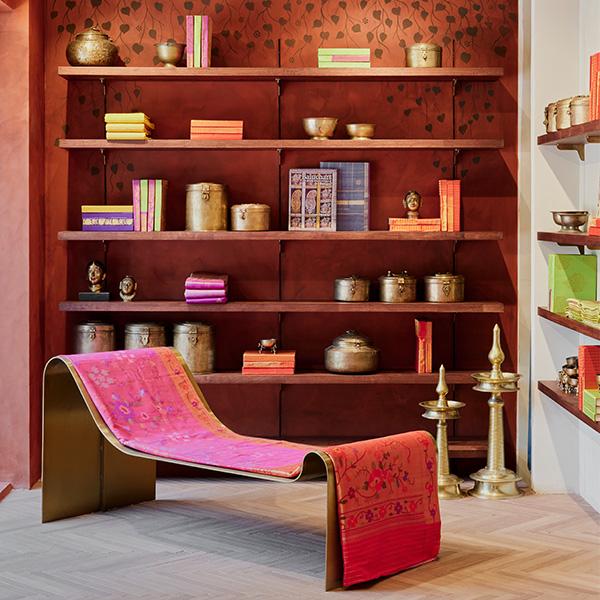
The saris are, naturally, the main attraction. I had expected to find the South Indian weaves long associated with the Kankatala name, but the collection extends well beyond them. Kanjivaram and gadwal sit alongside jamdani, chanderi, and kota, offering a reminder of just how varied the country's textile traditions are. Rather than treating each weave as a separate regional story, the collection allows them to exist in conversation, reflecting the ways in which techniques, motifs, and ideas have travelled between communities over generations.
For Mallik Kankatala, the chairman of the brand, much of the appeal lies in understanding how a sari comes to be. The intricacies of a weave, the skill required to execute it, and the knowledge passed down between generations are as important as the finished garment. It is this interest in the making, rather than simply the end product, that gives the collection its depth.
Kalaa doesn't just display textiles; it preserves what the family has chosen to carry across time—the hands that weave, the weight of old stone, and the quiet rhythm of a coast wrapped in silk.
Photo credits: Reuben Singh
Also read: The latest fashion news and launches to know
Also read: Tilda Swinton untamed: A rare conversation with Cartier’s new ambassador
ADVERTISEMENT
Must Read








ADVERTISEMENT