Unsure what the future holds? Maybe that’s OK
A new book makes the case for embracing uncertainty

A few weeks ago I was reading a story about AI job loss while I waited for my 11-year-old to finish his piano lesson. The general takeaway seemed to be that, like so many things in life right now, we aren’t sure what will happen and no one has a plan. I could feel my psyche scrambling in the face of such ambiguity. While my son butchered Beethoven in the next room, I found myself texting my husband theories to cope. “UBI?” “Nursing school?” Like maybe I’d be the one to figure out the future of work in the next twenty minutes.
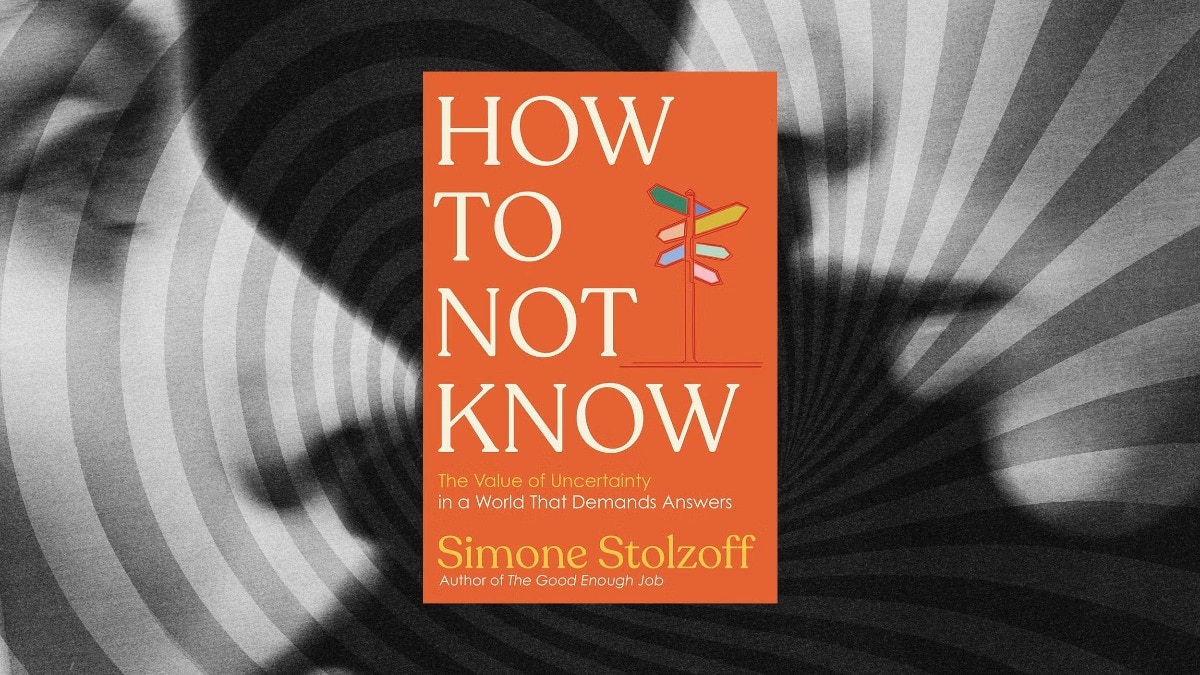
To author Simone Stolzoff, this kind of grasping for certainty is familiar. His latest book, How to Not Know: The Value of Uncertainty in a World That Demands Answers, argues that if we can resist this urge, we will allow ourselves to see the world as it really is, rather than as we wish or fear it might be. While Stolzoff is sympathetic, his project urges the reader to resist falling into what he sees as the three most common “certainty traps”: comfort (accepting anyone’s answer in exchange for relief), hubris (ignoring doubt because it’s too scary), and control (the fantasy that if you just think hard enough, you’ll find the right answer). The book is a deeply soothing cultural corrective, and it was born out of the author’s own work-related spiral.
When Stolzoff was about 28 years old and writing for a magazine in New York City, he got an unexpected job offer to join a design firm in San Francisco. “In some ways, it's like, you know, Oh, woe is me, the agony of deciding between two attractive job offers, you know?” he told me over Zoom. “But it really sent me through this, like, existential loop, where I couldn’t make up my mind for the life of me.” He began asking friends, family, his yoga teacher, even his Uber driver, what he should do.
Stolzoff says this period of existential angst brought two big revelations. “The first was that my job and my identity had become so entwined. It didn't feel like I was choosing between two jobs as much as it felt like I was choosing between two versions of myself.” This idea inspired his first book, The Good Enough Job, which happened to be published in 2020, when many of us were primed to re-examine our relationship with work.
The second revelation was that he had made the mistake of assuming there was a right answer. “I thought if I just banged my head against the wall, and came at it from every angle, I would know exactly which job to take,” he told me. In other words, Stolzoff was operating according to what he discovered was a common fantasy: that there is a so-called right answer, and our task is simply to find it. “I was looking for certainty where there was no certainty to be found.”
Stolzoff will be the first to admit that’s easier said than done. How to Not Know explores just how much we, as human beings, love certainty. Our brains are glorified prediction machines. Most of the time, this serves us well: If I eat that mystery berry, I might get sick. If I put my hand on the hot stove, I will get burned. If I drink this third cup of coffee I will be too anxious to think straight. (Some of these are harder to internalize than others).
The problem, of course, is when we’re faced with decisions that defy easy answers, or find ourselves in situations with outcomes we can’t know in advance. “Faced with uncertainties,” Stolzoff tells me, “people try to get to certainties, because they feel safer. And yet, the safe way out isn't always the best path for you.”
He cites a University College London study in Nature that found uncertainty caused more stress than pain does. Research participants who had a 50 percent chance of receiving a painful electric shock were far more stressed than those who had a 100 percent chance of receiving one. Research has also found the threat of losing your job takes a similar health toll to actually losing it.
It’s an increasingly relevant point. When Stolzoff was on book tour for The Good Enough Job, he tells me the most common questions he got from readers were along the lines of, “How should I think about my career in the age of AI?” or, “What will the future of my industry look like?”
“The truth,” he says, “is I didn't know. I didn't want to, like, pontificate on what I thought the future of work would be.” A lesser writer might have made the attempt—and certainly many have and will—but it’s a credit to Stolzoff that he embraced the deeper questions.
He told me he wanted to tell the audiences at his Q&A that he didn’t know what the future of work would be exactly (if only!), but that, “Maybe the most adaptive skill you can have at this moment in time is the capacity to tolerate that uncertainty.”
That the world is more uncertain than ever is debatable, Stolzoff concedes. “If you were living through the turn of the Industrial Revolution you might have a different perspective.” But, as Stolzoff points out, according to the Economic Policy Uncertainty Index, the five highest measures of collective uncertainty have all occurred in the past five years. And either way, the feeling of uncertainty is undeniably prevalent.
More than that, though, Stolzoff thinks our ability to tolerate the unknown has plummeted. “We have this expectation that answers should be readily available, and we have access to all of this information.” He thinks this is mostly, if not completely, due to the rise of the internet, mobile phones, and now chatbots.
“We feel like every question should have a chat GPT-able answer when, in fact, a lot of the questions of life—Who should I marry? What will my career look like? Should I move?—aren't things that have definitive yes-or-no answers.”
Not that there aren’t myriad pundits and influencers willing to sell us “false certainty,” offering us the always-alluring black-and-white solution to problems with no right answer, or decisions that we can only make for ourselves. The Five Best Cities for Remote Work. The Best Air Purifier for All Parenting Styles. top Ten Exact Things You Specifically Should Do To Be Rich, Hot & Never Die.
As Stolzoff deftly points out, though, it’s not just the attention economy. In recent decades, uncertainty about the climate, job markets, rising inequality, and housing shortages has skyrocketed, and at the same time, stabilizing forces like religion, community, and the kind of career that came with a pension and a Rolex at retirement have all lost their cultural stronghold. It’s no wonder we’re so eager to sketch out a five-year career plan.
The good news: your ability to sit with uncertainty is something you can actively improve. Think of it as a muscle you can build. When I ask Stolzoff for advice on how to do this, there is an air of desperation in my voice. We both know this question is not rhetorical, and that my desire for a hot tip or an easy answer defies the spirit of this project.
“Okay, I think there are two main things you can do,” he offers. “One is you can think back on past periods of your life where you've had to transcend uncertainty. And that can help build your faith in your own ability to handle it in the future.” I thought of a powerful line from Emily Anhalt, a clinical psychologist and a friend of Stolzoff’s: “Trust your future self to handle future problems.” Less a life hack than a life’s work. Still, I wrote it down.
“And the second,” says Stolzoff, “is to consciously choose to expose yourself to uncertainty.” In How to Not Know, we learn from anxiety researcher Michel Dugas that we can train ourselves to embrace the unknown in small, controlled doses, the same way someone with arachnophobia might look at pictures of spiders as exposure therapy. These small acts of faith can rewire your brain.
“It might not feel like taking a new route to work, or trying a new restaurant, or striking up a conversation with a stranger is that revolutionary, but it's through those micro-actions that you can train yourself to be more tolerant of uncertainty in other realms as well.”
In the meantime, for those of us prone to googling things like ‘how to earn money without losing soul’ and spiritually retweeting the famous Cher inquiry, “whats going on with mycareer,” How to Not Know is chock-full of decision-making tips.
Two of them come from the former professional poker player and author of How to Decide, Annie Duke. First, what Duke calls the Only Option Test: when choosing between different options—where to go on vacation, say, or which college major to choose—ask yourself, “If this were the only option I had, and I had to do it, would I be happy?” Your gut reaction will tell you a lot.
The second one, The Happiness Test, is particularly liberating. When faced with a paralyzing decision, ask yourself whether its outcome will have any effect on your happiness in 10 minutes. Ten days? How about 10 years? Considering that, per Duke, the average person spends 250–275 hours per year in “analysis paralysis,” we should perseverate accordingly.
Ultimately, How to Not Know reminds us that action is often the antidote to uncertainty. Maybe you’re choosing between careers. Rather than reading entire subreddits at 3:00 a.m., why not embrace the experiment? Sublet your apartment and try living in a new city for three weeks. Go on the third date, knowing you can change your mind. Practice saying, “This is what I’ve decided for now, based on what I know.” Instead of mapping out a pros-and-cons list about a career change, try a continuing-ed class and see how it feels. (Careful, though—this is how I ended up back in school at 42.)
“It's like being in a rowboat on a lake that's shrouded in heavy fog,” Stolzoff tells me. “You don't know exactly where you're going and you can't see very far in front of you, but all you can do is keep rowing. It’s through the rowing that you figure out where you are.”
This article is originally from harperbazaar.com
Image: Collage by Sarah Olivieri
Also read: Shida Bazyar on memory, migration, and 'The Nights Are Quiet in Tehran'
Also read: Belle Burden's memoir is making people hate their husbands