




ADVERTISEMENT
Objects of desire: Inside the New York gallery giving South Asian craft a new address
House of Santal is placing South Asian collectible design at the heart of Manhattan’s global luxury conversation.

A console fronted by hand-etched brass doors bears intricate iconography: majestic elephants, turbaned farmers, dancers and flourishing palms. A large ceremonial royal barge cuts through swirling waters. There is movement, drama, and storytelling. Designed by Chacko X Studio Moebius, the Native Console Table’s visual language is reminiscent of South Indian temple murals. The console reflects a craft-led convergence of traditional artisanal techniques and contemporary flair. The piece is on view at House of Santal in NewYork.
Exquisite objets d’art from across South Asia have found a home in this Manhattan gallery overlooking Rockefeller Center. Its appeal lies in foregrounding South Asian design and luxury. While NewYork is filled with galleries championing American and European limited-edition collectibles, South Asia remains notably underrepresented. Founder, Raksha Sanikam is all set to turn that narrative on its head.
“For a long time, Indian makers and craftspeople have contributed to some of the most important design and luxury industries in the world, often without receiving the visibility they deserve,” says Sanikam. “House of Santal is a way to place this work coming out of India and South Asia in direct conversation with the global design world. It’s a platform where it can be seen, understood and collected on its own terms.”
For House of Santal’s first chapter, At the Threshold of the Courtyard, statement pieces by 13 designers—each unusual in technique, contour, material, and tactility— offer a snapshot of the distinct visual language emerging from the subcontinent. Each piece is a collectible rooted in honouring artisanal craftsmanship.
The gallery swerves from a traditional white-cube format. One-of-a-kind furnishings are arranged across interconnected mini viewing rooms.“The central space acts as the courtyard. It is designed as a place for gathering, hosting and conversation,” says Sanikam. The pieces are placed according to the mood they conjure or the story they narrate.“We wanted the gallery to feel less like a showroom and more like a journey through rooms,” she continues. “Each threshold gives you a glimpse of what comes next, while allowing each piece to hold its own presence. The idea was to let each room feel like its own micro-curation, while still part of a larger spatial narrative.”
A coat stand by Rhizome, for instance, has been assembled using a brass lota (water vessel) hammered into shape by Punjab’s Thathera metalworkers, while its top has been crafted using reclaimed wood from Gujarat’s erstwhile Pol houses. In another corner, a bulbous, whimsical planter looks almost totemic. Designed by Karan Desai, the planter’s textured, terrazzo-like body is covered in patches of dusty pink, ochre, terracotta, teal and green.
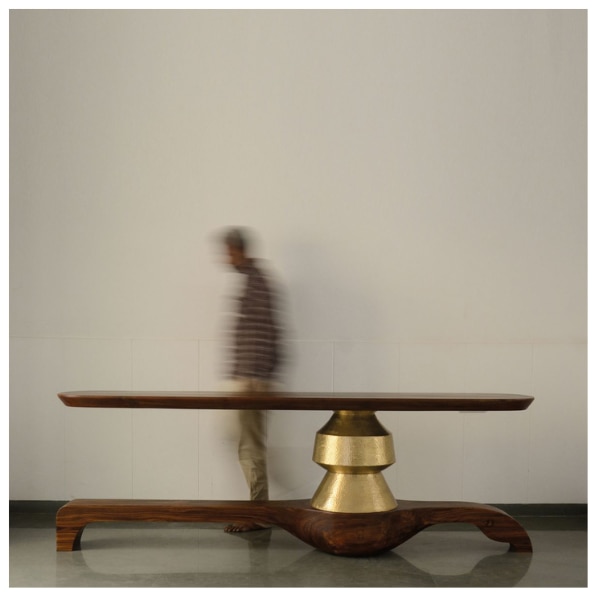
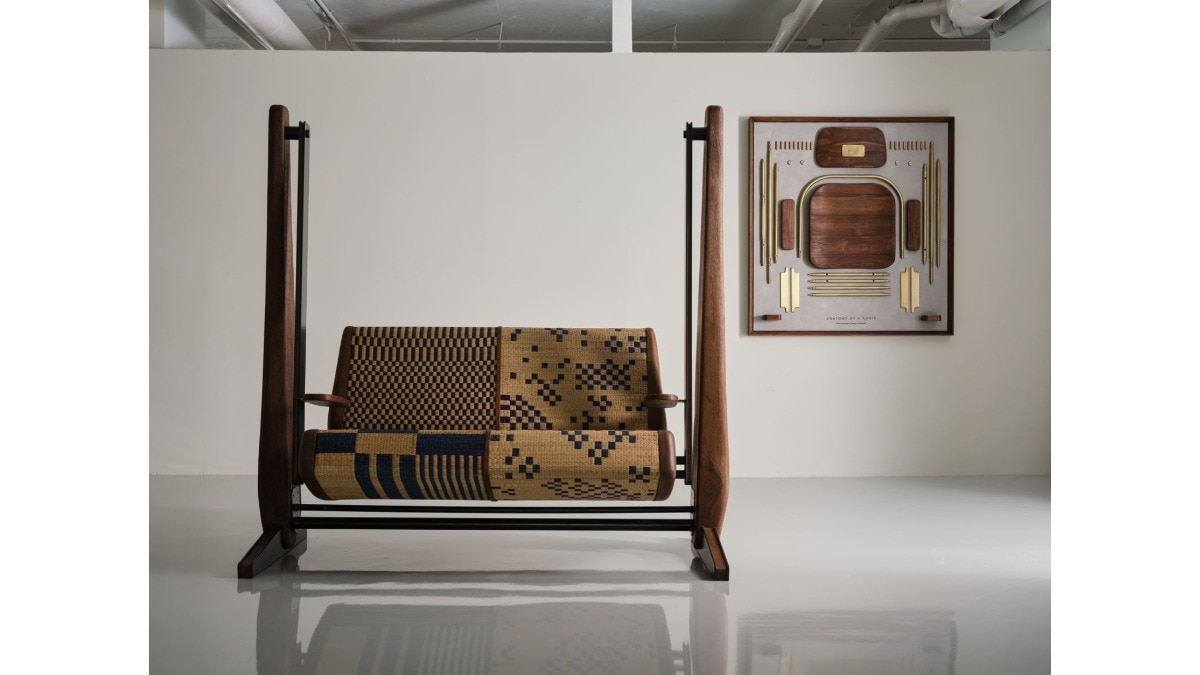
The Ghee Console Table by Rebecca Ruebens draws inspiration from the wooden havan kund (sacred fire pit) spoon used during Indian ceremonial rituals. Elsewhere, the Pattamadai mats, which are traditionally hand-woven by women artisans using river grass, are elevated from the floor and wrapped around an old-world Indian swing. Called the Beevi Pai Swing, the piece is a collaboration between Design ni Dukaan and Majja Design Studio who work directly with craft clusters in Tamil Nadu.
“The underlying thread across the exhibition is celebrating legacy craft,” explains Sanikam, who spent nine months assembling the exhibition, drawing on years of on-the-ground research undertaken before launching House of Santal. For its inaugural exhibition, Sanikam attended trade shows, visited studios and engaged in conversations with industry experts to finalise the curatorial line-up.“For me, it was less about filling a checklist and more about finding designers with a strong point of view, material intelligence and a clear relationship to craft,” she explains.
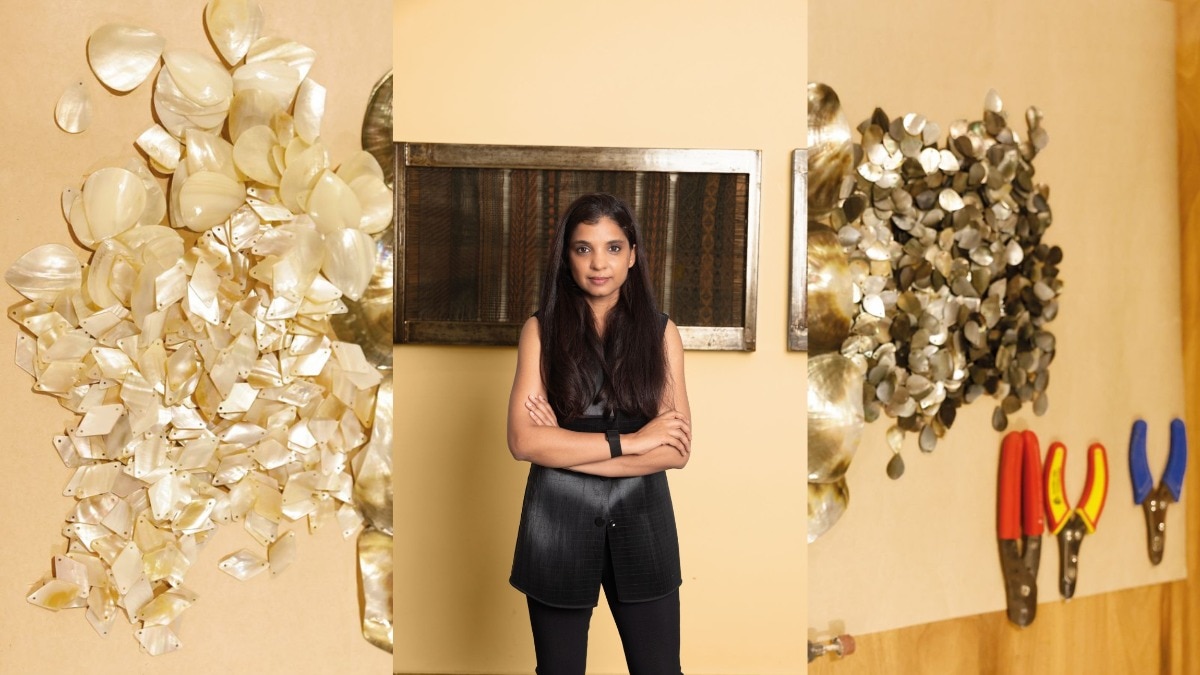
Sanikam’s path has been anything but linear. A former venture capitalist who completed an MFA in Interior Design at the Pratt Institute, she eventually joined the family business as an interior designer. Her own experiences while growing up in India were enriched by “colour, craft, architecture, textiles and rituals”, she says, all of which sculpted her astute understanding for design.
House of Santal borrows its name from Santalum, the botanical genus of sandalwood. The gallery’s colour palette, too, is a nod to the subtle warmth of India, where some of the walls are flushed in deep burgundy, recalling the ruddiness of sandalwood. “Across South Asia, sandalwood has long been associated with ritual, refinement, memory, and sacred offering,” Sanikam says. “It felt like a material that carried the spirit of what we wanted to build: something rooted, sensory and quietly powerful.”
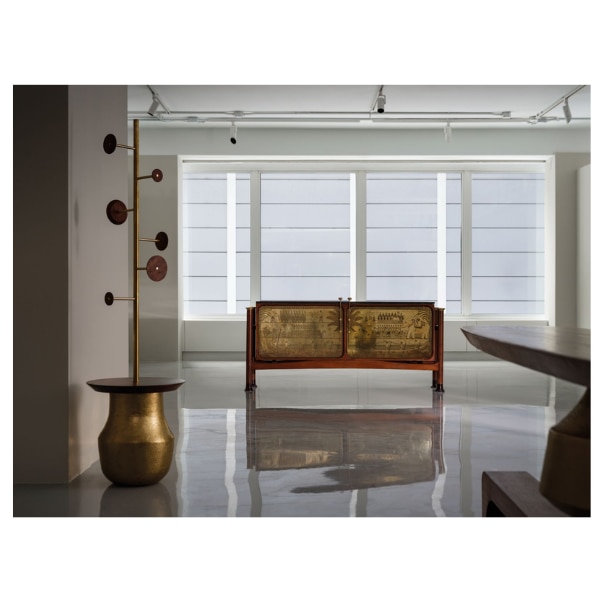
The gallery carries the mood of a private salon, where visitors can experience bespoke design. Nothing in House of Santal is too ornate or ostentatious. Rather, the furniture, lights, mirrors and objects showcase vernacular craftsmanship through a contemporary lens. They invite visitors to linger along the curves, the textures and grains; and to admire the intricate handiwork and cultural memories embedded within each piece.
This article originally appeared in Harper's Bazaar India's August-September 2026 print issue.
Image credits: courtesy of House of Santal
Also read: When your old life no longer fits: The psychology of personal reinvention
Also read: Calm stacking is a simple way to add serenity to your day
ADVERTISEMENT
Must Read







ADVERTISEMENT