




ADVERTISEMENT
How South Asian artists shaped the conversation at Art Basel Hong Kong 2026
Artists illuminate histories, bodies, and knowledge systems that stretch from Victoria Harbour to Art Basel Hong Kong.

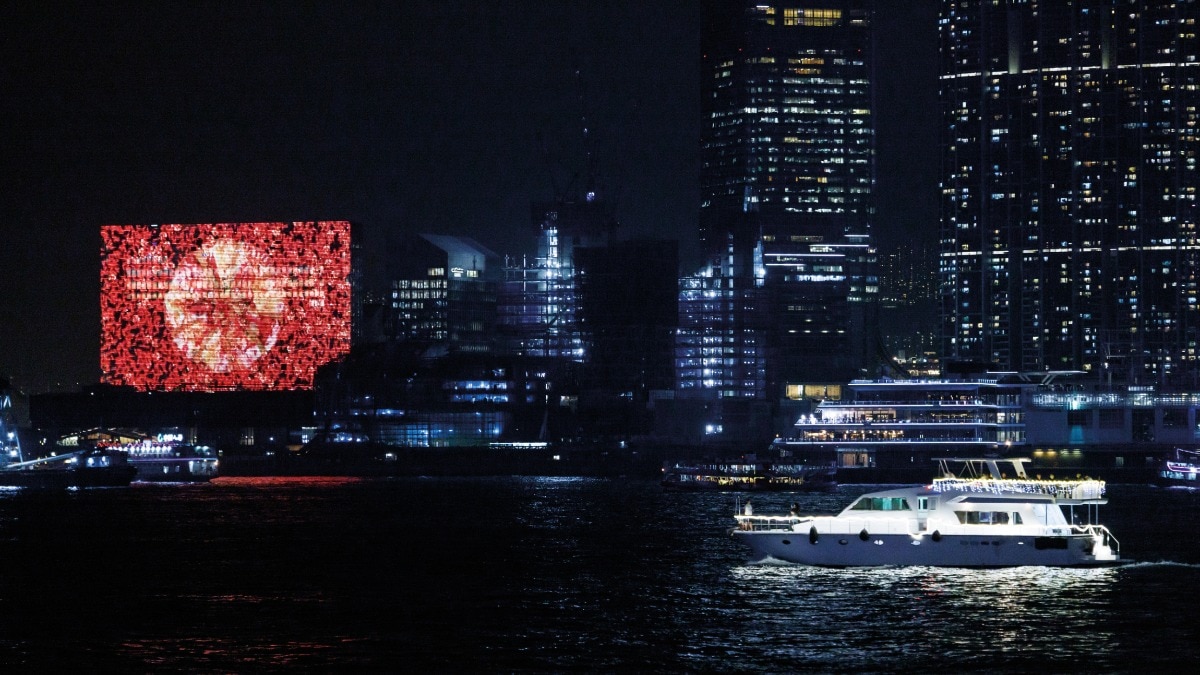
Before visitors even set foot in Hong Kong, in March, South Asian presence had already announced itself, written across the sky. On the M+ facade in West Kowloon Cultural District, artist Shahzia Sikander’s to 12 Nautical Miles casts its glow over Victoria Harbour each night from March 23. Animated from hand-painted watercolours and rooted in the visual language of South and Central Asian miniature painting, the work traces the entangled histories of empire that linked the British East India Company, Mughal India, and Qing China. As South Asian artists gathered inside the halls of Art Basel Hong Kong to present their work, Sikander’s animation was already framing the conversation from the outside.
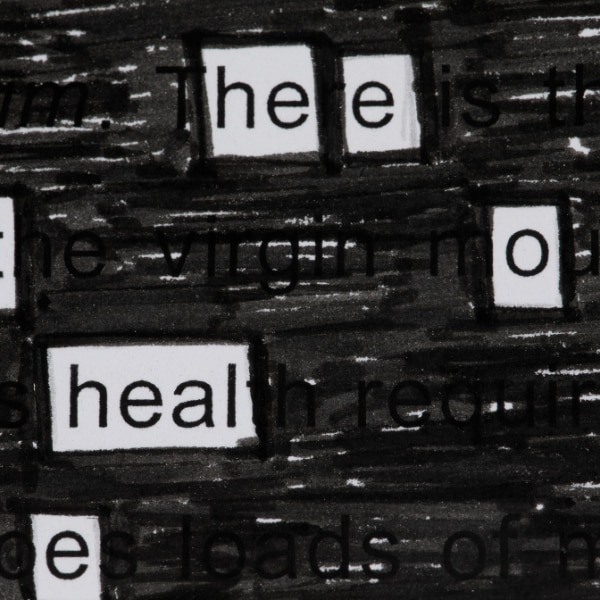
Inside the fair, the thread continued, quieter, but no less insistent. Neerja Kothari showcased with Shrine Empire, the New Delhi gallery run by Anahita Taneja and Shefali Somani, with a series born from losing the ability to walk. Following a neurological illness, Kothari relearned movement from scratch, guided by a physiotherapist’s commands, heel, toe, heel, toe, words that began to mutate as she repeated them. “Heel became heal. Toe became tow. Language misfired the way my body did.” Returning to two essays she had once loved, Henry David Thoreau’s Walking and Virginia Woolf’s Street Haunting—A London Adventure, Kothari began erasing them. Across all 51 pages, she scratched and blackened the text until only the letters forming heel, toe, heal, and tow remained, fragments stranded on white like a map of recovery. “The essays had once offered me dreams of wandering through forests and cities,” she says. “During recovery, their expansiveness felt painfully ironic. They roamed freely while my body struggled to move.” The result is a body of erasure drawings in which. absence becomes as meaningful as presence. What is obliterated illuminates what survives.
“Our approach to selecting artists for Art Basel Hong Kong is both intuitive and strategic,” says Taneja. “We aim to present artists whose practices we believe in deeply, while creating a presentation that feels cohesive, relevant, and engaging for a global audience,” adds Somani.
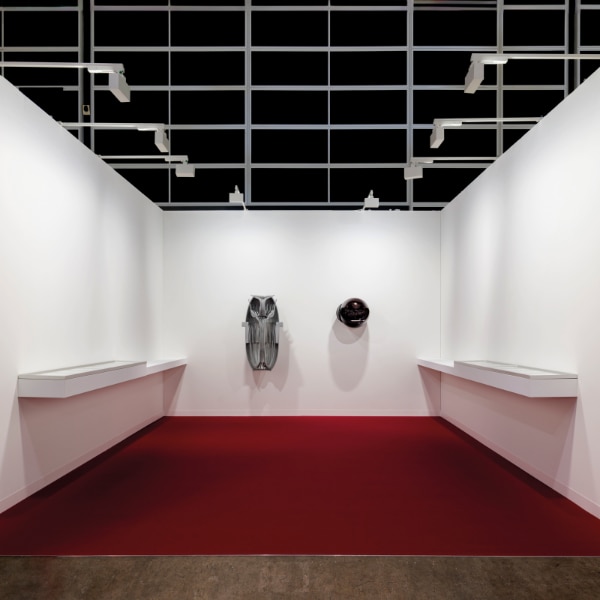
At Discoveries Booth was Amba Sayal-Bennett, presented by TARQ, the Mumbai gallery founded by Hena Kapadia, whose sculptural and paper-based works aim for something deceptively “neutral”: the anatomical diagram. The artist grew fascinated with the “cut through”, a Western medical illustration technique that dissects the body into isolated, readable parts. “I have been thinking about the cut-through in anatomical drawing as a sanitised perspective and false testimony,” Sayal-Bennett explains. “It creates a sense of looking through something, but when you physically see a body this way, it is much harder to differentiate.”
The critique draws on a personal inheritance: her Indian grandmother was a medical doctor who also practised Ayurvedic medicine, grounded in the body as a whole, at odds with the atomising logic of European anatomy. She found unexpected support in a set of Indian syncretic drawings at the Wellcome Collection in London, works that overlay biology onto tantric and Ayurvedic frameworks. “I was really interested in this idea of overlay,” she says, “and the possibility of multiplicity in bodies and practices rather than subscribing to a totalising system.”
Kapadia says the booth this year was more abstract, “focused on ideas of ‘seeing through’. I think the work told the story itself, from its strong visuals.”
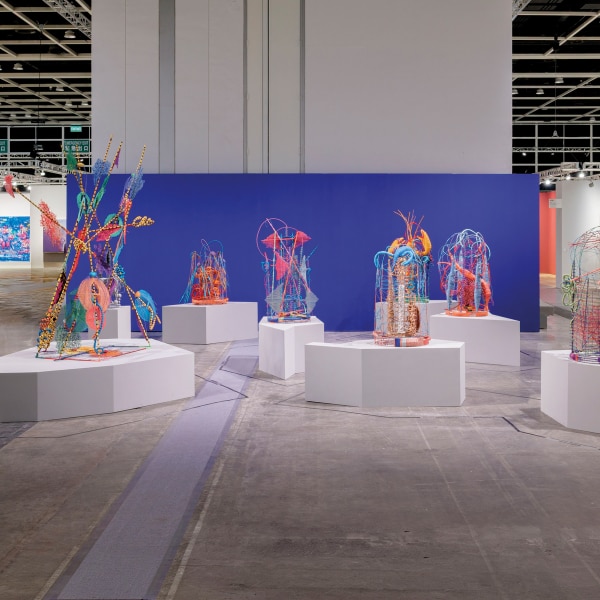
TARQ’s artist Parag Tandel was chosen to be part of the Encounters Sector this year, led and advised by Mami Kataoka, Director of the Mori Art Museum in Tokyo, alongside Isabella Tam, Curator of Visual Art at M+, Alia Swastika, a curator, researcher, and writer based in Jakarta, and Hirokazu Tokuyama, Senior Curator of the Mori Art Museum. Here, he brought a sculpture cluster rooted in the oral histories and cosmology of the Koli fishing community, Mumbai’s original inhabitants, a seafaring people whose identity has been shaped by the ocean for millennia.
The presentation, titled Anthems of Archipelago: We Are King of Ocean, comprised eight sculptures on eight plinths, seven representing the seven islands of Mumbai, the eighth the Yeoor Hills and forest. Works from his Talisman for Coastal Futures and Colour-Blind series were joined by a newer piece from Estuaries of Waning Sounds, developed since the São Paulo Biennial. Yarn stood in for fishing nets. “I tried deliberately not to utilise a literal fishing net,” shares Tandel. What drew Tandel to Hong Kong was its estuarine geography and festivals like Tin Hau, dedicated to the goddess of the sea, that speak to a spiritual relationship with the ocean resonant with Koli cosmology. “I am focused on loss of identity,” he says, “and drawing ‘Koli vocabulary’ on an international platform.” The artist adds, “I see art fairs as social sculpture where I always try to challenge the idea of art as just a decorative corner piece. While art fairs are seen as commercial spaces, they are also important ecosystems to gather and exchange within the art world.”
The Himalayan diaspora’s presence came into focus at Rossi & Rossi and Tansbao Gallery. Artist Tsherin Sherpa, who represented Nepal at its inaugural pavilion at the La Biennale di Venezia in 2022, showed 54 Views of Wisdom and Compassion with Rossi & Rossi, a practice at the intersection of traditional Himalayan iconography and contemporary art. Trained as a teenager in thangka painting under his father, Sherpa has spent decades pulling that sacred visual language into contact with displacement and the slow emergence of dying craft traditions. Tansbao Gallery, meanwhile, presented works by Lain Singh Bangdel (1919–2002), the artist, historian, and novelist widely regarded as the father of modern art in Nepal. Bangdel studied in Paris and played a defining role in establishing Nepali modernism; his posthumous presence in the booth created an arc, one that stretched well beyond the fair’s commercial rhythms.
At Sabrina Amrani’s booth, artist Wardha Shabbir brought work that felt continuous with the fair’s broader preoccupations. A contemporary miniaturist trained at the National College of Arts in Lahore, Shabbir works in gouache on paper, rooted in the classical tradition but oriented toward something more interior: maps of psychological and ecological space. Set to show work at the 61st International Art Exhibition of La Biennale di Venezia by Koyo Kouoh, she will present several works across the Giardini and the Arsenale.
The question of language, what it carries, and what happens when the systems that transmit it fail surfaced in the work of Mumbai-based artist Shilpa Gupta, who showed with Neugerriemschneider Gallery. She concurrently opened a solo exhibition at Hamburger Bahnhof in Berlin. What Still Holds, running through January 2027, centres on TRUTH, a sculptural installation visitors must physically move through: four metres high, over 14 metres long, presented in dialogue with Joseph Beuys. Gupta’s cross-continental visibility in a single week hinted at a broader cultural shift.
Together, these presences made a poignant argument. Kothari visited Hong Kong once, on a layover. Sayal-Bennett has never been. Tandel hails from a seafaring community. Sherpa carries the weight of a homeland scattered across diasporas. Shabbir is preparing for Venice. Gupta opened in Berlin the same week. Sikander made her way from New York and illuminated the sky. And yet the work had shed every mile. What came through in the concealed essays, the cut anatomies, the yarn-threaded talismans, the hand-woven rugs, the miniaturist’s gouache, the animation glowing over Victoria Harbour, was not an attempt to explain the subcontinent to a global audience. It was something more generative: an invitation to sit inside frameworks that Western art history has long treated as peripheral.
Images: Courtesy of Parag Tandel and Tarq
This article originally appeared in Harper's Bazaar India's April-May 2026 print issue.
Also read: Why Indian founders are bringing context back to wellness apps
Also read: Are we losing our relationship with language in the age of AI?
ADVERTISEMENT
Must Read





ADVERTISEMENT