




ADVERTISEMENT
Geetanjali Shree on writing, translation, and the changing face of Delhi
Booker-winning author Geetanjali Shree on a vanished Delhi, the language that chose her, and the slow art of writing by hand.

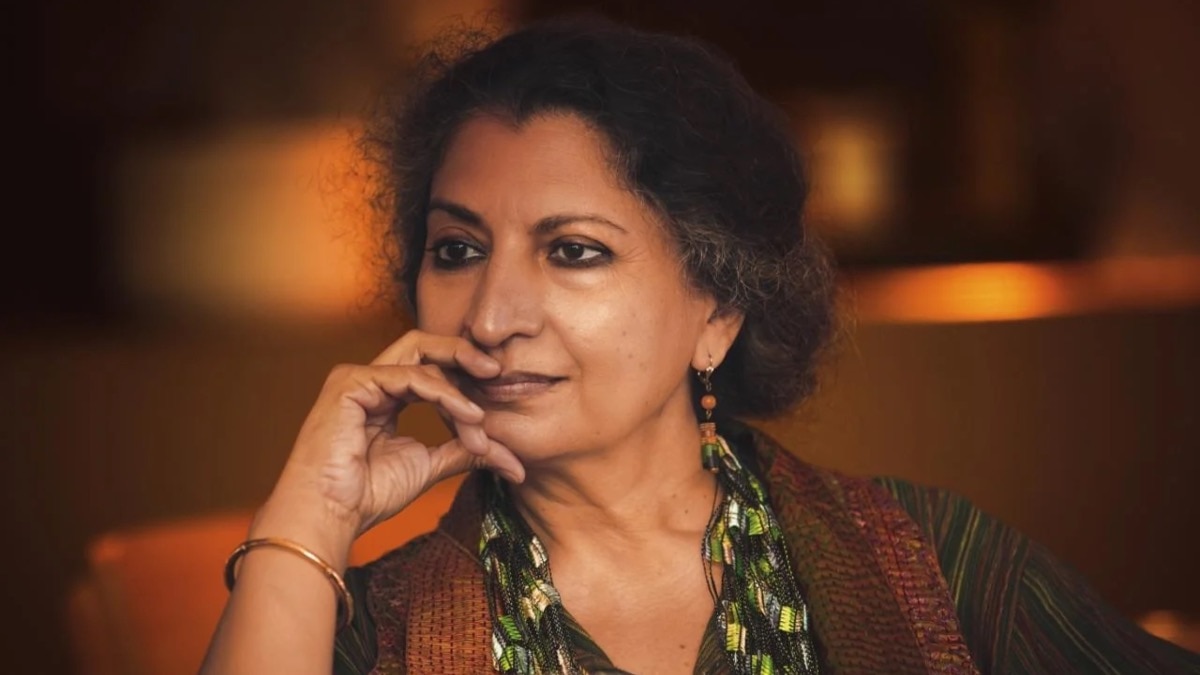
It is August. A capital caught in the whirlwind of rain. A greasy petrichor permeates the air as the familiar humidity begins to settle. Even the most sceptical at heart would argue that there is some meagre ounce of romance to be extracted from soaking up a city in the throes of a monsoon flush. But Geetanjali Shree, connecting with me over Zoom from her New Delhi apartment, flatly refuses to sentimentalise the rains. “Once upon a time, monsoons were lovely, as were the winters,” Shree says. “Now each season comes with its own mess and I actually no longer have any preference.” The city, she says, is “just exploding and unable to handle the crowds.”
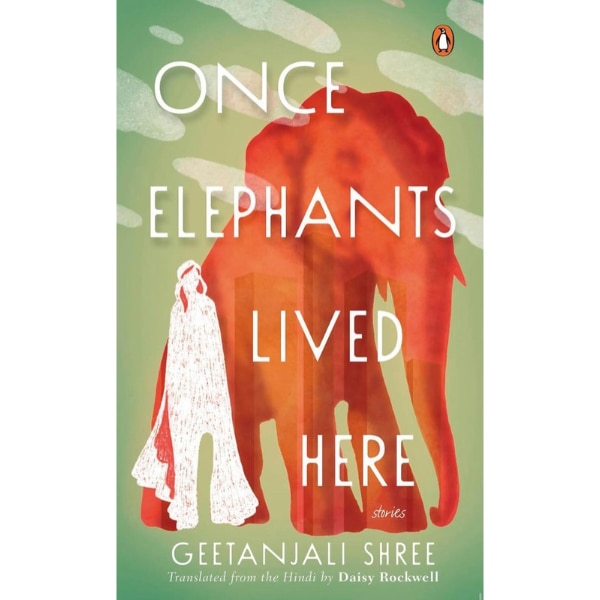
It is hardly the most whimsical note on which to begin a conversation, especially with a Booker-winning author best known for finding emphatic humanity and humour in the most ordinary, if not bizarre of situations. Her latest work, Once the Elephants Lived Here, is Daisy Rockwell’s English translation of Shree’s short stories. Written almost a decade earlier, it is a series of tales with no beginning or end, composed across years in different locations. Shree is gently dismissive, even chiding, of any apology on my part for classifying the tales as absurd.
“Absurd in literature is a very rich concept,” she says, describing it as a strategy she reaches for intuitively: a small, slightly unbalanced idea becomes a seed, and then something stranger. To this effect, the collection includes a story that “doesn’t stop”, about a woman who walks endlessly in circles. It began with Shree’s own morning walks around her housing society, circling the same short loop. “I don’t know how this stupid idea came to me,” she shares, conjuring the image of a wheel that cannot stop spinning. It eventually grew into something larger: a story about “the continued invisibilisation of women,” the anxiety of striving, and “wondering if indeed you’ve got anywhere or you’re just going round and round.”
Speaking of going around leads us to circle back to the city again, and our shared years of having spent time in it as students. But as we walk down that memory lane, the portrait of Delhi in the ’70s that emerges from her words is vastly different from the one I experienced three years ago, and a million galaxies away from the city we find ourselves in today. “For starters, it was a greener city,” she says, remembering “newly washed trees and the beautiful happy green,” alongside parrots, peacocks, and long walks among the monuments. But it was also a politicised, restless time. “We were all protesting about everything and being slightly ridiculous also sometimes,” she recalls. “In my time, it was important to be political even for those who, like me, felt unsure of their footing. Those formative years gave us a grounding which has served us well in later years.” That old energy, she suggests, has resurfaced in the youth-led unrest of recent months, and her response is characteristically double-edged. “It’s quite amazing,” she says, before quickly admitting to the anxiety it also causes, given the deeply unequal nature of the conflict.
I finally confess that I came to Shree’s work in translation, despite being fully capable of reading it in the original Hindi. Growing up, I had Hindi pressed on me as a second language so insistently that, over the years, I grew to resent it. Shree absorbs this information and looks out of her window before diagnosing the underlying problem. The Hindi that gets pushed on schoolchildren, she suggests, is a flattened thing, nothing like the language she writes in. She waves off my embarrassment with a knowing smile and urges me to read at least my favourite story from the collection—one about a woman who falls in love with the sky whilst at a writing retreat with robots—in Hindi at some point. “It’s also a larger symptom of how ignorant we are of the beautiful creations that are being made all over our country in so many different languages that we will never bother to even learn,” she says with a sigh. “So it’s really not your fault at all.” Guilty as charged nonetheless, I promise to read the story in Hindi. Shree smiles.
Raised in Uttar Pradesh in the early decades after Independence, when “there was a kind of idealism about the new India,” Shree became deeply rooted in the poetry of giants such as Nirala and Mahadevi Varma. Her mother, who died two years ago, was “always a Hindi speaker and a Hindi-knower,” and the letters Shree sent home from Delhi during her student years were always in Hindi. Though schooled in English, she says, “I was solidly bilingual, and I would even say that perhaps my Hindi was already much better than my English.” Hence, when she finally began to write, choosing Hindi as her medium for fiction was a foregone conclusion.
For years, Shree believed that “my form is the novel rather than the short story,” drawn to the larger canvas of the former and the room it gave her to dwell in confusion. But since the publication of this latest collection, readers have been talking to her incessantly about the stories, hungrily asking for more. “I suddenly began to feel maybe I should try short stories again,” she says. “Maybe it’ll be fun to have some silly little idea and play with it again and see where it goes.”
But while another short story collection might be on the horizon, any expectation of Shree translating her own work is out of the question. “I will go into translating my own works or those of others only when I feel my fictional side has truly dried up and I have no more stories to tell,” she says. She is entirely serene about being translated though. She shares a beautiful friendship with Rockwell, who regularly translates her fiction and shares her sensibility and sense of humour. “Translation is a creative process of its own. I do not mind small liberties that are taken here and there, and I never hover over word choices. I’ve done what I wanted to in Hindi, it’s out there, and now this is Daisy’s work to make.”
Shree admits to being a slow writer, one who writes multiple drafts and lets each gestate significantly. She needs seclusion to work, and her method is, unsurprisingly, analogue involving a Parker fountain pen. “It’s a pen my mother had given me,” she recalls. Every first draft must come from it “without brakes,” and every later draft sees her restarting from the first word. Only recently has she begun typing up her final drafts, and even that, as with life and art in general, she admits with a mischievous smile, is never quite final: “You keep tinkering, tinkering, tinkering. I think that is one of the few joys and excesses you have to hold on to, as an author.”
Images: Courtesy Penguin Random House
This article originally appeared in Harper's Bazaar India's November 2026 print issue.
Also read: The rise of the micro celebrity: Why influence is no longer about millions of followers
Also read: Anavila’s first home collection is a tribute to the village that shaped her
ADVERTISEMENT
Must Read









ADVERTISEMENT