




ADVERTISEMENT
A designer and an artist collaborate for a multisensory art installation inspired by 'Panchatantra' fables
Designer Vikram Goyal and artist Sissel Tolaas bring these timeless characters to life in sculptural form in an exhibition at Design Miami, Paris, from October 22 to 26.

Tales that live in our bones, and smells that hold our memories. Designer Vikram Goyal and Norwegian artist Sissel Tolaas have come together to collaborate on a multisensory art installation, one that speaks in the language of sculpture and smell.
Their dialogue finds its source in a story as old as time: Panchatantra. One of India’s most revered fable collections, it is a treasury of lessons, told through animals who teach survival, loyalty, and wisdom. These stories have travelled far from their birthplace, translated into Greek, Latin, Spanish, Italian, German, and English, cutting across continents and cultures. They have informed generations, shaping moral compasses through tales of jackals, elephants, and tortoises.
Now, these timeless characters have been summoned again, not through the written word, but as sculptural forms, solid brass embodiments of myth, housed in the former Parisian residence of Karl Lagerfeld. The walls that once witnessed haute couture now cradle a different kind of art, one that demands more than just the eyes.
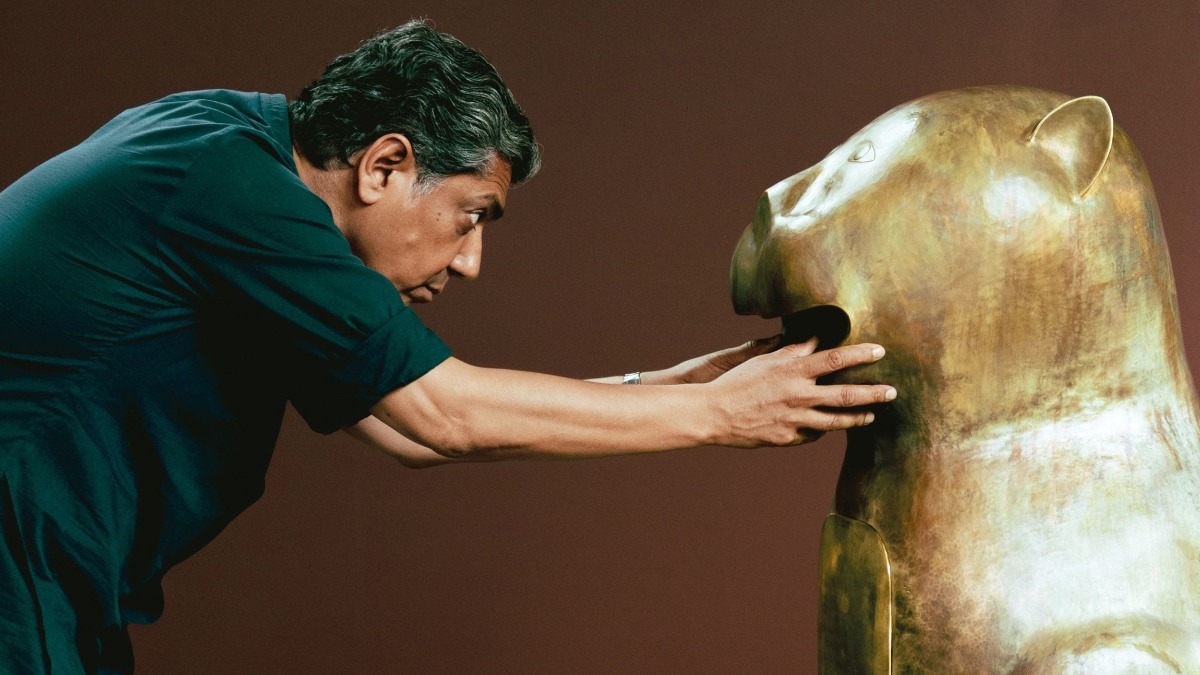
The work is not simply about form. It is about history. About the invisible currents, scents, and stories that surround and shape us. Goyal’s sculptures are functional objects, a tiger that doubles up as a console, a crocodile transforms into a bench, a tortoise becomes a coffee table, yet they transcend their utility. They invite the viewer to pause, breathe, and inhabit a space where story and substance entwine.
This synthesis of tangible and intangible recalls the dynamic collaboration between two French artists, François-Xavier and Claude Lalanne, whose practice inspired Goyal’s sculptural body of work in this project. Like the husband-wife duo, he uses animal forms as metaphors, conduits that speak to something primordial and historic. The animals in his work are not mere representations; they are vessels, embodying the intersection of the mythic and the material. Just as Jean de La Fontaine, the French fabulist of the 17th century, acknowledged his indebtedness to the Sanskrit Panchatantra, Goyal’s sculptures channel a lineage of storytelling. The fables, once oral and fluid, now crystallise in brass and smell, inviting a multisensory engagement with history and belief.
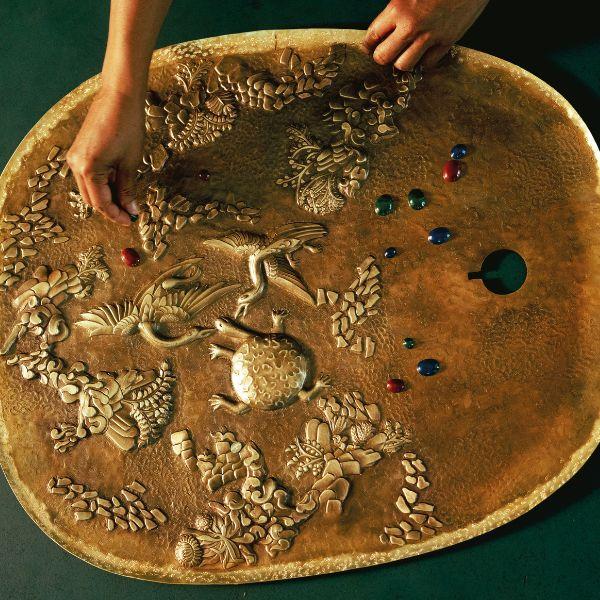
The Panchatantra itself is an archive of morals often cloaked in humour and surprise, and the stories demand reflection. One scene revisited by Goyal is the tale of the tortoise and the cranes. The tortoise, carried across the sky by two cranes, is warned not to speak. Overcome by pride and curiosity, it opens its mouth and falls. The moral, simple yet profound: think before you speak. But in these sculptures, the story gains new complexity. The tortoise’s expression hovers between awe and defiance. It’s a moment frozen in brass, full of tension.
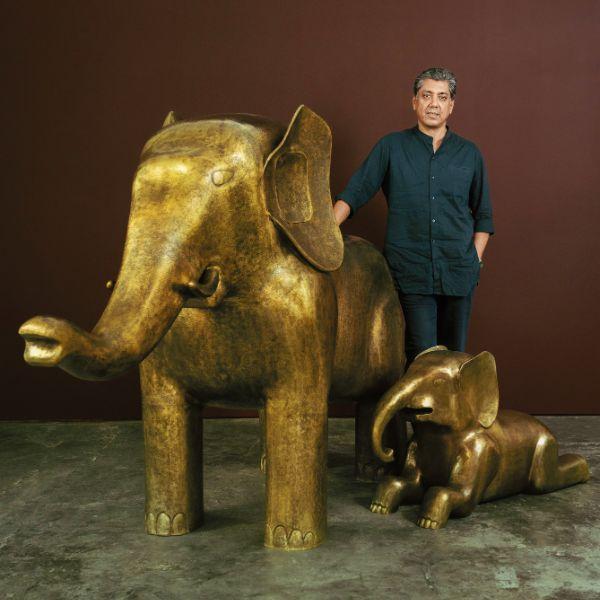
Another instance is the tale of elephants and the king of mice, which cautions, “Never underestimate anybody by their appearances,” says Goyal. It’s here that Goyal’s work subtly challenges the viewer’s expectations. His sculptures, while steadfast, harbour gentle personalities of animals that are curious rather than threatening. This gentle invitation extends beyond the visual, reaching into the olfactory realm, thanks to Tolaas’ pioneering practice. “Animals communicate through smell,” Goyal explains. “Fables and scent are both intangible, but they evoke memory. That’s what made it such an exciting and natural idea to work with Sissel.”
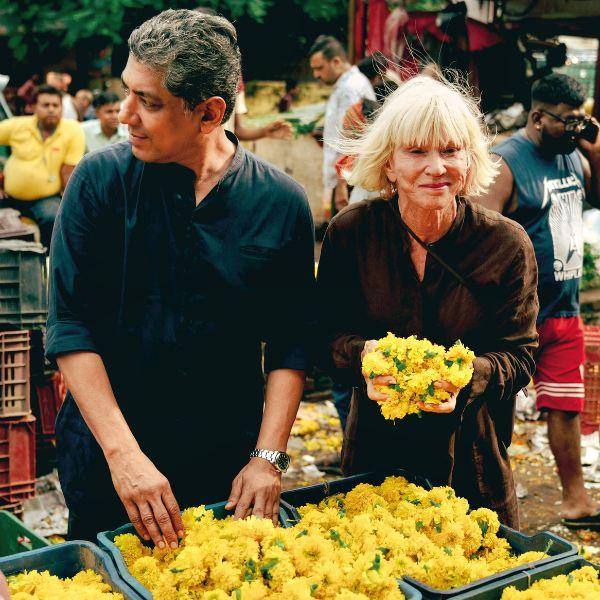
Tolaas is regarded as the world’s foremost olfactory artist, an alchemist of the invisible. She creates entire invisible worlds, journeys for the nose, blending art, science, and society. “I call myself a professional in betweener,” she says.
Her process is both meticulous and poetic. Using a headspace device—a small, mobile contraption that fits in her pocket like a camera—she traps the air around her subjects. This device captures molecules, which she then analyses using gas chromatography-mass spectrometry in the lab. In India, she bottled the scent of elephants, the aroma of flower markets, the metallic breath of brass in Goyal’s workspaces. Each smell carries a story and history. “Smell is a language humans forgot, but animals never stopped speaking,” she says in reference to the smells she bottled around elephants in India for Goyal’s sculpture. “Art allows me to ask questions science doesn’t yet have the language for.”
Tolaas compares her process to that of collecting invisible data. “Smell adds a whole other dimension; it makes you feel the work before you understand it. It bypasses the rational mind and goes straight to the heart. India overwhelmed me—the smells, the heat, the life. But that was exactly what I needed,” she says. To truly understand the scents she captures, she had to rescale—physically and emotionally— while in India. “It was humbling,” she recalls. “Air is political. Who gets to breathe clean air, and who doesn’t, is a matter of justice.” For her, scent is not only poetic but forensic, a form of environmental data. “When you walk through a landscape, you don’t just see it, you breathe its history.”
Tolaas believes emotion leads to memory, and memory leads to action. “These sculptures don’t just exist in space. They are surrounded by invisible information you take in with every breath.” In her view, smell is never passive. It is active, intimate, and charged. Air is everywhere, all the time, carrying stories, emotions, and memories. “Before there was the word, there was the molecule. Chemistry is the original language of life,” she says. “We live in a world ruled by the visual, but I try to resist it. I look at the world on behalf of how it smells.”
This philosophy resonates with Goyal’s vision for the project. The collaboration marks a new chapter for Goyal’s studio. “It’s a departure, our first real foray into multisensory art. For us, it’s a pivot, a risk, and a leap,” says the designer. Working with smell, for Tolaas, is working with time. Because smell always comes from something that once was. “Our nose is the only exposed part of the brain. It’s literally how the world enters us.” She calls the nose a “primitive oracle,” capable of telling us when something is right, wrong, or dangerous. In her work, molecules become words, a language to evoke, remember, provoke. “When I smell something, I’m not just detecting a substance, I’m listening to a conversation the world is having with my body.”
Together, Goyal and Tolaas have created a space where animals aren’t characters in a story; they are storytellers themselves. “We made them curious,” Goyal says. “Their personalities are gentle, inviting.” Through their work, the ancient lessons of Panchatantra breathe again, teaching us to see, smell, and feel the world more deeply. To recognise that stories are more than words; they are breath, memory, and the invisible threads that bind us all.
Lead image: The designer with Vyaghra
This article first appeared in the October 2025 print edition of Harper's Bazaar India
ADVERTISEMENT
Must Read

ADVERTISEMENT