




ADVERTISEMENT
When art runs in the family: Mother-daughter artists on creativity and legacy
Two mother-daughter artist duos reveal how creativity is transmitted through presence, not pedagogy.

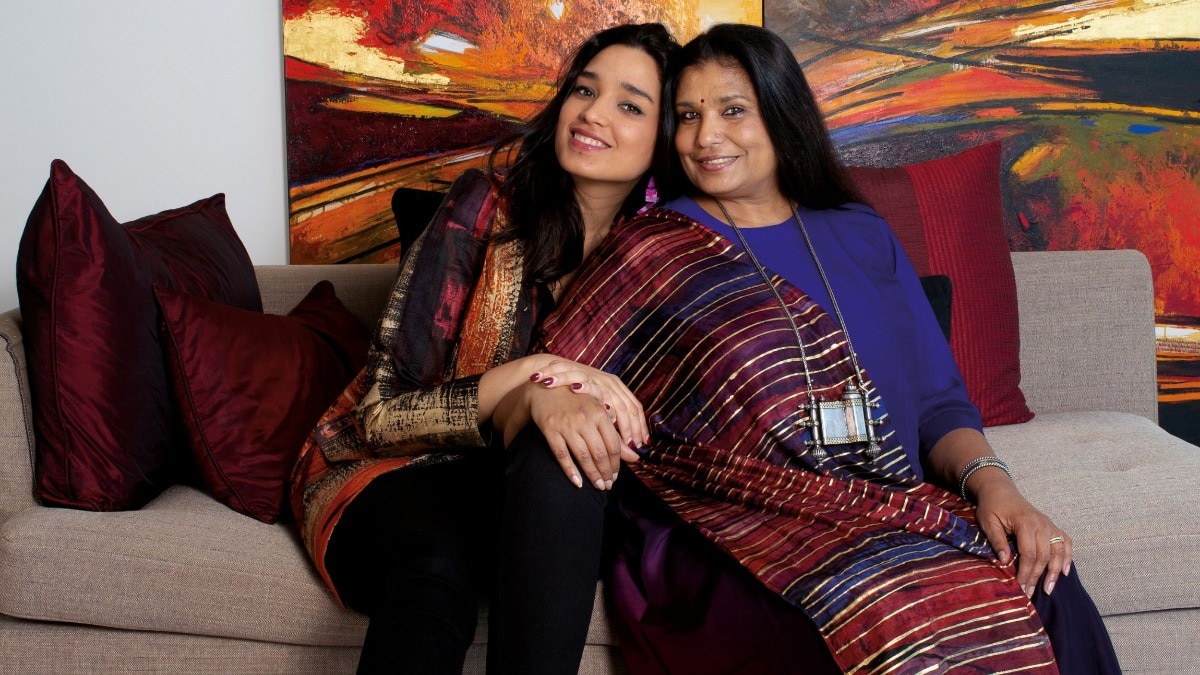
In families where art runs deep, mentorship is omnipresent. What binds painter Sujata Bajaj and her daughter and textile designer-artist Helena Bajaj is not advice dispensed or techniques handed down, but the quiet education of witnessing a life shaped by art and practice.
For Sujata, creativity was never separated from domestic life. “It was a part of daily life,” she shares. Her studio was inside the home. Helena had “her own pencil case, her own brushes and mini canvases,” and one unspoken rule: if she stayed in the room while her mother worked, she had to be creating too. “When she saw me working, she never disturbed me,” reveals Sujata. What Sujata noticed early on was not mimicry, but instinct. Helena’s sense of colour and aesthetics felt innate. She remembers her daughter coming home from school after being told her yellow top and blue trousers clashed. Helena had responded, quite reasonably, “but how can you say this, the sun sits in the blue sky and they go so well together.” Sujata laughed—and quietly noted in her mind that “something was definitely brewing”.
Helena remembers that same childhood as immersion. Creativity, for her, looked like a house that turned into “Santa’s workshop for weeks every December,” because gifts were always only made. At 12, it looked like Sundays at the art workshop while her peers played sport. At 14, it looked like internships in Indian factories, and finally, at 16, art schools in the US and the UK. “In essence, it looked like integrating at a young age that creativity could lead to a lucrative career and that aesthetics were no superficial musing,” shares Helena. More than anything, it felt enchanted. “Knowing I wanted my part in it someday.”
There was no single moment when the relationship formally shifted from mother-daughter to artist-artist. For Sujata, the change was gradual and unmistakable. “Product was moving a bit further and artistry was getting a bit closer,” says Sujata. Then came the phone call about a gallery contract. “This felt all too familiar,” she says. “I knew she was taking her skills into a new realm, one closer to home.”
Helena resists the idea of equality. “I still don’t see myself as a fellow artist,” she confesses. “That would suppose some sort of equal ground and I obviously have a very long way to go.” But there is trust now. Her mother asks for her eye in the final stages of a painting. Sujata listens when Helena returns from a project abroad, curious about what new knowledge she has gained. “It’s fun for me to occasionally be the resource for a change,” Helena says, “and think that there are things my mother can now learn through me after a lifetime of the opposite.”
However, their practices diverge by design. Helena is a textile designer first, an artist second. She works with dye, embroidery, metal, artisans, suppliers, corporations. Sujata is more solitary. “Helena is a much more collaborative maker than I am,” Sujata admires. She keenly observes her daughter’s appetite for knowledge and calls it insatiable. “She reads books about textiles, watches documentaries about textiles, listens to podcasts about textiles. She is obsessive in the most beautiful way.” That obsession, grounded in research and rigour, gives Helena’s work a different legitimacy, one Sujata recognises as partly inherited from Helena’s father, but fully earned. Sujata sees inheritance in the form of curiosity, aesthetic sensibility, work ethic, and what she calls “cultural fluidity as creative capital.” She marvels at Helena’s ability to move between Bogotá and Beirut, Delhi and Paris, building a network that “in fact...far surpasses me.” On Helena’s part, she calls her mother “my toughest critic and my most passionate professor.”
With her work, Helena wants to disrupt “cemented cultural biases” around craft and show that tradition can be “ancestrally charged” and still speak fluently to the present. Sujata, on the other hand, wants feeling to lead understanding. “Art should actually be like love,” she insists. “If you love something, you try harder to understand it.”
Over the years, the mother and daughter have become more like friends. They travel alike, research alike, obsess alike—searching for Suzani embroiderers in Uzbekistan, lotus weavers in Burma, ceramic courses that fit both their schedules. “She has steadily grown into a real partner in crime,” Sujata says.
Helena, now 30, feels time is unfolding in its own way. This was the exact age her mother moved to Paris and began her practice. “There is something oddly full-circle-esque about this moment,” Helena says, aware of the difficulties her mother faced, and respectful of “all that she has accomplished especially as a woman at her time.”
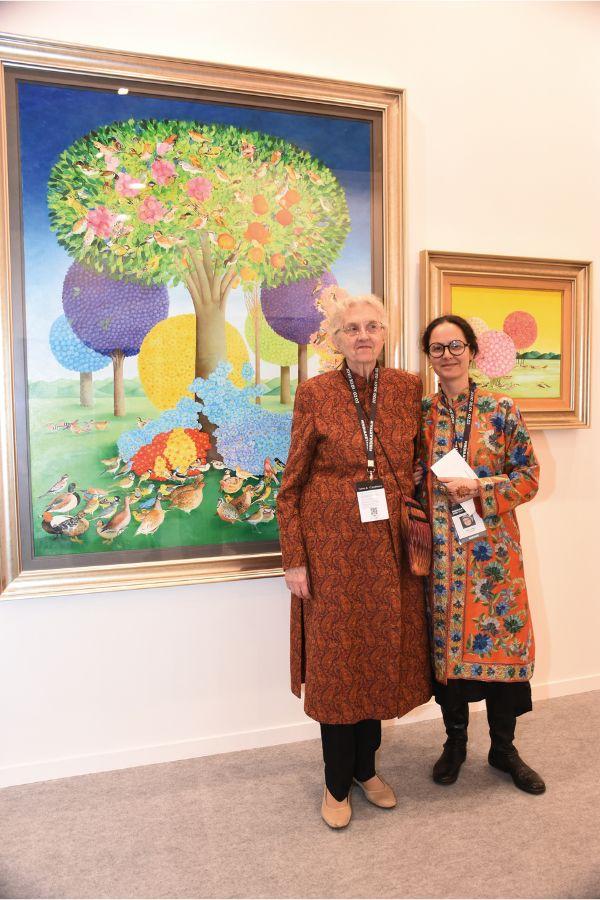
There is something enduring in watching someone else remain faithful to their practice over decades. This long view—of obsession sustained, of art braided seamlessly into daily life—became the real education, says French painter Maya Burman. She is talking about her mother and French painter Maïté Delteil.
For Maya, inheritance arrived in two intertwined ways. One was intimate, bodily, and unavoidable. “I was born into an artist family,” she says. “My parents’ artistic life has flowed through my blood from the very beginning, both artistically and domestically.” Art was not a separate vocation in the Burman household. The second form of inheritance, Maya explains, was slower and more elusive. “It’s the one you build over time,” she says, shaped by “images you love deeply—images that have such a strong emotional impact on you that you wish they could become part of you.” These attachments take hold instinctively. “There is no conscious desire to build this link, this lineage,” she adds. “It exists beyond my control, as it comes from something very deep within me.”
Maïté’s relationship to inheritance is strikingly different. Raised in rural France, she did not grow up with what she calls “a formal or essential education in art.” Drawing, embroidery, singing—these were skills young girls were taught but never to be take up professionally. “Apart from my own professional ambitions, I have never wished to pass on my knowledge of painting to others.” And yet, paradoxically, her life has been one long act of transmission, just by living it truly.
The mother-daughter duo has witness each other’s journeys closely. While Maïté watched Maya take “a long and sometimes very unusual path” into art, including a period of complete resistance to becoming a painter at all. Maïté speaks of this watching with characteristic restraint. “I watched both of my children develop artistically,” she says. “But I never pushed them toward becoming artists.” One became a scientist; the other, an artist. Maya, in turn, has been watching her parents’ artistic lives for more than half a century. “Even today, Maïté is 93, and I can still admire her day-to-day relationship with art.”
Maya’s process is organic, and she insists that her work is neither theoretical nor conceptual. “When I build a composition, I don’t try to follow anything artificial,” she says. “I sit in front of the paper and simply listen to what wants to emerge.” Her process begins with sketchbooks—“small visual notes” of buildings glimpsed in the street, patterns, sculptures, images encountered while reading. These fragments hold “memories of the feelings I had when I made them.” The colours and the small histories that give life to the work emerge without premeditation, she shares. “In the morning, I know where I will paint, but I do not know what the painting will become,” adds Maya.
For Maïté, the idea of storytelling was embedded early. “When I was young, there was no television,” she recalls. “We spent our evenings with our grandmothers listening to their stories.” Those nights shaped her world and her understanding of it. Meaning, for her, lives in myth, in timelessness, in craft carried out with care, she adds.
Maïté has painted alongside her husband, Sakti Burman, for a lifetime. “We always saw each other’s work, but we never felt the need to influence one another deliberately,” she shares. What they shared was “a common goal: to become good painters. We never wanted to compromise our work for the sake of money.”
Maya inherited this devotion to slowness and privacy. “I have never enjoyed public relations or socialising very much,” she admits. She left Paris for a village of 30 people. “I spend my days in my garden, with my brushes and my dogs. My husband is my only daily connection to another human being.”
When asked about legacy, Maïté turns away from the idea of artistic inheritance. “When I had my children, I tried to teach them, above all, to become good human beings,” she says. Human values, she insists, have always matter more than social position. Neither mother nor daughter believes in art as merchandise. “My paintings are a mirror of my soul,” Maïté puts it simply. Maya is even more uncompromising. “I do not believe I have any responsibility toward an audience. I paint first and foremost for myself,” she concludes.
Lead Image: Courtesy Sujata and Helena Bajaj
This article first appeared in the February 2026 issue of Harper's Bazaar India
Also Read: String theory: How Carnatic music is shaping the global sound of artists like Susheela Raman and Abi Natesh
Also Read: Bodysuits briefly fell out of favour, but these styles will win you back
ADVERTISEMENT
Must Read

ADVERTISEMENT