Inside Aranyani: Tara Lal’s sacred architecture of forests and memory
At Sunder Nursery, Tara Lal’s Aranyani Pavilion transforms colonial histories and native plants into a space for healing

Tara Lal has the best childhood nickname I’ve heard. Nange Peyar. One is quick to imagine Mowgli-like soles leaping between trees and sidestepping anthills. Little feet fluent in earth. Lal grew up in Delhi in the 80s, and her father, having noticed his child pocketing dried leaves, found her books about trees. On weekends, they’d go to different parks in the city, and learn the names together. By 12, she knew the scientific names of many. “I spent all my time in the garden. I was such a little ‘junglee’ girl and so in love with the shape of leaves,” she says on a Zoom call during the inaugural week of the Aranyani Pavilion, a first-of-its-kind public initiative in India and South Asia foregrounding ecology through architecture. Titled Sacred Nature, it is structured as a spiral walkthrough installation. Voices and footsteps layer over each other as I speak to Lal; the sound of her life’s work suddenly belonging to other people. “When you learn their names, recognise what they’re like, it’s not just greenery.”
Lal, the environmental conservationist and creative director behind the Aranyani Pavilion, tells me she didn’t want to keep theorising nature from a distance. Before her PhD, she had already studied architectural history, trained as an architect, and worked in design. Moved between drawing boards and research proposals, between buildings imagined and arguments footnoted. “As much as I love research, the real work that I loved was being in the field. Academia has a side that can get very lost and far removed from the world it studies. I didn’t want to get caught in that trap.” There was a time she thought she would go to ranger school instead. She imagined waking at four in the morning, the house still dark, pulling on her gear and stepping outside before the day had begun. She would be out for hours. Field work is still her most favourite thing in the whole world.
The pavilion though was always in her mind, maybe not in exactly this form. “I’ve always wanted to bring together these two sides because I think that art and architecture have the potential to really emotionally move us. Giving people facts doesn’t actually change anything,” she says. “We hear them, but it doesn’t connect. When we’re moved emotionally, that’s when we make changes.”
When I ask about the process, she says it involved a whole lot of writing. Diaries. Sketchbooks. Pages and pages until the thinking began to take shape. And then she walked into Sunder Nursery one morning, felt a tingle, quick and electric under the skin. This was it.
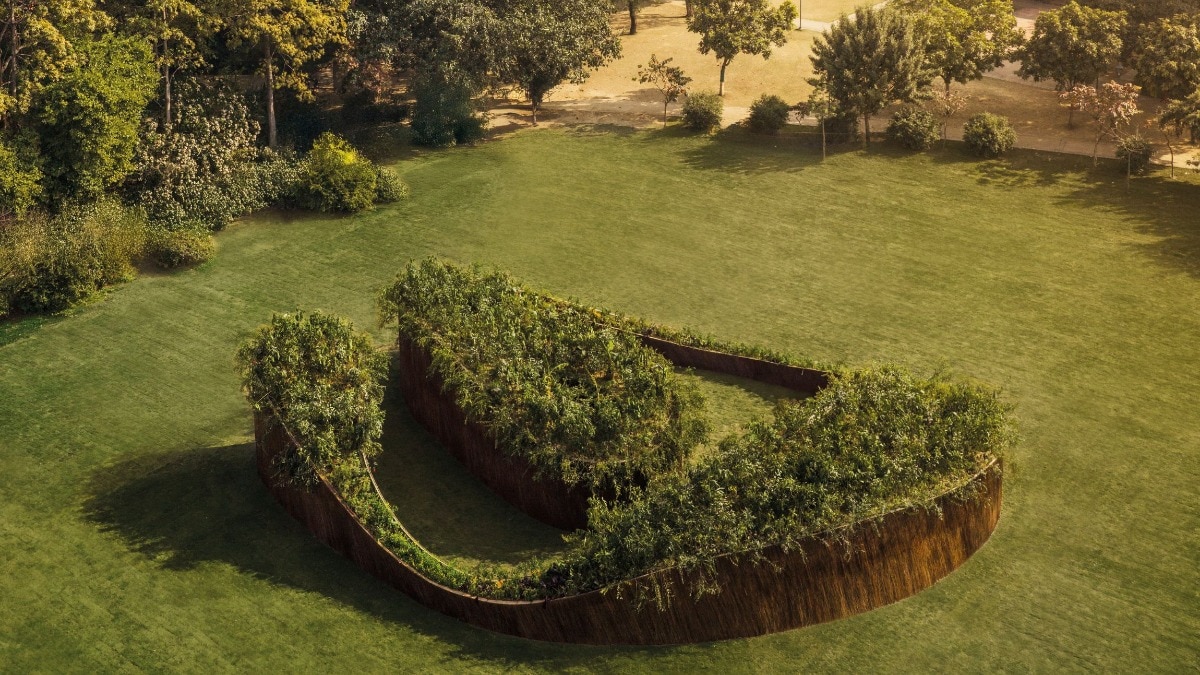
Aranyani’s structure is built from lantana wood. An invasive species introduced by the Portuguese and spread by the British, who brought it from Latin America to ornament colonial gardens. Over time, lantana spread aggressively, overtaking millions of hectares. “We had to learn a lot about lantana as an actual construction material. So we couldn’t just use the raw material as it was. It had to go through a whole process to become viable. Even then, it was too thin, not strong enough to stand on its own. So we had to figure out what kind of structure would support it.” This led to multiple collaborations which, Lal says, was one of the most beautiful things about this project. Above the lantana frame, there exists a living canopy of 40 native species. Tulsi, neem, jasmine, marigold, pomegranate, and juhi, which she remembers growing up with. At Aranyani, the invasive becomes the frame through which the native returns.
The spiral form is something Lal has studied in sacred geometry. The structure spirals inward, mimicking the geometry that nature returns to; in shells, in storms, in galaxies. At the centre, sits a 5.5-foot soapstone monolith. “That we once worshipped a forest goddess and now barely remember her says a lot,” Lal shares. “When we stopped revering the feminine and the earth, we also stopped protecting them.” The pavilion draws heavily from her travels through sacred groves—Madagascar, Nagano, Jaisalmer, and Meghalaya. She noticed that these regions were all colonised. “Often, the only forests that survived were sacred groves. They endured because communities protected them.”
At a breakfast for India Art Fair patrons at the pavilion, visitors from Japan, Austria, and Mongolia asked if something like this could take root in their own countries. She says that was always the point. For it to resonate, to connect, to move beyond boundaries of culture, race, and religion. But her favourite moments are with the schoolchildren. “I love seeing the schoolchildren come and sit in the rock shrine area, and meditate.” It loops back to the barefoot girl learning tree names with her father.
In a recent conversation with noted British author Sathnam Sanghera about colonial landscapes, she explored how forests were redrawn as timber stock, rivers were seen as trade routes, land as yield to be measured and taxed. She spoke about how the relationship to land had never been just economic. “It was lived, ritual, seasonal. But colonial law named vast ecologies wasteland. And that was set up by the British, but those structures exist still, which is really sad. In architecture and in design, even in how we live, we’re still grappling with colonial history,” Lal says. “The question is how to create models of repair, so healing becomes possible.”
But what can an ordinary person do, someone without land or funding? The answer begins with paying attention. Simply knowing what is native and what is invasive in your own garden, or in the strip of soil outside your building. She urges connecting children with the garden, however modest it is, to let them press seeds into soil and wait, to watch for the first split of green. Plant for pollinators, she suggests, even if all you have is a balcony with two pots and a railing that catches afternoon light. Urban gardens matter. The city is not sealed off from life. A cluster of flowers on the tenth floor can still call a bee out of its wandering.
“To build community, you need a physical place to gather. This is that place,” she says about the pavilion which will leave Sunder Nursery on February 20 and travel to Jaisalmer, to the Rajkumari Ratnavati Girls’ School next. The plants will go too, lifted and replanted. In transit, it will learn another landscape. And somewhere, a girl who might pronounce Aranyani for the first time will stand inside it and feel that the land is not distant, not owned, not abstract but hers to tend and protect.
Image: COURTESY ARANYANI PAVILION
This article first appeared in the February 2026 issue of Harper's Bazaar India
Also Read: How much travel do you really need to heal this year?
Also Read: Normcore is over. The nerd has inherited cool