




ADVERTISEMENT
What makes 'The Invite' a great sex comedy? It’s the talking, actually
A24’s latest comedy is an unexpected chamber piece that follows in the footsteps of 'Who’s Afraid of Virginia Woolf?'

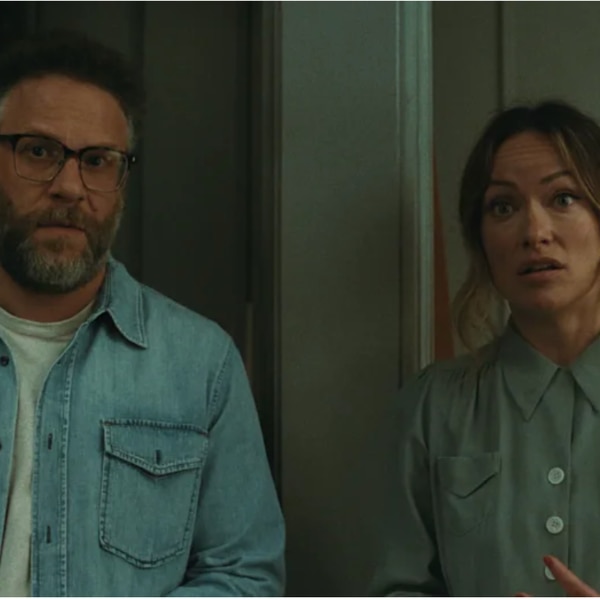
We meet Joe and Angela, the married couple at the heart of A24’s new film The Invite, played by Seth Rogen and Olivia Wilde, through a supercut flashback, with images of them laughing and looking lovingly at each other, before a montage set to Fabienne Delsol’s ’60s-inspired love ballad “I’m Confessin’ ” transports us to the present, where Joe gruelingly commutes home across San Franscisco on his folding bike and Angela rushes across town running errands. It’s already apparent that married life has dulled their spark, as an epigraph from Oscar Wilde flashes on the screen: “One should always be in love. That is the reason one should never marry.”
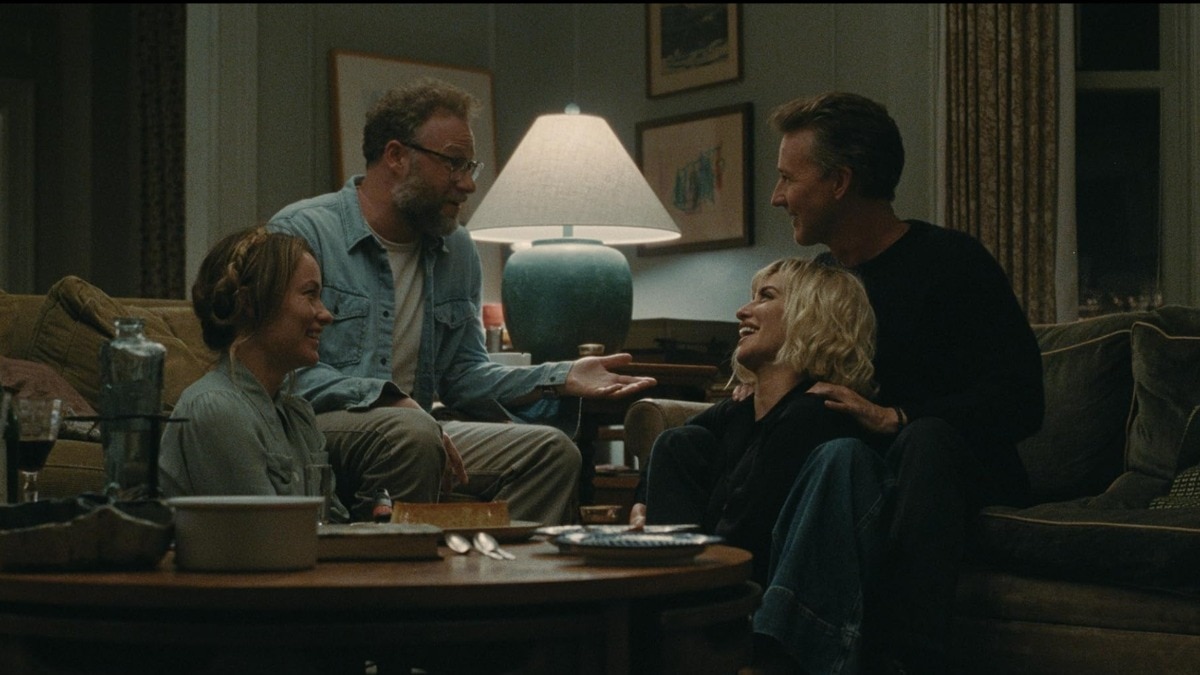
Joe and Angela are now parents, and their once-carefree lives are now spent exhausted, simply cohabitating, with sex a distant prospect. The only thing they talk about is their 12-year-old daughter (never on screen because she’s at a sleepover) and the eccentric neighbours’ loud sex upstairs. But things are bound to be different tonight, because Angela has invited Pina (Penélope Cruz) and Hawk (Edward Norton)—you guessed it, the eccentric neighbours from upstairs—over for dinner. And thus the stage is set for a 107-minute chamber piece in which all four volatile players come clashing together for an emotionally turbulent dinner party.
The Invite, directed by Wilde and written by Rashida Jones and Will McCormack, based on the 2020 Spanish film Sentimental (written and directed by Cesc Gay, who originally and unsurprisingly wrote this as a stage play), finds close kinship with Mike Nichols’s Who’s Afraid of Virginia Woolf? The legendary 1966 film finds four powerhouse actors dining and drinking together—a volatile closeness that oscillates from intimacy to locking horns. A less capable director might fumble the careful balance that made Virginia Woolf successful, but Wilde’s attention to her characters allows for razor-sharp repartee in which the actors relish the movie’s fast-paced, witty dialogue. As with any dinner party, the true barometer of a film is measured by the quality of the banter.
Joe and Angela’s acrimony supercharges the movie’s opening; the two immediately go toe-to-toe, with Joe lamenting the neighbours, his bad back, and life in general, while Angela’s overwhelming frustration boils over after a day picking up tons of jamón (terribly pronounced by Angela) to impress Pina and baking a soufflé. But where Rogan and Wilde revel in the resentment, Pina and Hawk, to put it plainly, are straight shooters. Hawk immediately calls out the tense atmosphere when he arrives and even tries to reassure Joe and Angela by saying they “love a contentious environment.”
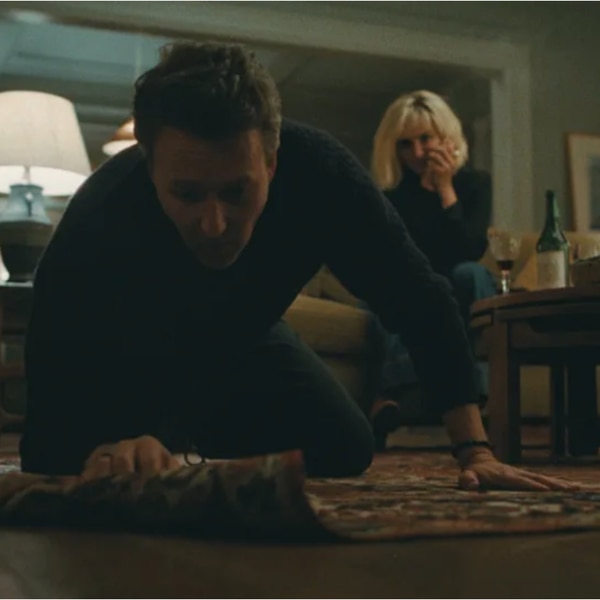
The Invite leans into its taut environment, as the two couples swap in the house: Pina joins Joe to smoke a joint in his office; Hawk tours the neurotically designed apartment with Angela (who details the nitty-gritty choices, from the bathroom’s vintage penny tiles to three shades of blue she wants to paint their bedroom—which Joe can’t tell apart). The suspense is cultivated by McCormack and Jones’s rapid-fire dialogue, Dev Hynes’s hyper-anxious soundtrack, and the quick cuts between the two swapped couples. Every corner of the house is suffocated by the building tension. Pina and Hawk clearly goad the unfulfilled sexual desire in Joe and Angela as they tour the house. The house itself is full of triggers: a piano Joe refuses to play (because he sees himself as a failure), a record featuring a love song Joe wrote for Angela (Hawk tries to play it, and Joe snaps), and the unrenovated, unpainted bedroom, clearly a space existing as an afterthought.
The break in the tension finally arrives when Hawk and Pina offer up their own invite after a round of tequila shots: group sex. Suddenly, the endlessly tense bickering disappears as Joe and Angela scurry away to confer in Joe’s office, sharing an energetic exchange where they’re simultaneously talking and giggling over each other as they let the proposal sink in. When they return to the living room, their body language looks completely different, defined by a close physical intimacy as they cuddle up closer to each other, as Pina and Hawk detail their previous group-sex escapades, from a “sex menu” they receive from conventions to a 10-person sex birthday party. We finally see the last glimmer of love (and comfort) between Angela and Joe before everything falls apart.
What sets The Invite apart from your run-of-the-mill sex comedy is the way genuine anger and sadness are delicately woven into the witty banter. After Joe falls and hurts his back (following his clumsy near-sexual encounter with Pina), Hawk unfurls a monologue about how his first wife passed away before he ever let her open up to him, an unexpectedly emotional moment in the film. It’s also why, when Joe and Angela finally confront their “dead marriage,” diagnosed as such by Pina, we feel the piercing reality; the banter suddenly stops as they allow the house to become silent for the first time.
The final, quiet moments of The Invite leave us with Joe and Angela, their life together unravelled before them after a single chaotic evening. We are left both revelling in the jokes and rattled by their emotional severity. As the couple quietly plays piano together, you care for these two troubled lovers, and even if they don’t seem perfect, you hope they find love again, with each other and within themselves.
This article is originally from harperbazaar.com in June 2026
Lead image: IMDb
Also read: Meet 'The Odyssey’s' epic cast
Also read: Lilith Fair lives! The meaning behind Olivia Rodrigo’s Daisy Chain Fields Festival
ADVERTISEMENT
Must Read





ADVERTISEMENT