




ADVERTISEMENT
Paris Haute Couture Fall/Winter 2026 was a study in fantasy and craftsmanship
Paris’s couture season becomes a meditation on fantasy, excess, restraint, and the human hand in the age of AI.

Yes, Paris is beautiful in the rain. And in the golden, buttery embrace of a summer sun. Imagine this town in the ’20s, through the rain and the sun. The writers, the artists, the designers. Dreamy? Yes. Now imagine the city in a heatwave.
Hundreds of people—city dwellers, office-goers, creatives, tourists, students, lovers—jumping into Canal Saint-Martin to find a moment of respite from the torturous bearings of the sun. Hallowed maisons rescheduling their shows days before their runways, citing the unbearable heat as a reason. Editors queuing outside venues in shorts, tank tops, and fans; their usual stilettos swapped with sliders and ballet flats. Air-conditioned clothing, the kind you only see in Ridley Scott productions or Rick Owens runways, finally becoming a roadside reality. In short, as Paris burned through a historically hot July, the fashion industry got a fall-winter couture season for the books.
First came the larger concerns. Climate change was no longer a headline to scroll past while a faltering global economy raised questions about the relevance of haute couture. And beneath it all lingered the anxiety of artificial intelligence: could four isolated days in Paris, the Mecca of design and creativity, really quiet the insecurities it provoked? As the global fashion community descended upon Paris for sophomore couture outings at Dior and Chanel, and new chapters at Balenciaga and Jean Paul Gaultier, these questions found surprisingly reassuring answers. Sometimes through metallic pleats, often through distortions of material and form, but always saved by finely embroidered sartorial imaginations of seasoned couturiers that seemed far from shy of commenting on the state of affairs that surround us today.
FANTASY AS MACABRE
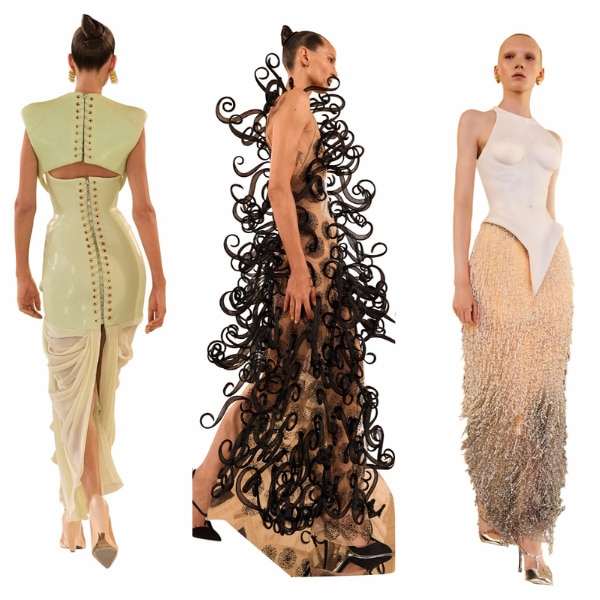
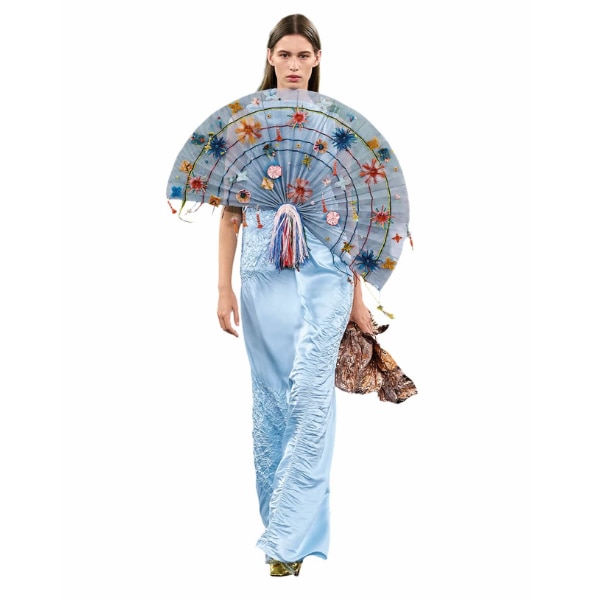
Very few people in today’s world of couture and dressmaking know how to tell a story like Daniel Roseberry. His ability to evoke a sense of awe barely stands second to his ability to fearlessly embrace the macabre, often coming up with shapes and forms that provocatively evoke the darkness of our times. This season at Schiaparelli with The Abyss, Roseberry took us into the depths of the ocean, from where fantastical, Ursula-like tentacled creatures emerged onto the runway. Roseberry began his collection with an attempt at imagining what the deeply human act of making couture would look like in a future that currently appears dotted with the replicative possibilities of AI. His ruminations took him to an atelier outside Paris whose work with silicone and latex led Roseberry to develop swathes of double-sided satin-like fabric that then got translated into distorted jackets and breastplates—sensuous in their construction, yet disturbingly eerie in their sheen.
Yet, hope was to be found in his closing looks, which included a homage to Gaudí’s iconic architecture through floral embroideries that included thousands of flowers sewn into the fabric and kept alive for days in the atelier with sugar water. The closing look, which paired a silicone breastplate—complete with muscular curvatures and veiny details—with a feathered skirt resembling the spikes of a sea urchin, was Roseberry’s plaintive vision of humanity heading towards uncertain atrophy.

FANTASY AS VENGEANCE
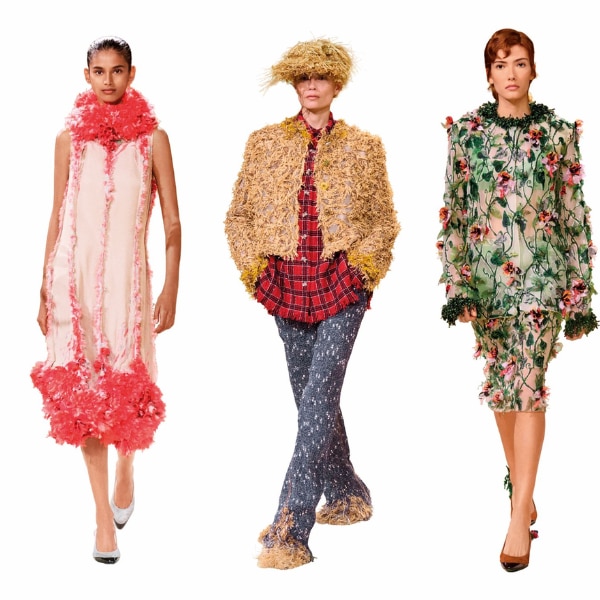
If fantasy became a tool to reflect on the unknown horrors of the future for Roseberry, for Matthieu Blazy at Chanel it was a lens to filter the joys and travails of womanhood. Unbothered by the fussiness of previously established House codes, Blazy’s second couture collection, like the ones before, kept probing at something deeper: who truly was Gabrielle “Coco” Chanel as a woman, before anything else? Blazy began his journey with an old book of fairy tales that he found in Mademoiselle’s apartment. A laborious mood board of sprouting beanstalks that Blazy himself planted at his atelier became a recurring motif, as the Grand Palais runway stood populated with Jumanji-inspired giant psychedelic flowers and vines luring viewers into their invading snares.
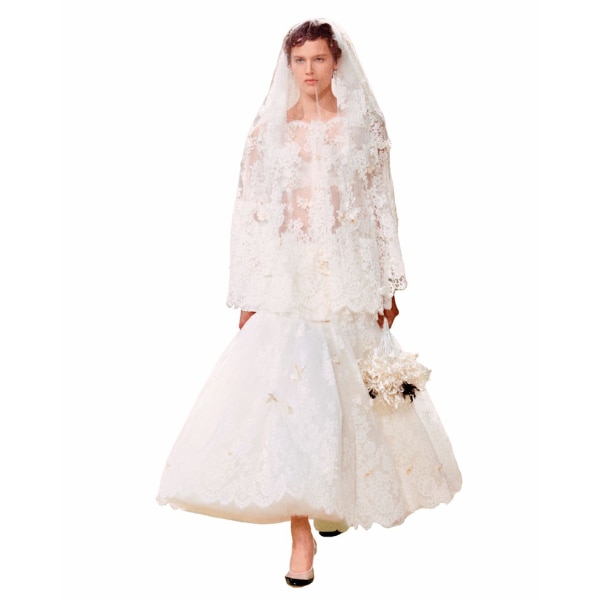
They grew into the opening look, a sheer vest and skirt in rough guipure that brought to mind a magnified tweed weave, paired with Coco’s leather-bound volume of fairy tales that inspired the collection itself. Then came vine embroidery crawling with 3D blossoms, setting the stage for a line-up dense with flora and fauna—a cornerstone of Blazy’s aesthetic. Spidery flowers climbed up a lilac linen shift dress with a pleated skirt while insect-shaped buttons nestled on a glistening black jacket speckled with poison-ivy green. Minauderies, a treat for a select few devoted collectors, cropped up as magpie nests while heels elsewhere emerged with the figure of Jack clutching onto his heaven-reaching vine.
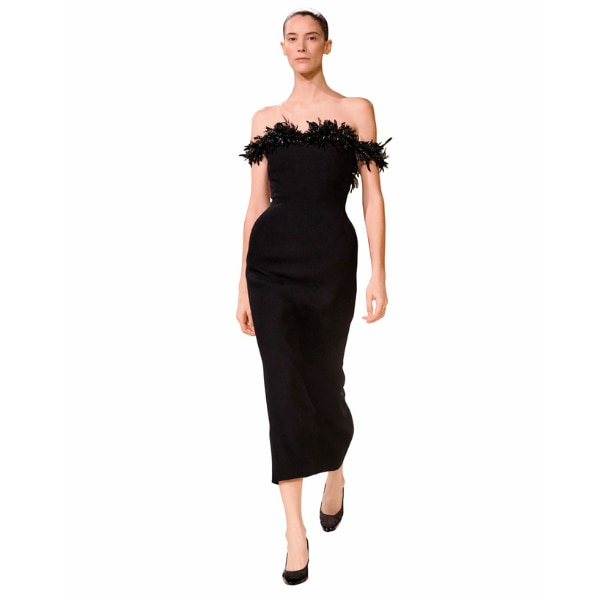
But Blazy’s final masterstroke of whimsical humour came with the decision to end the show not with a traditional Chanel bride, but with a woman in an off shoulder black dress (which also celebrates its centennial anniversary this year), hemmed with feathers. Chanel, as Blazy rightfully pointed out after the show, never got married, and this final look of liberative autonomy was her revenge on the happily-ever-after we ascribe to our women.
CONSTRUCTION AS RESTRAINT
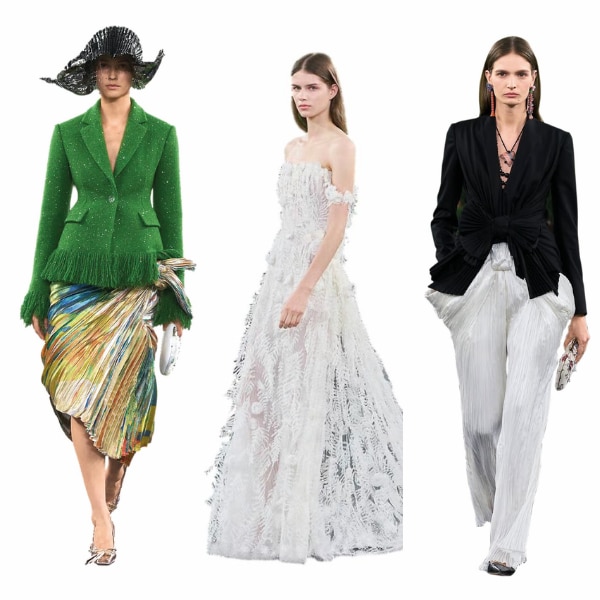
At Dior, after Magdalene Odundo, Jonathan Anderson turned his attention this season to the works of Lynda Benglis, the American artist whose boundary-pushing work across painting, sculpture, and textiles translated on the leafy Musée Rodin runway as wrapped, tied, and metallic fan pleats by Dior’s atelier. One minute, silver pleats were exploding outward from an asymmetric cocktail dress; the next, trouser suits with waisted, frilled black jackets were matched with white bias-cut silk trousers. Among the collection of clutches were purses covered in antique Indian chintz; others, made of porcelain, were decorated with water lilies.
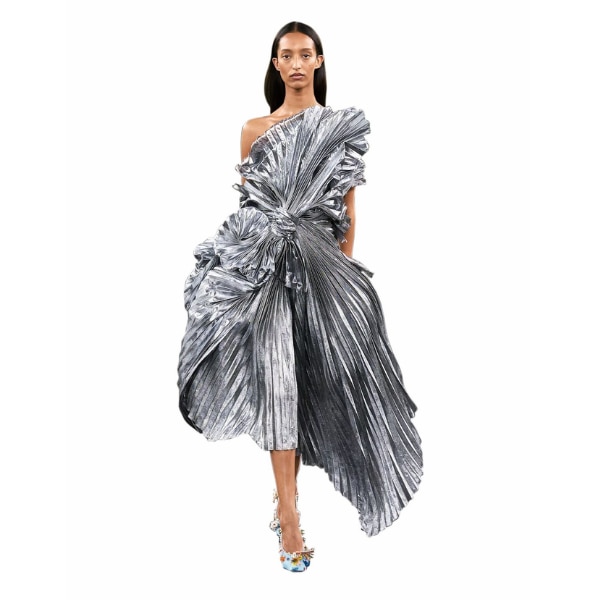
There was some relief in seeing Anderson comfortably settling down within his own vision for the House of Dior, if one remembers the anxiety that marked his first womenswear outing in 2025. It is no mean feat to even attempt to take up stewardship of a Maison as widely scrutinised as Dior. But Anderson’s biggest win of all has been his reinterpretation of the Maison’s iconic Bar Jacket, which the designer seems to have freed from its structured rigidity. Instead, 80 years later, Anderson has found within its construction a way to melt hardness by embracing a f luidity of form, with sensuously draped trompe l’œil shapes that will definitely go down as a significant contribution to the designer’s personal legacy in this hallowed House.
CONSTRUCTION AS EXCESS
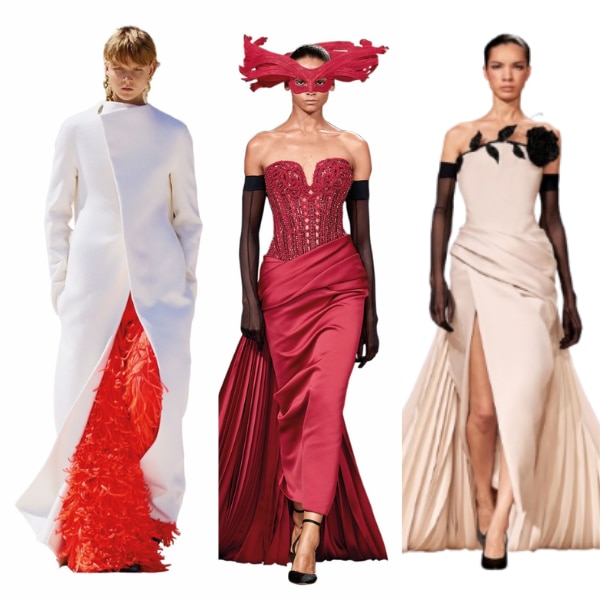
But if Anderson’s Dior was a study in artistic restraint, Pierpaolo Piccioli’s Balenciaga couture debut was a study in calculated excess—and the irreplaceable, tangible engineering of the human hand in an age where the intangible, efficient perfection of AI seems to rule the roost. Since his ready-to-wear womenswear debut in October last year, Piccioli has steadily drawn the Balenciaga audience to the House’s primary codes of exceptional tailoring and craftsmanship, seeded in ideas of opulent romance. There is no doubt about Piccioli’s talents as a couturier; for years he has steadily wowed clients and editors with his ethereal creations at Valentino. At Balenciaga, he continues his penchant for excess, pairing the romance of Cristóbal Balenciaga with the satirical edge of Demna’s erstwhile vision for the House.
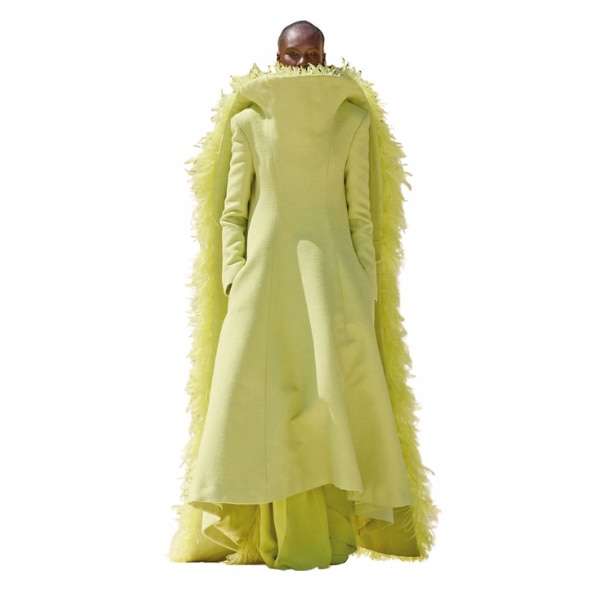
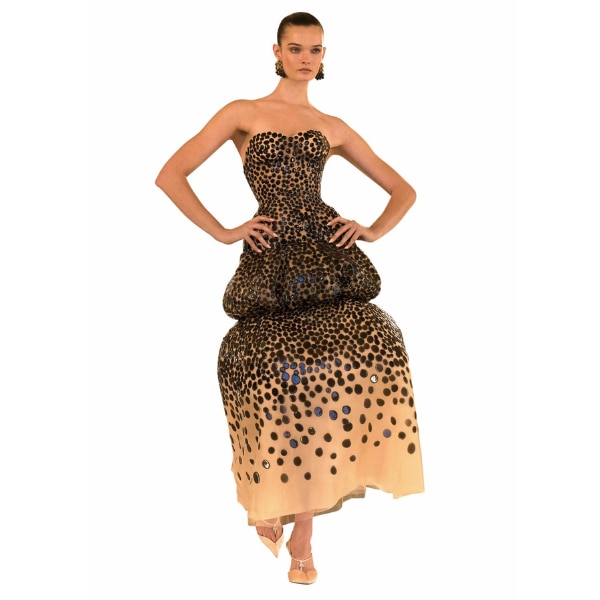
The volumes came in sweeping shades of lemon yellow, the brightness of purples, and the most shocking of reds (barely diminished under the searing hot sun on the Cité Universitaire steps). The extremities within the collection were equally striking: an austere, narrow black evening dress with a trailing satin scarf was followed by a voluminous balloon skirt that trailed behind and enveloped the very form of the model walking in it. Elsewhere, the same skirt was reimagined in a feathered pouffe, paired with the sleekest blazer, slashed and fitted with the cold engineering of a sceptic. Finally, there were column dresses with bodices untouched by corsets and held together instead by meticulous micro-stitching that hugged the wearer’s waist. With colours, excess, and an imagination of form that never sacrifices the wearer’s body at the cost of the fabric, Piccioli’s Balenciaga couture was timely, nostalgic and perhaps just the excuse for joy that clients need to justify the hundreds and thousands of dollars they spend on a single couture order every season.
THE SECOND COMING
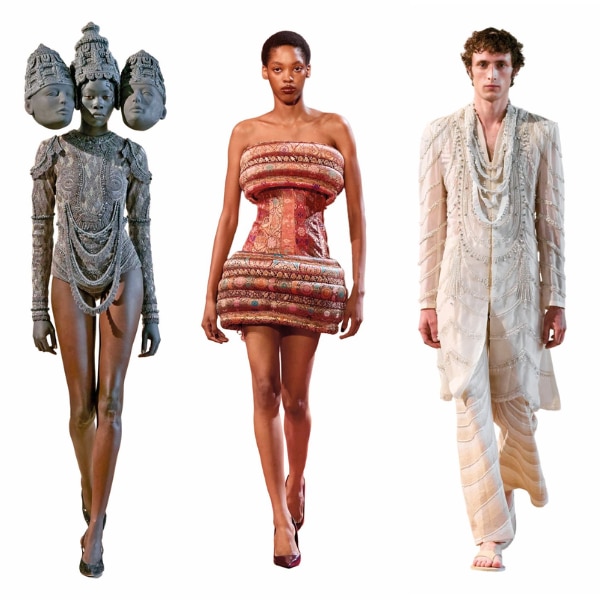
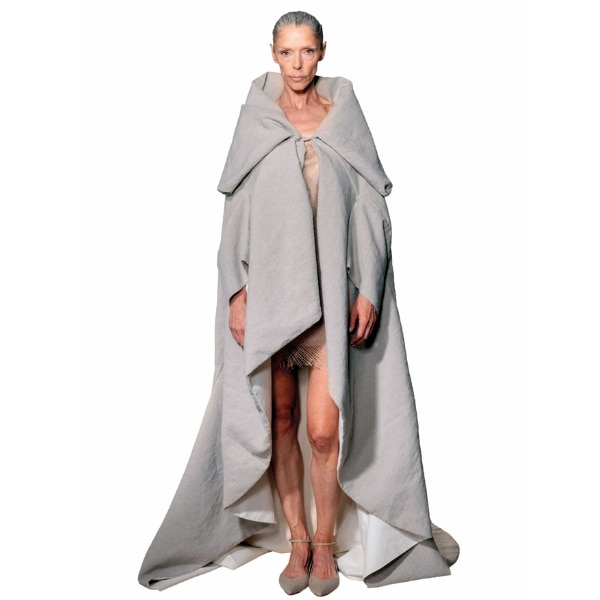
Taking inspiration from their 1999 “Russian Doll” show, Viktor & Rolf returned to their eccentric runway performances this season, reimagining the present as a second coming of the Gilded Age. In an era where a new vanguard of opulence emerges in the form of AI tech billionaires while rising sea levels, wildfires, and recession continue strapping down working-class spending, the designer duo distilled couture and the Gilded Age 2.0 into two principles: decadence and restraint.
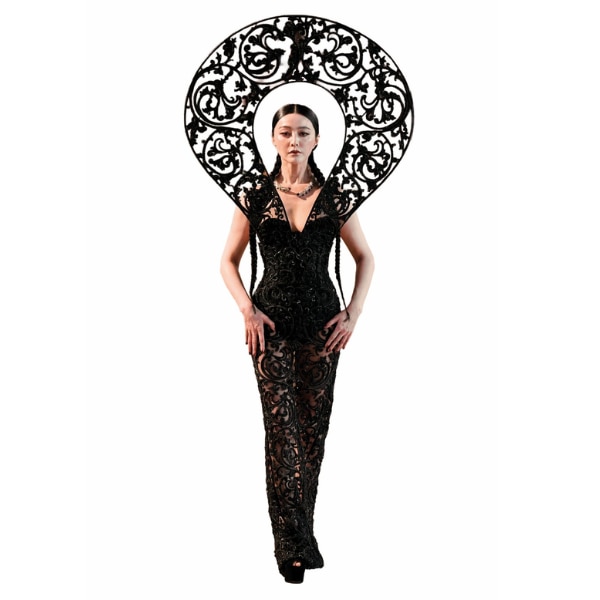
On a rotating stage with mirrored bedrooms, two models—one old and one young—faced the audience as they changed in and out of a series of mirror silhouettes. Those worn by the older model were imagined in humble burlap while the younger model wore gilded embroidery. It was a stark commentary on our times and the almost interchangeable effects achieved by fabrics rooted in similar intentionality. Ultimately, it made a case for couture itself and its impossibility to exist without the almost Apollonian and Dionysian employment of decadence and restraint.
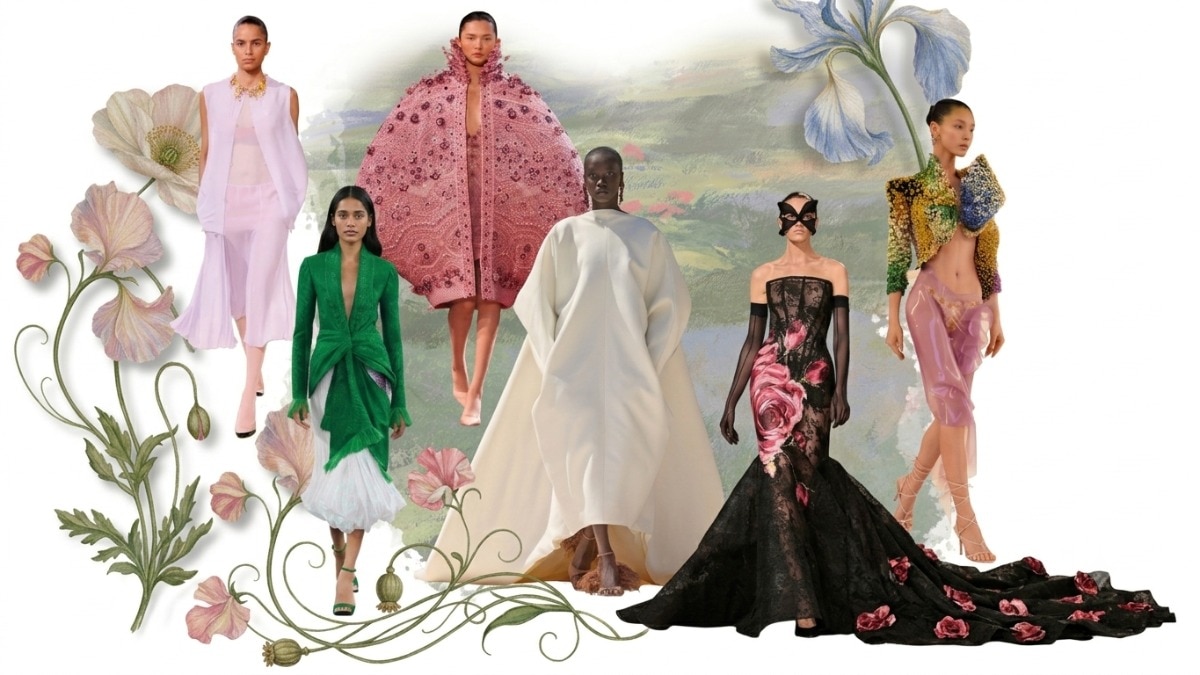
The romance of the Gilded Age and the ’20s also appeared in Elie Saab’s Salvador Dalí-inspired couture. Taking a cue from the phantasmagoria of balls from the first decades of the last century, and the anonymity offered by the comfort of surrealist (albeit mandatory) masks, Saab’s collection continued building on the House’s foundation of red-carpet dressing. In an age where people, like Gilded Age ballgoers, hide comfortably behind the anonymity of social media handles, Saab reimagined evening gowns embroidered with Dalí’s “Meditative Rose” as a leitmotif, exploring the sociological frisson of seeing, not seeing, and being seen.
THE HOME BOYS
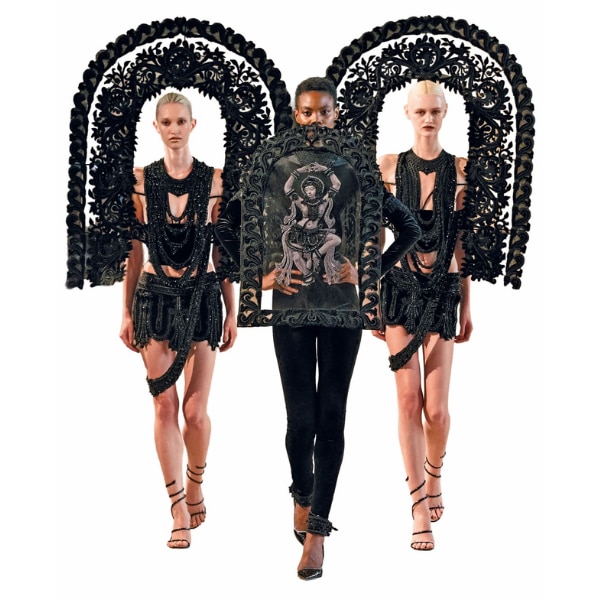
And finally, there was the Indian contingent. For his 14th couture week outing, Rahul Mishra presented Devi. Inspired by the stone sculptures of the Khajuraho temples and the Ajanta and Ellora caves, Mishra presented a collection in which the tactile intricacy of stone carvings was translated into trompe l’œil embroidery. Elaborate necklaces and carvings appeared on flexible jersey fabrics in the form of beaded and sewn embroidery pieces. The craftsmanship on display—from gota patti to zardozi to chikankari—was exceptional.
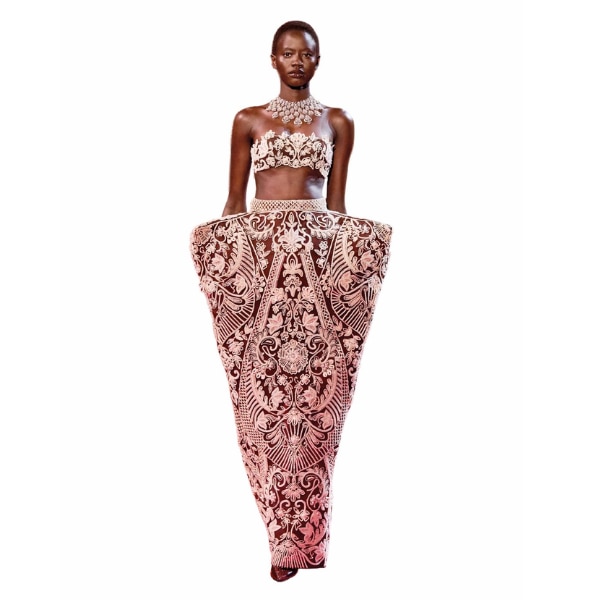
Over the past decade-and-a-half, Mishra, despite being a guest member on the official haute couture calendar, has become a regular fixture on the Paris scene. With each season, he continues to push the boundaries of not just Indian craft but its distillation through a refined design lens. Full-body suits imitating the ancient art of carving divinity into stone surfaces gave way to the designer’s distinct couture embellishments—a real fashion collector’s dream. Despite the dated nature of the core idea itself—one that has repeatedly inspired designers from the subcontinent— Mishra’s collection possessed a freshness of spirit, perspective, and wearability that is rarely expected of South Asian designers.
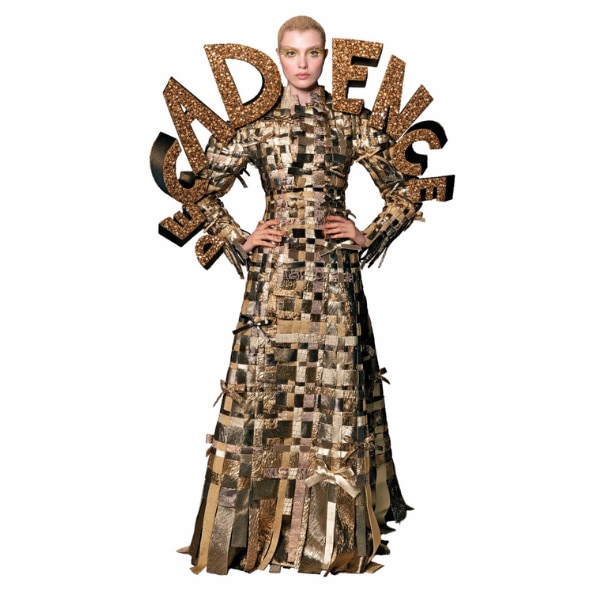
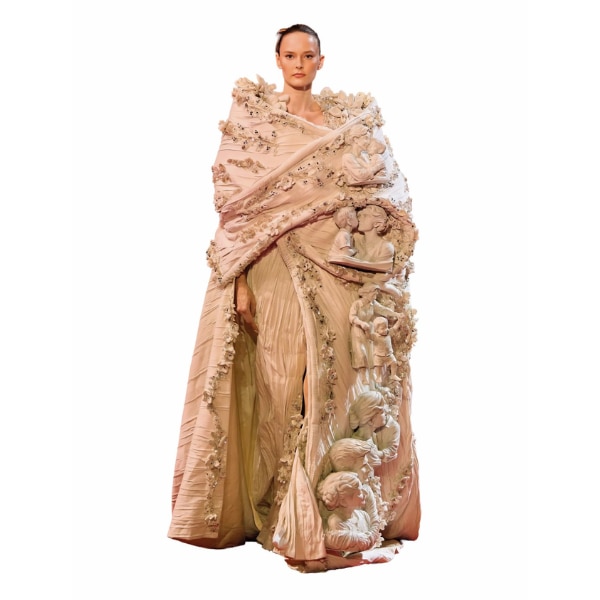
And then, there was Manish Malhotra. If Mishra’s outing was a masterclass in the manipulative powers of design, Malhotra’s first presentation on the couture week calendar was a tour de force in Indian craftsmanship. Titled Maa and dedicated to his own mother, whom he lost a few months before the show, the collection opened with a cocoon coat sculpted into scenes of mother and child. As the show progressed, the rounded, cocoon-like shapes became embellished with what Malhotra called “the knots of love”, including a plunging gold gown adorned with serpentine embroidery. The bangles his mother wore became a bustier gown, rendered in vintage brocade saris and stacked across the bustier.
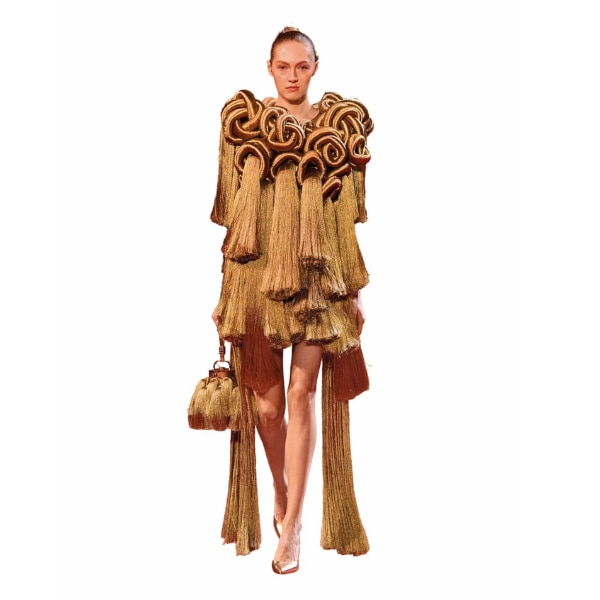
Throughout, the couturier cast a light on heritage Indian crafts, such as vintage salli embroidery, taban sequins, zardozi, resham, crystal work, and incredibly ornate hand embroidery. With dramatic takes on the classic lehenga silhouette, Malhotra’s message about championing Indian craft front and centre could not have been clearer. And now that his name has taken root outside the subcontinent, it will be interesting to watch how Malhotra develops his fashion language and makes it resonate globally.
This article originally appeared in Harper's Bazaar India's August-September 2026 print issue.
Lead image: Artwork by Trushieta Naringrekar
Image credits: Courtesy of the brands and Getty Images
Also read: The future of fashion starts here: Miraggio unveils its A/W ’26 collection
Also read: Is playing it safe on the red carpet the new ‘chic’ trend? The 2026 Emmys might say so
ADVERTISEMENT
Must Read

ADVERTISEMENT