




ADVERTISEMENT
"I have nothing to wear": why your full wardrobe is making you feel less stylish and more stressed
So many of us have more sartorial choices than ever – here's why that could actually be making life more difficult.

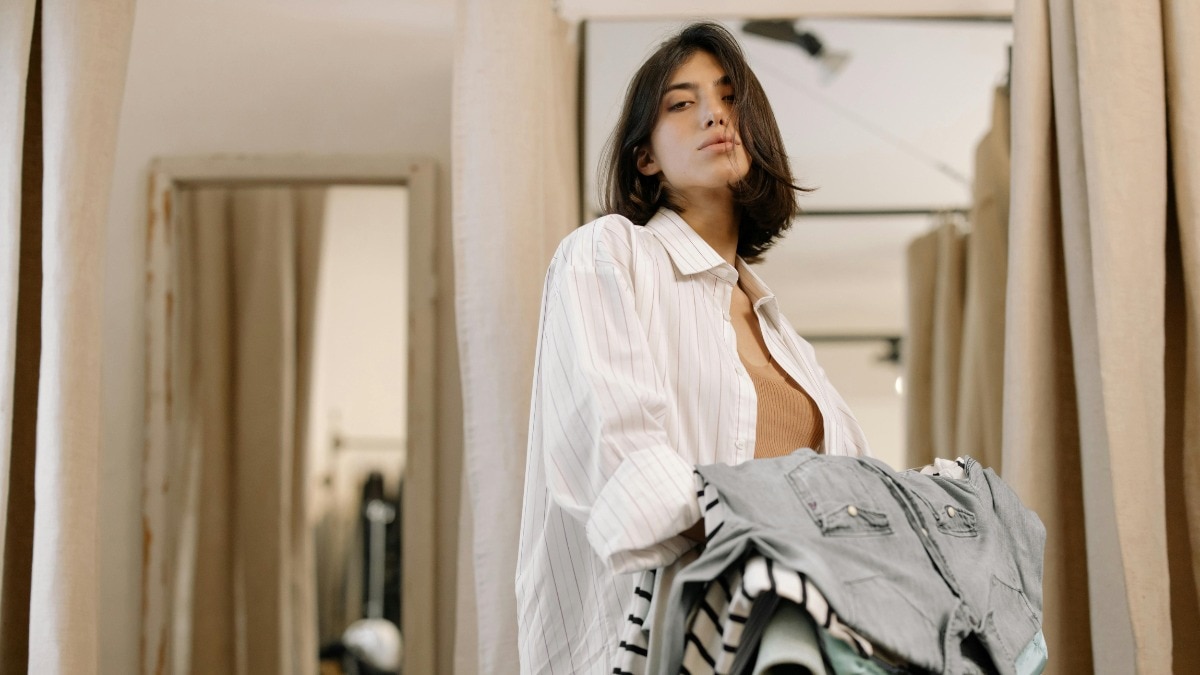
Almost every woman has said some version of it. You stand in front of a wardrobe packed with clothes, rails crowded with hangers, drawers full, and yet the words slip out instinctively: I have nothing to wear.
It is an odd contradiction. Our wardrobes are fuller than at any point in recent history, yet many of us feel less stylish, less certain and more overwhelmed when getting dressed. What was once a creative ritual can now feel somewhat paralysing. The modern wardrobe has become a place of overwhelm.
Clothing has never been more accessible. Online shopping, fast fashion and constant product drops have dramatically expanded what the average wardrobe looks like. What was once a seasonal refresh has turned into a continuous flow of newness, with some high-street retailers releasing more than 500 new designs each week. At the same time, social media has transformed fashion into a constant visual conversation where outfits are seen, shared and evaluated at an unprecedented pace. The result is the pressure to keep evolving our wardrobes in order to keep up.
Yet, as our closets grow, our satisfaction with them often shrinks. Instead of feeling inspired by endless possibilities, many women report feeling overwhelmed.
Angela Morris, a PR consultant and mother of two, recognises the feeling immediately. “Yes, daily,” she says, when asked if she has ever stood in front of a full wardrobe with nothing to wear. “I crave efficiency and speed as a working parent. If something doesn’t make me feel good, it has to go.”
For Morris, the issue is not simply quantity but uncertainty. “I don’t think I fully understand my shape,” she admits. “Confidence plays such a big role. I’ll remember seeing a photo and think my arms looked awful in that top, or remember how uncomfortable a pair of trousers felt. Ideally I would love someone to say, ‘This is your shape, this is what suits you.’”
"Instead of feeling inspired by endless possibilities, many women report feeling overwhelmed"
Psychologists have long studied this paradox of abundance. While we often associate more choice with freedom, research consistently shows that having too many options can produce the opposite effect. Decision fatigue occurs when the brain is forced to process too many possibilities, making even simple decisions feel exhausting.
Fashion stylist Rianna Faye sees this regularly with her clients. “Women often feel like they have nothing to wear because they have too many options and not enough staple pieces,” she explains. “A lot of wardrobes are built around individual outfits rather than versatile pieces that can be layered, repeated and styled in different ways.”

Anna Cascarina, a former fashion editor, stylist and author of The Forever Wardrobe, has observed the same pattern throughout her career. “Women often fill their wardrobes with clothes they love in theory: trend pieces, impulse buys, sale purchases that feel like bargains,” she says. “But when it comes to getting dressed, nothing feels cohesive. The biggest mistake is building a wardrobe in pieces rather than as a system.”
According to Cascarina, an overflowing wardrobe can still feel empty if the pieces do not work together or reflect the life someone actually lives. There's underinvestment in basics, while statement pieces accumulate without a clear purpose. “A wardrobe can be overflowing yet still feel empty if the pieces don’t mix well together or you don’t feel confident when you put them on,” she explains.
Natasha Williams, sales and education manager, recognises this feeling from her own routine. “I often stand in front of my wardrobe feeling like I have nothing to wear,” she says. “It’s partly because I wear the same things the same way, but also because I’m just not excited by anything I have. Getting dressed can feel laborious."
"The biggest mistake is building a wardrobe in pieces rather than as a system"
Part of the issue is how wardrobes are now constructed. Many people build them around trends rather than foundations. Without core staples acting as an anchor, new purchases often exist in isolation. These may feel exciting at the moment of purchase but difficult to integrate into everyday dressing.
Shopping has become tied to short bursts of dopamine. The excitement of spotting a trend online, placing an order and waiting for a parcel can feel rewarding in the moment, but the emotional payoff rarely lasts.
Jessica Powell, a birth and post-natal doula, recognises the pattern. “I’m an impulsive buyer,” she says. “I’ll buy something because I loved it at that moment, then later realise it doesn’t suit me.”
Over time, this creates wardrobes made up of disconnected pieces rather than cohesive collections. Powell recently donated five bags of clothing after realising how overwhelming her wardrobe had become. “I had years of impulse purchase... It made getting dressed stressful rather than enjoyable.”
Social media has added another layer of complexity. Algorithms on TikTok and Instagram constantly introduce new aesthetics, trends and styling formulas. Fashion psychologist Shakaila Forbes-Bell believes this constant visual input can blur the boundaries of personal style. Rather than dressing from a clear sense of identity, people often respond to external cues by recreating outfits they have just seen online.

“When we are exposed to so many different aesthetics, it becomes harder to identify what genuinely resonates with us,” she explains. The result is wardrobes filled with pieces that feel exciting individually but struggle to work together in everyday life.
This cycle also reshapes how we experience shopping. Forbes-Bell has described many purchases as driven by the dopamine rush of acquisition rather than long-term enjoyment. Clothes bought in this way quickly lose their emotional value, even if they once felt exciting.
Ironically, the path back to feeling stylish often lies in doing less. Forbes-Bell notes that what we perceive as effortless style usually comes from consistency rather than constant experimentation. Coherence, not minimalism, is what people interpret as confidence.
Cascarina believes the solution lies in curation rather than accumulation. “Social media floods us with ideas about what to wear, but clarity comes from editing,” she says. Her advice is to identify shapes, colours and fabrics that repeatedly appeal to you and build from there. “Social media should be a tool, not a rulebook.”
When clients feel overwhelmed, she focuses on what she calls “anchor pieces”. These are reliable wardrobe foundations such as a well-cut blazer, great-fitting jeans, wide-leg trousers or the perfect white T-shirt. Once these are established, mixing in trendier or statement pieces becomes far easier.
Faye offers similar guidance. “Strip everything back and start with staple pieces that work across multiple outfits,” she says. The goal is to build what she calls an 'evergreen wardrobe' grounded in reliable silhouettes and colours that complement the wearer.
"The problem is rarely a lack of clothing. It is a lack of connection between what we own and who we are"
In response to the chaos of modern wardrobes, a small cultural shift is emerging. Increasingly, women are searching for clarity rather than novelty. This might mean editing wardrobes down to pieces that truly work, adopting a personal uniform or investing in brands whose collections integrate easily into everyday dressing.
Labels such as Toteme, The Row, Joseph, Sezane and Me+Em have resonated with shoppers seeking pieces that complement an existing wardrobe rather than compete with it. For Powell, this has meant learning to dress for the person she actually is. “Understanding what works for you makes the biggest difference,” she says. “For years I overcompensated by buying more clothes. Now I’m happier with fewer things that actually suit me.”
The “nothing to wear” paradox reveals something fundamental about modern fashion culture. The problem is rarely a lack of clothing. It is a lack of connection between what we own and who we are. When wardrobes become trend archives rather than reflections of identity, getting dressed can feel alien. But when clothes are chosen with intention and personal style emerges through repetition and familiarity, the daily ritual of getting dressed becomes simple.
Perhaps the real solution to the paradox is not more clothes, but a clearer sense of the person wearing them.
This article originally appeared in harpersbazaar.com
All images: Pexels
Also read: Jewellery-first styling is the biggest shift in fashion right now
Also read: South Asian designers just gave Coachella its best-dressed year yet
ADVERTISEMENT
Must Read




ADVERTISEMENT