





ADVERTISEMENT
Elsa Schiaparelli’s most iconic designs come alive at the V&A in London
Sonnet Stanfill, Senior Fashion Curator at the V&A Museum, tells us how a century of shock, wit, and surrealism comes alive in London’s first retrospective dedicated to the life and works of Elsa Schiaparelli.

"It has been a really exciting and energising week,” says the Albert Museum in London. Sporting her characteristic black-rimmed glasses and navy blue blazer, she joins me on a call from her museum office, a few days after the opening of V&A’s landmark exhibition Schiaparelli: Fashion Becomes Art—a first-of-its-kind retrospective in London with over 400 objects celebrating the life and works of couturier and artist Elsa Schiaparelli. “It’s been a very positive reception, with really good reviews, and visitors are appearing to enjoy it. It’s been wonderful,” reveals Stanfill, who last led the charge behind
the curation of V&A’s widely acclaimed exhibition Naomi: In Fashion—dedicated to the life and works of 90s British supermodel Naomi Campbell. Stanfill admits to coming up with the idea behind the exhibition seven years ago.
“Since I mentioned it to the director of the museum, we were both keen on keeping the conversation going and finally scheduled this exhibition three years ago, out of which I have spent the last two-and-a-half bringing it to life,” she adds with a smile. Stanfill first encountered some of the rarest and most important creations of Elsa when she joined the museum as an assistant curator and was tasked with overseeing study appointments within the permanent collection.
“Unsurprisingly, Schiaparelli’s works were some of our most requested garments, and I remember entering Schiap[arelli]’s world for the first time through these designs,” she recalls. In those days, as she tangibly came to encounter the avant-garde artists’ landmark dinner jackets and artistic collaborations—like the foundational shoe hat she created in collaboration with surrealist Salvador Dalí—she recalls a sense of “surprise and wonder” coursing through her veins. “The clothes were so spectacular and beautifully constructed. But I was also struck by the humour of it all— the unusual buttons from harlequins and acrobats to galloping horses and dangling carrots, the surprising and witty embroidery embellishments.”
This wondrous sense of surprise runs as a fil rouge throughout the museum’s underground Sainsbury Gallery, where the exhibition takes place. Inviting viewers into its carefully designed world through an immersive video installation, the exhibition opens with a silent dialogue between two pieces: Elsa Schiaparelli’s 1938 padded Skeleton dress from the Circus collection (the only known surviving version of the dress from the original collection, and a favourite of Stanfill’s) and Daniel Roseberry’s 2021 rhinestone-encrusted, lung-shaped brass necklace from the Matador collection: each reflecting the Maison’s two creative director’s ongoing preoccupation with ideas of fragmentation, anatomy, and death. It’s a temporal dialogue that attempts to give words to a creative exchange between artists born across centuries—a responsibility that was infallible to Stanfill and her team.
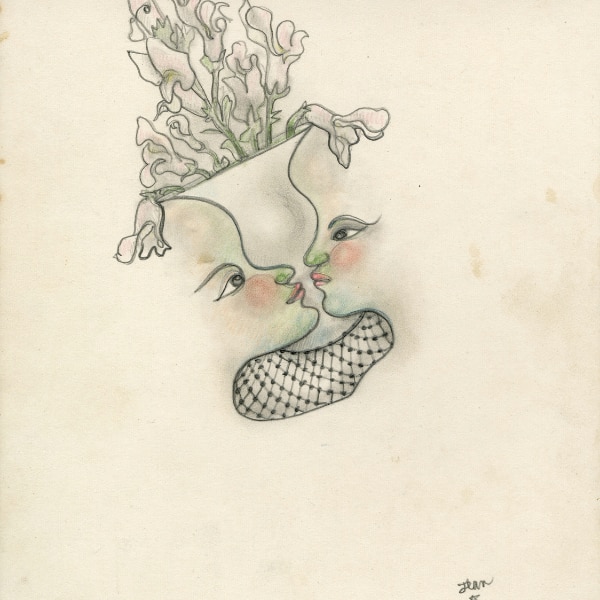
“In this exhibition,” Stanfill explains, “we have attempted to approach Elsa’s work through the lens of not just fashion but also art, photography, and the performing arts. Roseberry, who was appointed creative director of the Maison in 2019, was also equally important to us because his works have created a massive clientele and following for the House today. We wanted to create alternative moments like this between Daniel and Elsa throughout the exhibition.”
However, curating a retrospective of this nature that spans nearly a century does not come without its own set of challenges. Despite searching for years, Stanfill could not source any surviving ski suits by Schiaparelli, a garment by Elsa that she had only seen in sketches and photographs. “Elsa started as a sportswear designer, and made extremely stylish suits for skiing, which she loved as a sport herself,” Stanfill longingly says. “If one comes on the market, I would love for someone to let me know!” But sourcing archival garments from permanent museums and private collections was also coupled with the responsibility of preserving the fragility of these ageing garments.
Not to mention, the stressful anticipation of ensuring one of Roseberry’s two Scorpion Sisters from the Spring-Summer 2026 haute couture collection presented in January also found their way into the exhibition. “But”, she adds, “we were determined to tell a full story that included the clothes but also accessories, bijoux, and perfumes. It was akin to becoming Sherlock Holmes, honing that detective eye to source the pieces that were robust enough to help us tell this story.”
Born in 1890 in Rome, Elsa Schiaparelli launched her fashion career in 1927 by designing a knitwear line featuring trompe l’oeil designs. By the 1930s, she had her own boutique in Place Vendôme and, despite her immigrant, single-mother status, found herself designing over a thousand pieces of sportswear, jackets, trousers, fabrics, and evening dresses for women from the highest rungs of society every year. With over 400 people in her employ, in 1935, she even designed a sari-inspired evening dress in silk based on the wardrobe of Princess Karam of Kapurthala, following her visit to Paris earlier the same year. Australia-born Molly Fink, who in 1915 married Raja Martanda Bhairava Tondaiman from the Indian princely state of Pudukottai, was also a client, along with the likes of Wallis Simpson.
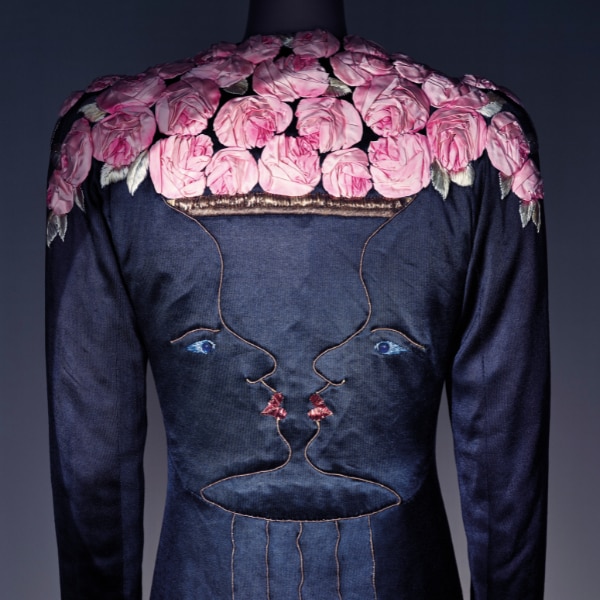
The exhibition unfolds across three distinct movements: the first explores Elsa’s work as a designer and the many House codes she established; the second explores her collaborations and creations with surrealists like Man Ray, Jean Cocteau, and Salvador Dalí; and the third, through original research drawn from the archives of V&A, along with never-before-seen pieces from Elsa’s short-lived London boutique in Grosvenor Square. The exhibition delves into the couturier’s relationship with cinema and photography while underscoring Roseberry’s place in the Maison’s evolving legacy. The density of this complex subject matter is distilled into vastly accessible comprehensibility by the exhibition’s design, which is as immersive as it is intentional.
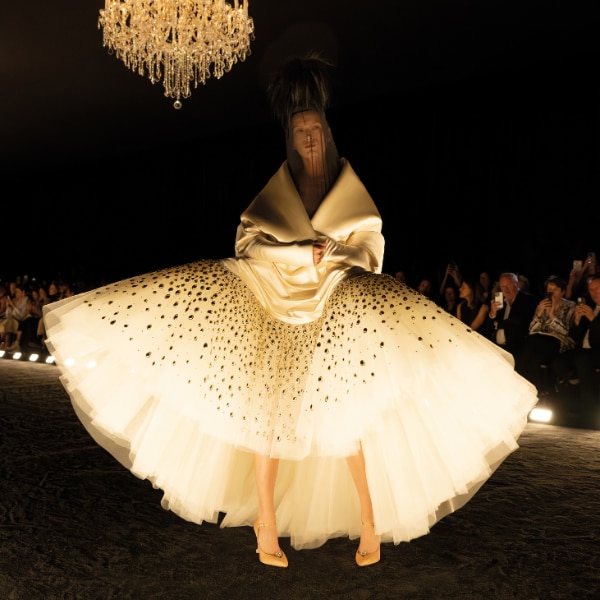
Created by the designer duo behind Nebbia Works, the gallery is divided into fluid sub-sections with occasional moments of rupture deliberately situated to create a sense of déjà vu. “There are instances where you encounter the same object twice, from different angles,” Stanfill explains. “Partly, it’s practical —but it also creates a sense of recognition and return, meant to catch you off guard.” These moments of rupture also parse Roseberry’s couture works, which, through their strategic placements and dialogues with Elsa’s creations, become an unmissable spectral force of their own. Lighting, too, Stanfill explains, plays a crucial role in this experience. “So many of the garments are in black, a notoriously difficult colour to light. We wanted to guide the visitor’s eye with dynamic lighting,” she says, “sometimes focusing on something as small as a button, to make sure one’s attention does not waver.” The result is a shifting, almost cinematic environment, complete with moving projections, shadow play, and subtle surrealist references that mirror the spirit of Elsa herself.
As one makes their way through the exhibition, the looming presence of war and its effect on Elsa’s works becomes an unshakeably recurrent strain of thought. In fact, Elsa herself had famously said, “In difficult times fashion is always outrageous.” Truly, the closer one gets to the collections made during the years of the Second World War, the more one finds Elsa’s designs take a restless, maddening turn. As this exhibition opens to the public at a time when the world finds itself yet again on the cusp of global conflict, the urgent relevance and resonance of Elsa’s works are not lost on Stanfill. “I don’t have any particular insight into Elsa’s works,” Stanfill says with a pause. “Except the closer you get to the war years, the more feverishly creative her designs get. I don’t know if the same will be true for Daniel because back then, the war was in the streets of Paris, and today it is on our televisions. But these are unsettling times, and I hope our visitors will take back the message of how important it is for creativity to thrive in times of strife—be it through Elsa’s or Daniel’s works of art.”
In the end, what emerges is a calibrated, always shy of valorising, truly academic paean to the works of one of haute couture’s most outrageous artists. And an evolving legacy that seriously puts to rest any doubts for those still stupidly clinging to the notion that fashion is not art. Because in all earnestness, it truly is, and rightfully, like other works of art, belongs within the conservationist archives of a museum.
The exhibition will run till November 8, 2026.
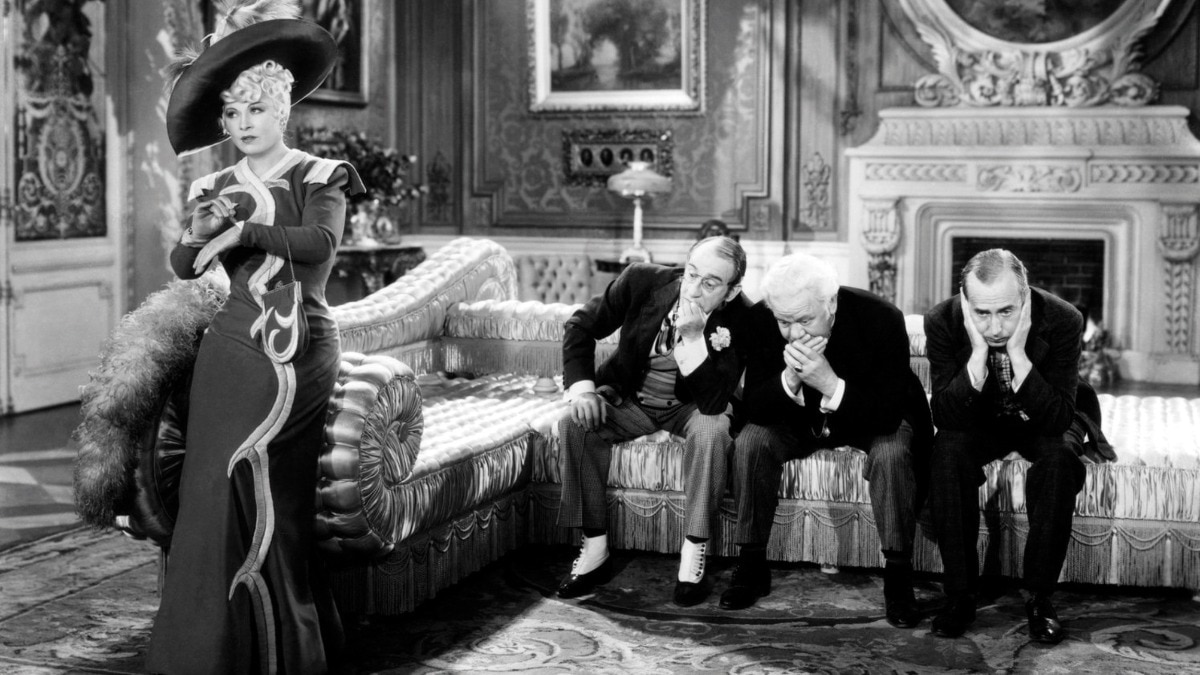
Lead image: Every Day’s A Holiday (1937)
This article first appeared in the April 2026 issue of Harper's Bazaar India
Also read: Cruise 2027 saw Chanel, Dior, Gucci, and Louis Vuitton go all in on drama
Also read: From Travis Scott to Puma x Superkicks, the coolest sneaker drops to know now
ADVERTISEMENT
Must Read



ADVERTISEMENT