




ADVERTISEMENT
Suspended states: Manipuri dancer Surjit Nongmeikapam on dance, conflict, and resistance
In Fountain, the dancer and choreographer turns the suspended body into a meditation on memory, political paralysis, and the fragile possibility of resistance.

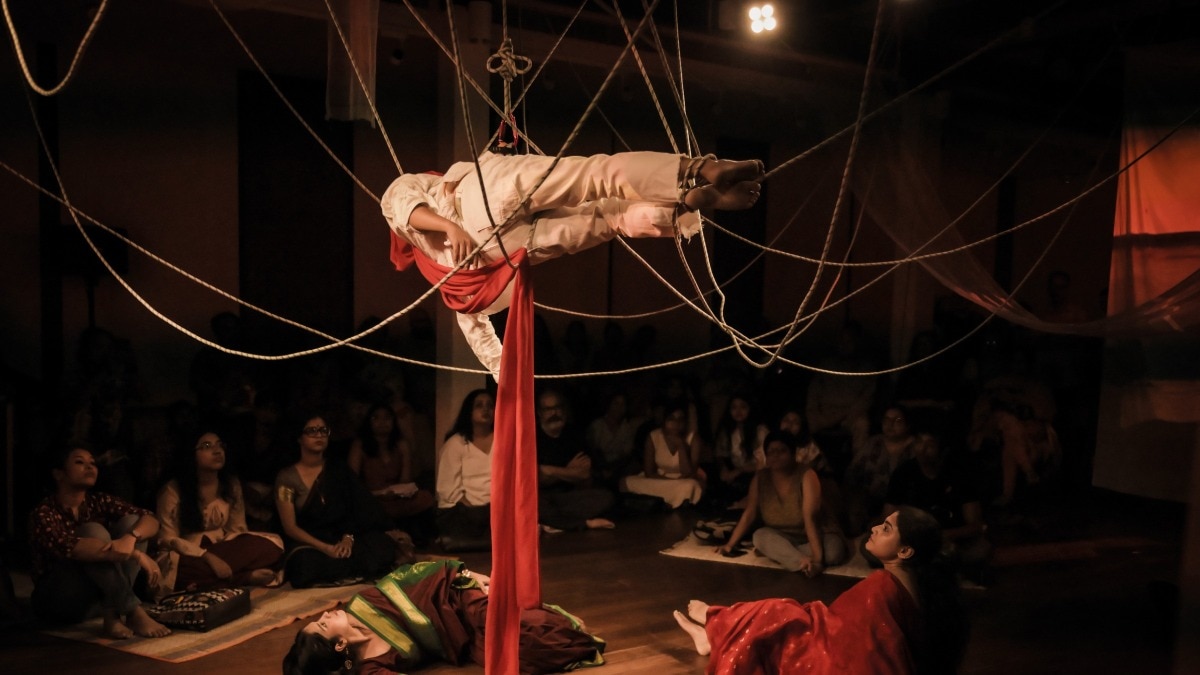
At the beginning of Fountain (2024), we encounter a figure suspended from the ceiling, entangled in a snare of ropes, his limbs poised awkwardly as he is forced to rest mid-air. An eight-legged arthropod will loom over its prey soon, and vanish in a flash. Under crimson theatre lights that flash intermittently, slicing through the air, he wakes and struggles, which further entangles him within a position of stasis in the ropes. A sudden pause—he waits, listening to the voices around him, and asking that we wait with him.
A degree of endurance permeates through most of dancer-choreographer Surjit Nongmeikapam’s work. When the Manipuri artist first brought his show, Meepao, to Kolkata four years ago for Pickle Factory Dance Foundation’s annual performance festival, a single hefty bamboo pole was passed between a group of dancers as they moved around in a cyclical rhythm, their feet tracing repetitive patterns that stirred up memories of those forgotten or left behind. An evocation, sans conjuring. The dancers sweated through it, and so did a puckish organiser who had attempted to pick it up. Effort courses through Nongmeikapam’s body in spasmodic jerks as he reaches for the rope, straining towards movement.
It was listening to anxious bodies not wanting to move that the work was conceived two years ago, against the backdrop of protests in Manipur amid the ongoing ethnic conflict between the Meitei and Kuki-Zo communities. “It was an environment where we didn’t know what was happening, and we believed Manipur would be over,” he said. “The tension made everyone feel like not doing anything. I was asking myself as a performer, am I still dancing, am I still making movement?”
Someone from the audience gets up and holds his head for a few minutes as he shifts from hanging upside down. Two screens blare out the morning news, mapped onto diaphanous screens that encircle the web in which Nongmeikapam is trapped. We now sit before a television set, mirroring one another’s 24- hour news cycle. Nongmeikapam and I spoke a few weeks after the performance, which was part of At the Still Point’s annual festival, the day after Manipuri musician Chongtham Vikram Singh was killed outside his home in South Delhi. Nongmeikapam was back in Manipur preparing for his group show at the Venice Biennale called Hakchang-Polang (Body Vessel), which shapeshifted the body into vessels from Manipur, in this case, the polang, a traditional bamboo basket woven by hand. They then infused these objects with memories embedded within the body of displacement and social fissure.
Nongmeikapam originally conceived Fountain as a durational performance, with his suspended body remaining in a gallery or open space for hours, like a “picture in a room.” According to him, “a fountain is a place where everyone meets.” It was a social experiment to see how people see and react to a body suspended in the air. “They are free to lie down or take a picture, and have the freedom to do whatever they want. It was interesting for me to interact with other bodies, when they felt like supporting me. In that way, the show is never the same anywhere,” he said.
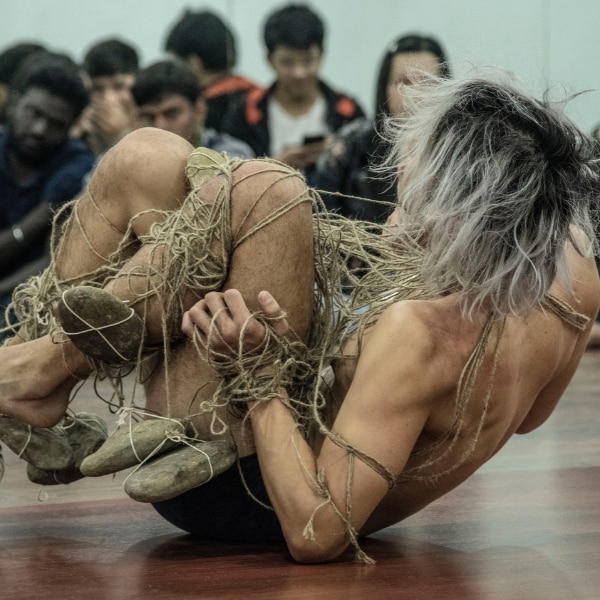
However, how long can one look at a picture? Not for long, Nongmeikapam seems to suggest within the show. Nor does he deem it necessary, deliberately redirecting our gaze towards two screens with collaged narratives from his short performance 2020 film Samnaba (Merge), which was created during the Covid-19 lockdown. A blackened, fire-scorched Longpi pot, traditionally made in Manipur, rotates in the air, held up by ropes, before shattering. Fragments are gathered and bound by rope, which hang around Nongmeikapam’s body—transformed into Longpi itself with a paste of ground serpentine stone used on the pots—like sonorous weights, brushing against each other as they move with him, producing dull staccato clanks; remembrance turning into sonic resistance in the sheer defiance of being held together.
“Ropes which tighten become an alternate site of protest in my work,” added Nongmeikapam, who has been working with the medium for more than a decade now, reflecting on their omnipresence in street protests as a barrier for protection, and the body finding ways to manipulate and move amidst constraint. In a photograph taken by the Brazilian visual artist Regina Walter after she invited adults and children to play and experiment with ropes in a public park during Brazil’s military dictatorship, someone wrapped it around their body completely—while it spread like a spider’s web around a woman’s head, who swayed and moved despite it.
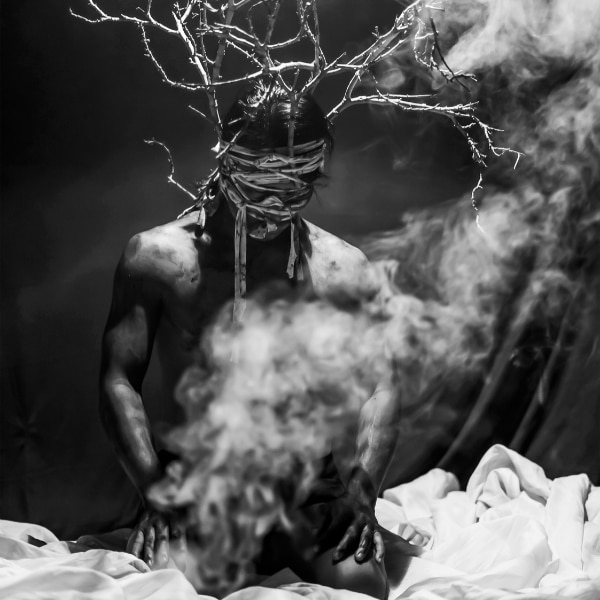
The artiste insists that, although his work is rooted in Manipur, it speaks to more than the state alone. “That’s why I covered my face with a red cloth,” he said. The curator of At the Still Point, Paramita Saha mentioned it was thinking of the work during the SIR conflict before the West Bengal elections that made her programme the work. “It could be anybody suffering amidst what is happening around the world today,” he elaborates, “However, the personal enters as I bring with me my memories through these images, about issues I’ve been speaking about in my work for a while. I carry them with me like an archive, which I open and unbox with those around me at that moment.”
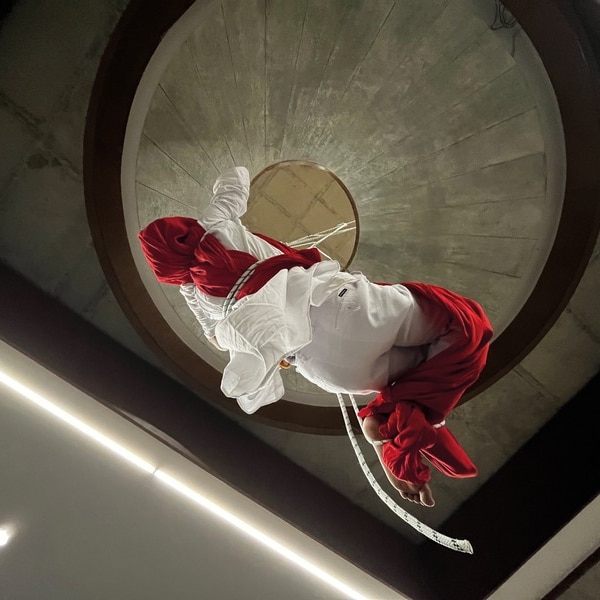
These moments play on the dual screen through flashes of a video he had taken of his late grandmother singing or the controlled, abstracted Thang-ta movements of performers in his PECDA (Prakriti Excellence in Contemporary Dance Awards) award-winning show Nerves, where they stand amidst a wasteland of newspaper reports on Manipur with bamboo sticks instead of the Thang-ta sword. The bamboo is elegant yet incredibly strong, Nongmeikapam reflected last year. The way the plant sways yet remains unbroken in a storm informs his practice, allowing him to find what he calls “strength in softness” through fluid, grounded movements.
Courtesy: Frank Sperling and Rana Ghosh
Urged by his parents to follow his interest in performance, he moved to Bengaluru to train at the Natya Institute of Kathak and Choreography under Indian classical dancer Maya Rao. It was there that his doubts about fitting himself into a classical movement vocabulary began. It stayed with Nongmeikapam as he returned to Manipur to train in the sharp martial art gestures of Thang-ta under stalwarts like Gurumayum Gourakishor Sharma and M Ibomcha Singh, alongside immersing himself in the language of resilience in the theatre being produced at Kalakshetra Manipur under Heisnam Kanhailal.
It was working with contemporary dancers that he found the freedom in a newfound language of physicality. It was what he desired. He started looking at the body as an instrument for communication while training in dance therapy in Kolkata and working with people who had been displaced and children growing up in conflict zones. They did not share the same language as him, making him think of movement as a means to communicate. “That’s when I realised how movement can tell a story from Manipur,” he said, and began developing a language of dance which he calls ‘yangshak’ or the art of practice, where movement is as much discipline as it is research, grappling with the unfinished.
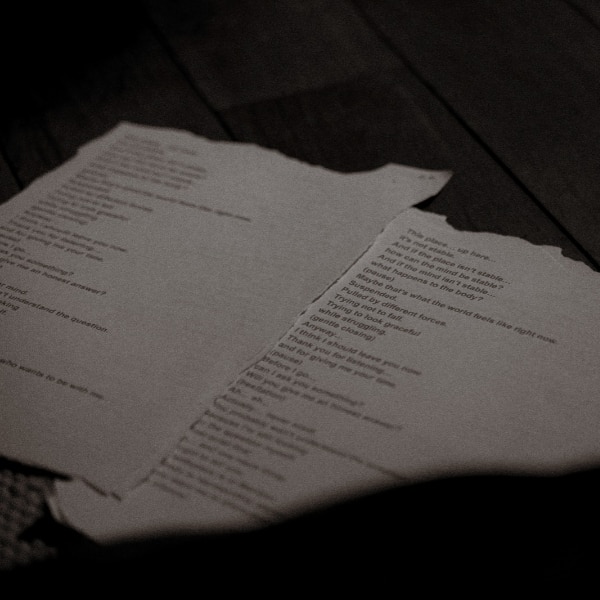
Nongmeikapam leaves us with provocations scattered on sheets in the air, against the familiar sounds of the television going off. Instead, he tells us that he is trying to look graceful as he struggles not to fall. A question emerges in the projected text as he asks whether we would give him an honest answer. A pause, before he realises that he is still searching for the question himself. “(Soft apology),” he adds, text transcribing the gesture, “(slow and reflective).”
Lead image: Surjit Nongmeikapam in a moment of suspension over the bodies of his audience performing Fountain at At the Still Point Act II. Courtesy: Rana Banerjee
This article originally appeared in Harper's Bazaar India's November 2026 print issue.
Also read: Geetanjali Shree on writing, translation, and the changing face of Delhi
Also read: The art of fashion image-making with James Lalthanzuala and Raunak Singh Rana
ADVERTISEMENT
Must Read

ADVERTISEMENT