




ADVERTISEMENT
Is birth the end of our truth? An artist duo explores pregnancy, identity, and creation
Artists Doyel Joshi and Neil Ghose Balser explore the strange, blood-red feelings of pregnancy and creation in a new series of portraits and artworks.

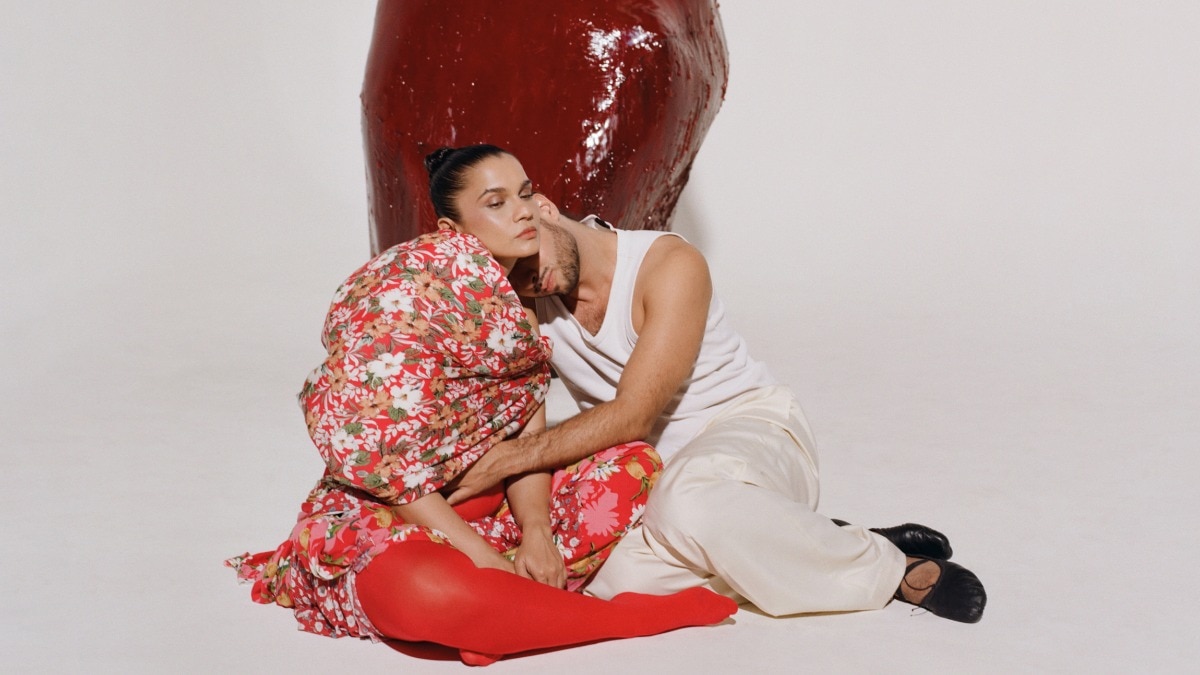
What does it feel like when your life changes in a way you can’t quite explain yet? For artists Doyel Joshi and Neil Ghose Balser, the change is something deep and sticky, almost blood red, a feeling that seems to move through the body—the heart, the limbs, the stomach, the womb—all at once.
When we speak, the artists behind the interdisciplinary practice How Are You Feeling Studio are together on speakerphone. The studio itself grew out of their wedding ceremony, staged as an immersive performance with installations, costume and music at Mandawa Castle in Rajasthan among friends and family, a spirit they now carry into their work, transforming ordinary spaces into environments organised around a single feeling. Doyel answers first, Neil follows. They interrupt each other, correct themselves, then circle back. They are still, in a way, processing what they are about to share: they’re pregnant.
“Yes,” Doyel says, laughing at the strange weight of saying the word out loud. The reaction is not quite the uncomplicated excitement that usually accompanies pregnancy announcements. At one point she asks: “Is giving birth fu***** up our truth?”
Neil answers her almost immediately. “The process of falling in love, making a child, making art, it’s involuntary,” he says. “But it also comes with confusion, with doubt, with the disruption of the self you thought you were.” For the artists, choosing to have a child now feels like an expansion into a new self. “Responding to your biology, choosing to get pregnant in a world where it isn’t strictly necessary, expands our truth.”
The same expansion appears in Self-Portrait, the artists’ cover artwork for this issue, starring Ananya Panday. In the image, two film cranes face each other like figures: one dressed as a man, the other as a woman, the female form visibly pregnant. Their machine bodies, covered in soft fabric, suggest an unexpected intimacy, but also a negotiation of the fragile space that opens between two people when another life begins to appear.
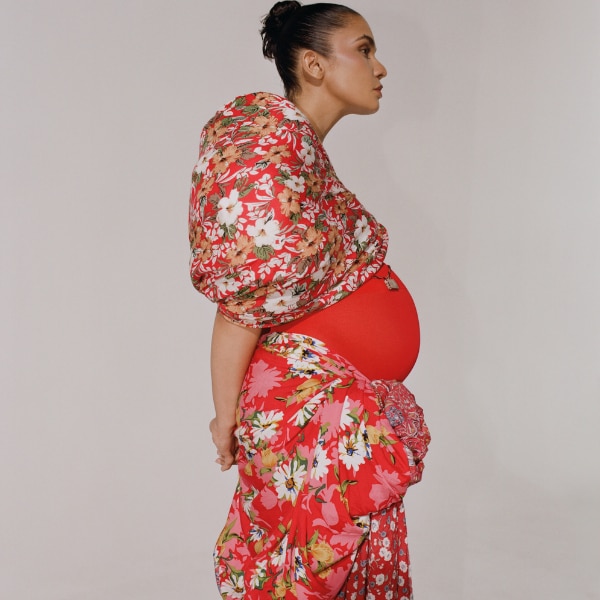
The idea continues in a series of portraits featuring the artists. Shot on film with photographer Rid Burman, the images observe a relationship in transition. “We resisted being photographed initially,” Doyel confesses. “Our pregnancy felt too private to expose. But at the same time, as artists, there’s this obsessive need in us to unthread things, dissect them, expose them outwardly.” Now she describes the experience differently. “It’s very physical,” she says. “I just feel kicks, movements, and truths inside me. And I wanted to find a way to express that.”
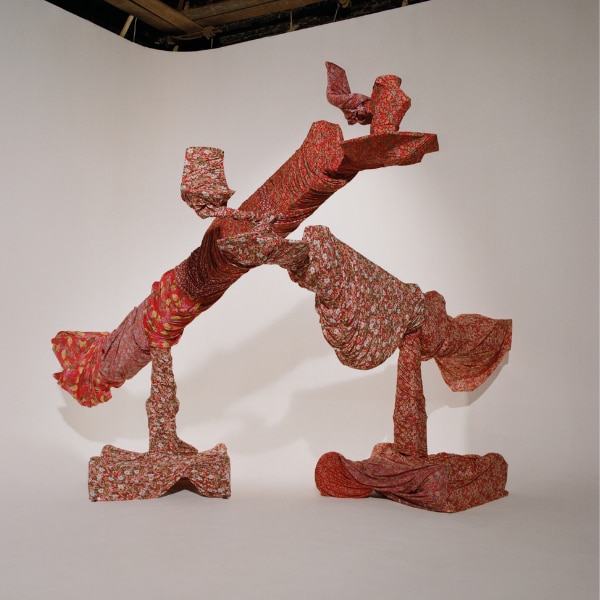
In the photographs, Doyel appears standing or in a birthing squat. Her gaze is steady and alert, directed both inward and outward. Her body is wrapped in the same fabric as the cover artwork, bought from a modest wedding-cloth shop, the kind of bright, synthetic textile that forms the backdrop of countless middle-class wedding portraits across India, including their own. The effect is quietly sculptural. “I feel powerful,” she says. “Like I can walk through fire.” For once, she adds, she doesn’t feel the need to perform masculinity in order to prove strength. “I can simply be in my body. And right now it feels monumental.”
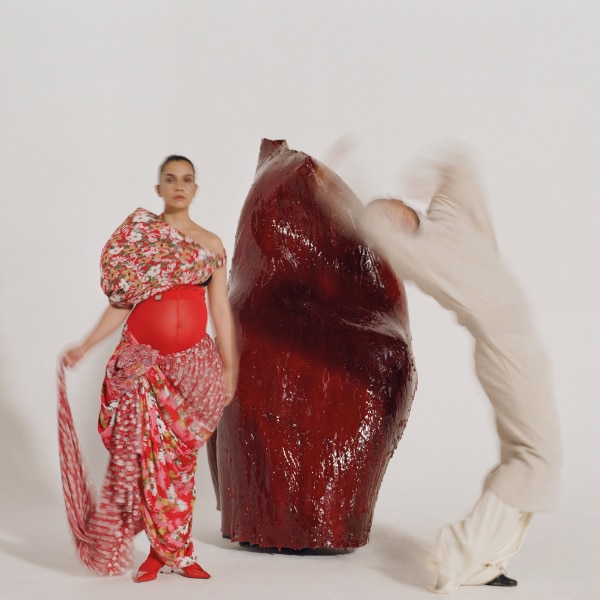
Neil’s transformation takes another form. “There is awareness,” he says. “Nervousness. Uselessness. Powerlessness. The unknown.” He pauses. “It’s like the moment before you faint.” Then he adds something that surprises even himself. “But the man’s body changes too.” The shift, he says, is subtle but constant. Instincts sharpen. Protective impulses emerge. “It’s like everything is happening to your partner,” he explains, “but your senses become heightened, constantly asking: what can I do?” At times, he admits, the role can feel strangely isolating. “I feel like a bee around honey,” he says, “hovering around the experience.” Recently he has taken up Gaga, a movement language, his way of returning to the body, and preparing for what lies ahead. In one of the photographs, Neil seems to enact the metaphor, circling Doyel, attentive and restless.
Between them in the studio sits another object that has emerged from this period: a large sculptural work made from metal coated with gond, a natural edible gum widely used in North Indian sweets and traditional medicine. The work was made in Jaipur and appeared as a centrepiece of the group exhibition, Tradition & Transformation, at Jaipur Centre for Art in May 2025.
Working with the material required time and proximity. The artists spent weeks rubbing the sticky substance into the sculpture’s surface, staining it with deep red pigment. “Gond is sensual,” they say. “Working with it together forced us out of our heads and into our bodies. At some point we realised it was also making us want to have a child.” Historically, gond has also functioned as a binding material in miniature painting and architecture, an invisible adhesive holding surfaces together. “It’s funny,” Doyel says. “Gond was the first thing every doctor told me to eat after I got pregnant.”
Why humans feel compelled to create, whether art or life, remains difficult to explain. “The compulsion of doing it,” Doyel says finally. “The same compulsion that makes us create.” Both carry the same mixture: awe, terror, joy, and bewilderment. “It makes you want to throw up,” she says, laughing. “But it’s also beautiful.”
These portraits hold the uneasy beauty of change. Two people on the threshold of parenthood, and a thousand feelings briefly held inside the frame before life moves forward again.
Photographs by Rid Burman
Styling by Anchal Notani
This article first appeared in Bazaar India's March 2026 print edition.
Also read: What is the “first in my bloodline” trend taking over the internet?
Also read: We may have traded personality for paperwork
ADVERTISEMENT
Must Read


ADVERTISEMENT