




ADVERTISEMENT
“I love to paint and I love paint”: At 85, the abstract artist Ann Purcell refuses to be bored
A show at Berry Campbell in New York gathers some of the octogenarian painter’s early works.

Ann Purcell first wanted to paint after reading W. Somerset Maugham’s novel The Moon and Sixpence. The book, which draws inspiration from the life of Paul Gauguin, details how Vincent van Gogh learned to make art by copying masterworks. On a rainy day, Purcell thought to do the same, so she dropped by her neighbourhood drugstore to pick up her first painting supplies. She began by copying Pablo Picasso’s melancholic clown portrait, Pierrot (1918). “I was just immediately hooked from that moment on, and I just started painting on my own constantly,” Purcell says on a recent phone call. “That was the trigger.”
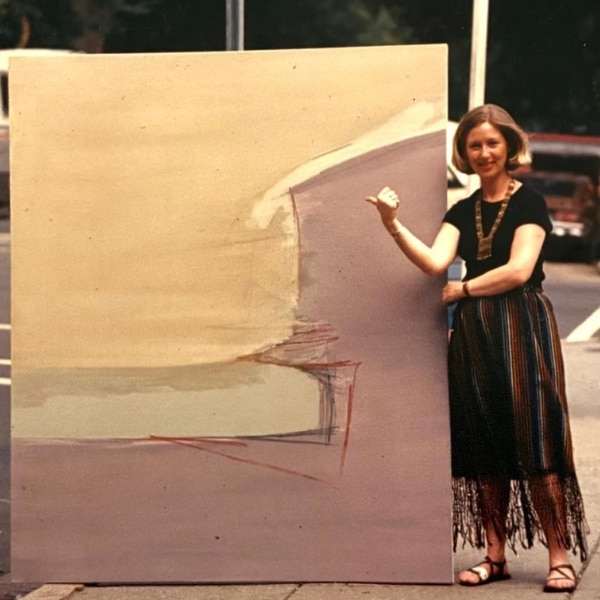
Purcell, now 85, is still hooked. The New York–based artist paints nearly every day, as she has done for five decades. She is known for large-scale, gestural abstract paintings featuring clashing colours and stochastic, or random, patterns. Legendary art critic Benjamin Forgey described her work as “light-filled paintings” and “a delightful, sensual explosion” in the 1970s, a pivotal decade for the artist. At the time, however, many of her paintings never reached the gallery, as she “wasn’t intending them to be shown” because she was “too busy working and trying to survive.” Some 50 years later, just blocks from her first New York studio, Purcell’s new show at Berry Campbell features paintings from 1975 and 1979. “The Seventies” is the first exhibition to revisit the period immediately after she left her hometown, Washington, D.C., to pursue painting in New York.
Ann Purcell with one of her large-scale paintings
Before painting fully took over her attention, Purcell pursued a political career. During the day, she worked as a legislative assistant in the Senate, at a time when there were few women in those positions; at night, she attended George Washington University. Following the advice of a guidance counsellor, she finally decided to major in painting, enrolling in a summer class with American colour field painter Gene Davis. Despite having a job lined up with documentary filmmaker Charles Guggenheim, she felt so inspired by Davis’s class that she decided to focus her attention solely on painting. “I just felt an increasing urge to know what it was like to paint full-time,” she says.
“The one I most blame for putting me on a different road path here is Gene Davis,” Purcell jokes. “I can either thank Gene Davis or blame him because I probably would have had a second home in the Hamptons now if I had stayed in film.”
Purcell was spellbound by an “obsession with paint and colour,” and in the first part of the 1970s, she leaned in. This obsession was charged by an independent study in Mexico from 1969 to 1971 that served as a springboard for her practice and led to her first solo exhibition at Villa Roma Gallery in San Miguel de Allende. The decade soon offered the artist more definitive affirmation: a solo show organised by legendary art curator Jane Livingston at the Corcoran Gallery of Art in Washington, D.C., in 1976. “I got shot outwards, backward, like a rocket, not intentionally, but life sometimes throws you some strange balls, and you’ve got to catch them,” Purcell says. The next year, the artist dove headfirst into the New York art world, residing in a “dangerous studio loft” in Chelsea.
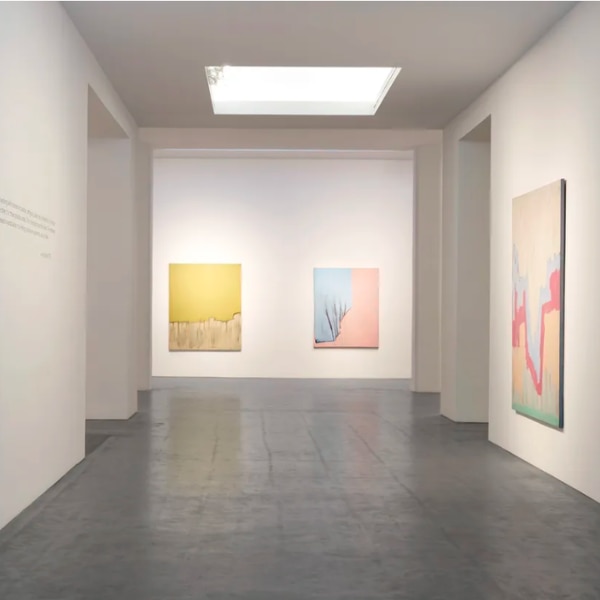
Installation view of Ann Purcell’s “The Seventies” at the Berry Campbell gallery in New York
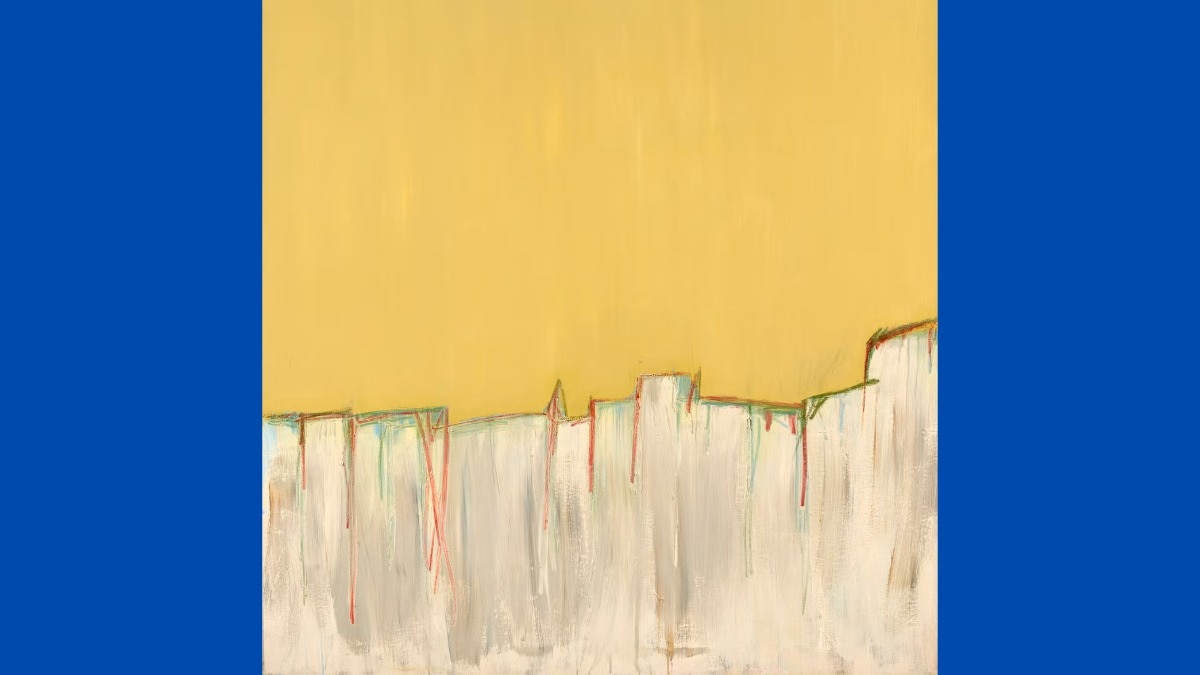
Experimentation has defined Purcell’s lifetime of painting, starting in that Chelsea loft. “That was a period when I was very much exploring colour and space form,” she recalls. Her paintings from the late ’70s are characterised by luminous colour fields broken by clawing streaks of paint, some resembling a bright horizon shattered by frenetic, gestural horizon lines. Space Paling (1977), part of the Berry Campbell show, features a field of Tuscan-sun yellow broken by a jagged red-and-green horizon line. These disruptive colours drip onto a messy grey-and-beige canvas. It’s a simple yet deliberate use of colour that pops up throughout her career. Purcell’s later work—her better-known “Caravan” or “Kali Poem” series—is characterised by these same energetic brushstrokes atop vast colour fields. In the works in “The Seventies,” Purcell is displaying the first step of her career, the foundation of her control of space and colour, which allowed her to experiment later on. You can see this movement toward rough, often erratic brushstrokes in Javelin (1978), where a triad of colours—beige, light green, and midnight blue—clashes with one sharp orange streak running vertically.
Only a few years later, Purcell started what is perhaps her most famous series, the “Caravan” paintings. She travelled to Provincetown, Massachusetts, with E.A. Carmean Jr., the former chief curator of the National Gallery of Art, who introduced her to American abstract expressionist Robert Motherwell in 1982. (They spoke for 45 minutes about paintbrushes at the hardware store.) She spent four summers there, working on the “Caravan” paintings, rich abstract canvases inspired by Henri Matisse’s cutouts and the horizon of the Provincetown harbor. The resulting paintings can be identified by Purcell’s acute attention to space, in which bulkier abstractions sit on sweeping color fields. “When I got to Provincetown, I remember that summer when I was walking [and] overlooking the bay, and I saw the boat suspended in the bay, and it was just such an unusual deep space,” says Purcell. “Provincetown helped me connect to the idea that I was seeking, which was to use this painting process to create deep space.” “The Seventies” now provides context for these paintings, revealing how the technical intricacies embedded in Purcell’s earlier works paved the way for them.
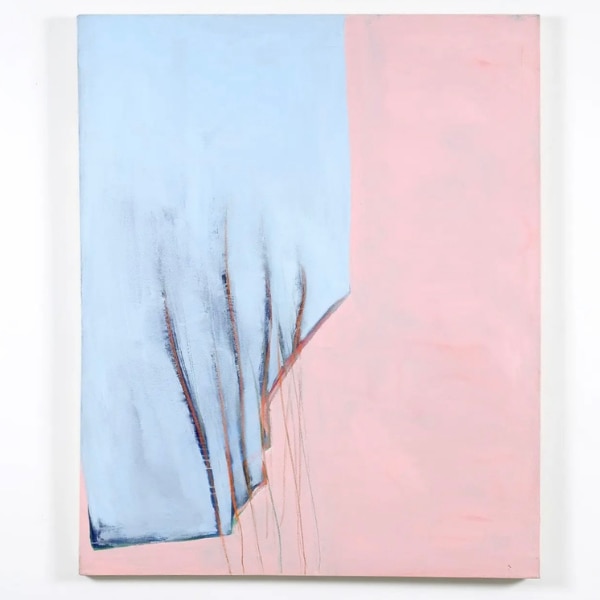
The new show is a revealing look at the underpinnings of Purcell’s process. It transports us back to when she first started painting seriously, driven by an appetite for experimentation and learning. Works like Runaway (1978) or Barclay (1978) might be mistaken for starting points for other paintings, waiting for those bulky forms, but in reality, they give us an inside look at the moment the octogenarian artist found her voice (or at least started to). Over the decades, this curiosity has never wavered. She is still creating new paintings and researching new artists. (For the last decade, she tells me, she’s been focused on Asian art.) And most importantly, she refuses to become stagnant: “I hate to admit it, but a lot of these people over 80 years old—they’re boring,” she jokes. What keeps her motivated today is what has always kept her motivated.
“I wrote that in that first catalogue essay. I remember those words were in there: I love to paint, and I love paint,” Purcell says. “I pursued art history purposely because I just felt like the possibilities were infinite with art history and that I would never be bored for the rest of my life, which is true. There’s always something new around the corner to learn.”
This article is originally from harperbazaar.com in June 2026
Lead image: Berry Campbell
Also read: 'Conscious unbossing' is the workplace trend where ambition no longer means becoming the boss
Also read: India's young artists are having their moment. Here's what's driving it
ADVERTISEMENT
Must Read







ADVERTISEMENT