




ADVERTISEMENT
Tabu on freedom, fame, and choosing her own path
Tabu has never chased relevance, never performed rebellion, and never explained herself. She built a career of extraordinary freedom the only way it can truly be built: by being free. A rare, unguarded conversation with the actor who rewrote the rules before anyone knew the game had changed.

There is a word that has followed Tabu for the better part of three decades. It has appeared in hundreds of profiles, been recycled across publications without question, and lodged itself so firmly in the cultural imagination that even today a caller rings to ask: “So are you in Bombay now?” (The caller assumed that she has moved to Hyderabad). The word is reclusive. Tabu’s reaction to this, when it comes up during our conversation, is not hurt or weariness. It is something closer to bewilderment laced with the very particular irritation of someone who has been misquoted so many times she has almost made peace with it. “Reclusive is a very heavy term,” she says. “It means a person does not come out of their house or their room for days on end. Meanwhile, I’m shooting every day. At the time publications were writing this about me, I was doing five films at one go. So how does that make any sense?”
She admits that she indeed wants to find the person who started this. “Because somebody was definitely gaining something from sending me to Hyderabad.” A pause, then the laugh—the one that is warm and almost infectious. “Sit with a dictionary when you write about someone. And if you’re not comfortable in English, it’s not necessary to write in English at all.”
The irony is that this frank, unhurried, occasionally exasperated woman who will tell you exactly what she thinks about media vocabulary and the laziness of today’s copy-paste journalism is as far from reclusive as a person can be. The actual Tabu is curious and very much present. She is reading Amitav Ghosh’s 'The Glass Palace', gifted to her by Rhea Kapoor, dreaming about Goa, preparing for a Telugu film with Vijay Sethupathi, and excited about the next one with Nagarjuna—his hundredth. She is, as she rightly points out, working!
The labels that have surrounded Tabu over the years—reclusive, elusive, exclusive, mystery maiden, ice maiden—say more about the publications that deployed them than about the woman herself. The Hyderabad story is the one that still gets her. For years, many publications have confidently reported that she had moved back to Hyderabad. “With so much confidence,” she marvels. But behind this irritation is a kind philosophical generosity. “I feel people will give you the label that suits them,” she says. “They had to write something different about me, something they couldn’t write about other actresses. Once somebody wrote it and it became a thing, everybody started following. Let’s make her like this.” She shrugs and adds, “Ultimately, it said more about what people wanted to think about me than who I actually was.”
And who she actually is, is something she has been quite clear about. She has always been the person who found a genuine comfort in her own company, and whose choices have always flowed from that comfort rather than toward any particular image. “It’s not like I decided, ‘I will be by myself’,” she clarifies. “It’s not a decision. It’s a part of your personality. Being by yourself is one thing. But when people say reclusive or exclusive, they’re defining your way of living. And how do they arrive at that conclusion?” She raises a pertinent question with this. “If you’re not at every party, if you’re not doing every film, if you’re not networking everywhere and all over the place, then you’re reclusive? Basically, if you don’t follow the norm, you’re reclusive.
It is, she notes, a standard applied almost exclusively to women. A woman who does not perform constant visibility is mysterious. A woman who turns down roles is difficult. A woman who gives real reasons instead of polite excuses is trouble. “You should not give a real reason for not doing a film,” she says, mimicking the advice she never followed. “Give the excuse of dates and walk away. I didn’t understand that. If I don’t like the script, I don’t like it. And I said so.”
Talking about different standards meant for women, she points out the relentless cultural policing of women’s bodies and faces. “People are more worried about your age than you are yourself. They want to show you the mirror, as though you don’t have one at home,” she laughs. The process of ageing, she argues, is nothing like the sudden revelation the world treats it as. “The person answering that question hasn’t aged overnight. We experience it every single day. It’s not like one day someone wakes up at 20 and next day they turn 45.”
When it comes to beauty, she says what has shifted with time and experience is not the values but the speed and efficiency. The trial-and-error phase—what works, what doesn’t, what colour suits her, what eye make-up works on her—resolves faster now. “In the beginning, you experiment with everything,” she says. “But eventually you know that two and two is four. That whole process becomes faster, more intuitive. And then you’re also open to experimenting with new things.”
To understand Tabu’s career is to understand what it meant to say yes to things the industry was not ready for and to have the instinct to recognise those things as worthy, even when no template existed for them. But she refuses to call it rebellion. “My journey is not an act of rebellion,” she has said before, and she returns to the idea now. “It was simply a reflection of who I am. The roles I chose, the decisions I made—they came from some similar place throughout my life. Some part of me has been completely unchanged.”
What was that unchanged part, I ask. “My need for self-expression, I think—that was the fundamental driving force. And then wanting to express, experience, and feel the characters I was being offered. The desire to inhabit different people’s skin. And not just different—they were characters that weren’t the norm in the industry.” She pauses and then adds: “That’s what gave me my rush. To be able to do stuff that most people wouldn’t readily do. Not letting go of those chances.”
The characters she is talking about stretch across a filmography that reads, in retrospect, like a sustained argument about who women are allowed to be on screen. In Astitva (2000), a woman with a life beyond her marriage. In Maqbool (2003), Lady Macbeth transplanted into Bombay—all lust, ambition, and unapologetic hunger for power. In Cheeni Kum (2007), a woman who wants what she wants, on her own terms. In Haider (2014), a moral complexity that defies easy sympathy or condemnation. “We did not want to see that kind of darkness in a Hindi film heroine,” she says.
“We did not want to see that kind of unapologetic sexuality, or lust, or hunger for power in the heroine. It was blasphemy.” She says the word with a certain relish. “So yeah. That’s what excited me.” But she also gives the credit where it’s due. These films happened because directors imagined women this way and trusted her with the imagining. “If Mahesh [Bhatt] hadn’t come to me with Astitva, it wouldn’t exist,” she says. “I give credit to Mahesh for writing a woman who’s like that. And Vishal [Bhardwaj], for giving me Lady Macbeth—where you can’t even think of a conventional heroine going there. Any film, it’s teamwork.
And what has changed since? “All of this has become mainstream now,” she observes. “Now everyone wants to do edgy, dark characters. For me, it’s nothing new. I was part of the films that actually rewrote how we saw the Hindi cinema heroine.”
OTT has accelerated everything. The shock threshold has shifted. The audience, she notes, has become sophisticated to the point of being almost over-prepared. “We have started doing so much pattern recognition,” she says. “People have started to predict what’s going to happen. Making something truly unpredictable is not impossible, but it is difficult.”
Somewhere in the middle of talking about all of this—the labels, the characters, the industry’s long, slow evolution toward the kinds of stories she has been a part of since 2000—the conversation turns to the word everyone in the industry has been saying for the past decade: Relevance.
How does Tabu stay relevant? On the face of it, it is a reasonable question to ask any actor navigating an industry that treats time as an enemy. But when I put it across to Tabu, I get a reaction that suggests the question itself may be the problem. “I didn’t even know about all of this. We have started using all this terminology and now we’re becoming conscious of it. I don’t have any plan that requires me to be relevant. I have no interest in being relevant. Who needs relevance?”
But this disavowal of relevance is not a strategy. For her, it is the logical outcome of a value system in which what you do matters and what people think of what you do matters considerably less. “I need to do what I want to do,” she says. “To enjoy what I’m doing. To do stuff that matters to me. When I say yes to something, I want to say yes to stuff that excites me in some way or the other.”
When I ask her if she would consider OTT, her argument remains the same. “For me, it has to be a new experience. A new kind of character. Something I would say yes to.” And that is how she has thrived in the industry as well. She has built her career on a prior condition—a sense of self so settled that the refusals and acceptances both flow naturally from it. She did not become free by making bold choices. She made bold choices because she was already free. “Freedom existed first—that’s why the no came. Only if you have freedom can you say yes or no.”
When she looks back now, does she see a pattern? “Of course. If you look at anyone’s decisions, their graphs, you will always see a pattern. At that time, I went with what my instincts told me. But I think the fundamental driving force for my decisions was very, very individualistic. To me, that’s the pattern.”
Now, she says, she has arrived at a place where words like relevance, authenticity no longer impress her. “It’s in the being, not in the talking or the doing. ‘Human beings are a work in progress’,” she quotes a line she read somewhere. She calls herself a work in progress too and is just getting started. In an industry where surnames are inherited currencies, Tabu has operated for over three decades on a mononym. No family name doing the quiet work in the background. Just Tabu. If there is a single quality that most defines her, it is curiosity. An appetite for the new that shows no sign of diminishing with age or success. “I’m terribly excited about going to set,” she signs off with an enthusiasm of someone who still genuinely loves the process.
Editor: Rasna Bhasin (@rasnabhasin)
Interview: Malika Halder (@malikahalder)
Photographer: Soujit Das (@soujit.das)
Stylist: Gopalika Virmani (gopalikavirmani)
Cover Design: Mandeep Singh Khokhar (@mandy_khokhar19)
Editorial Coordinator: Shalini Kanojia (@shalinikanojia)
Makeup Artist: Savleen Manchanda (@savleenmanchanda)
Hair Artist: Hiral Bhatia (@bbhiral)
Set Design: Nikita Rao (@nikita_315)
Assistant Stylist: Grace Soni (@grace_soni_)
Line Producer: Salim Memon (@salimlineproducer)
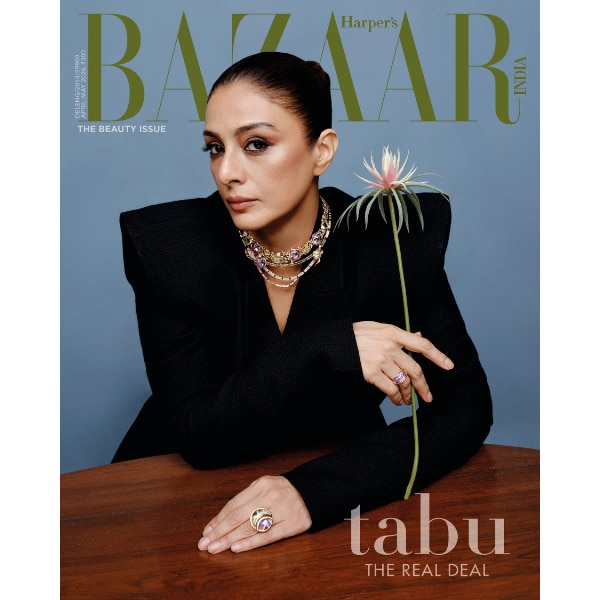
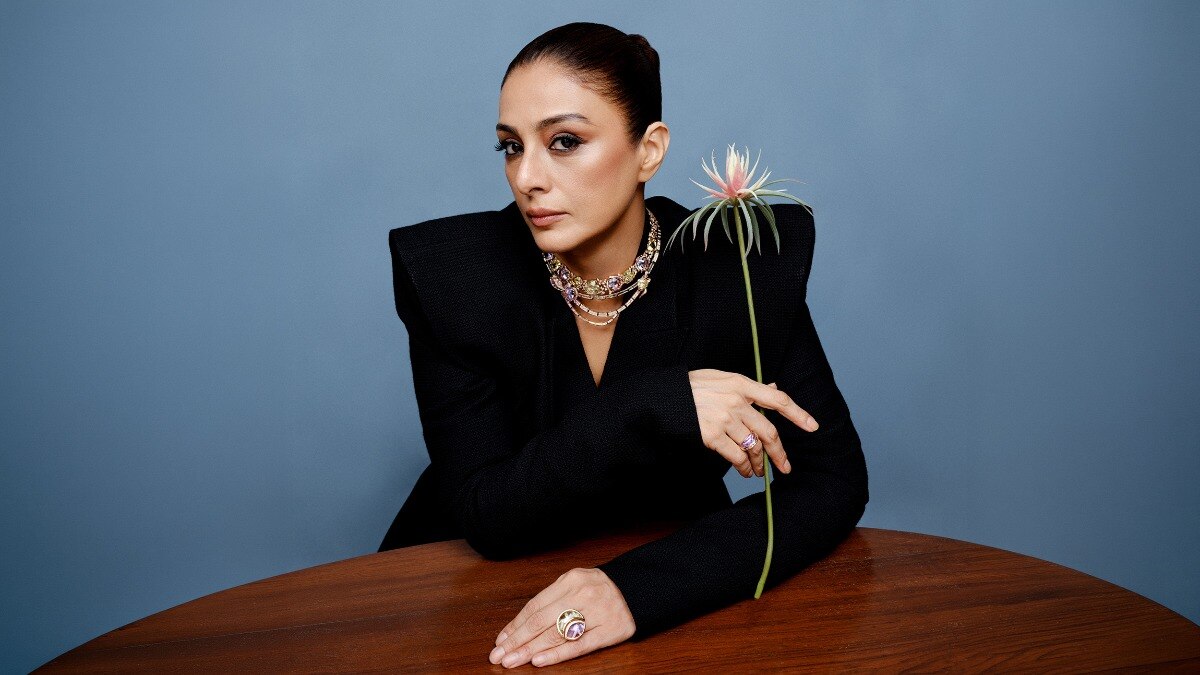
Tabu is wearing a shoulder-structured jacket from the Red Thin Line collection by Rajesh Pratap Singh, paired with the Colour Me Spring necklace, Eternal Knowing necklace, The Eternal Dance ring, and Flower of Life ring — all by Zoya Jewellery.
Also read: Sreeleela on curiosity, craft, and the dualities that define her
Also read: You don’t get to define him, Ahan Shetty does it for himself
ADVERTISEMENT
Must Read





ADVERTISEMENT