




ADVERTISEMENT
Harper’s Bazaar LuXperiences 2026: Why experience is the new currency of luxury today
Rahul Mishra, Pushpa Bector, Richa Singh, and Antonio Ferraioli unpack why modern luxury in India is no longer about ownership, but about experience and participation.

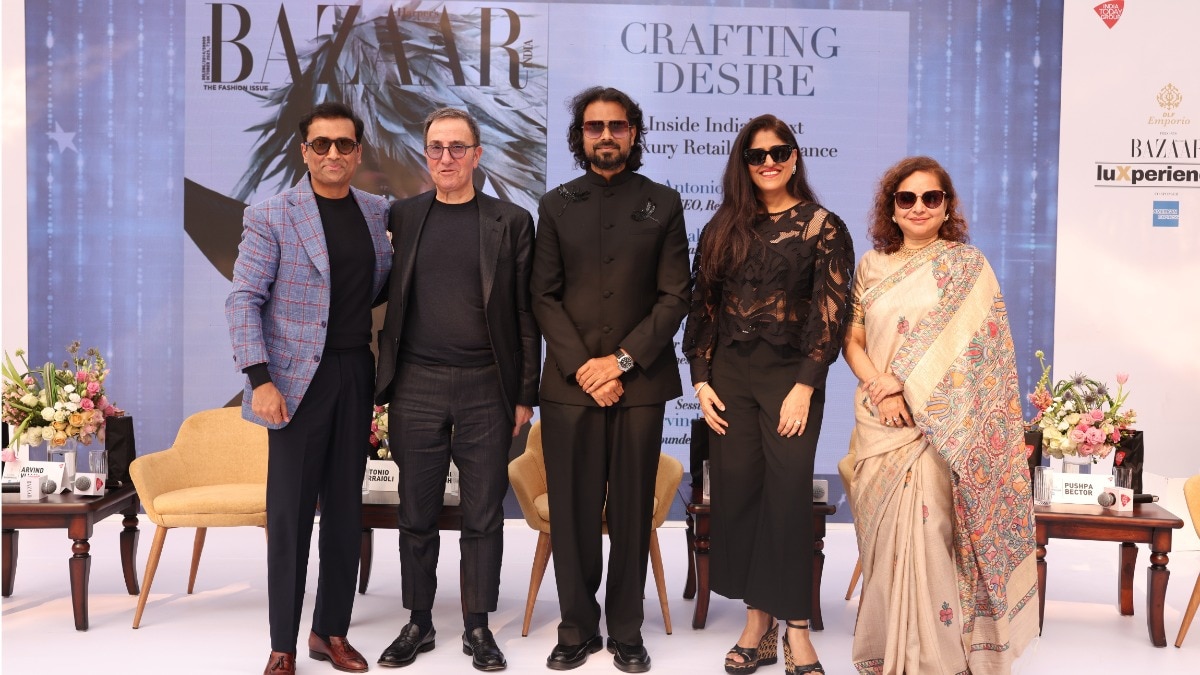
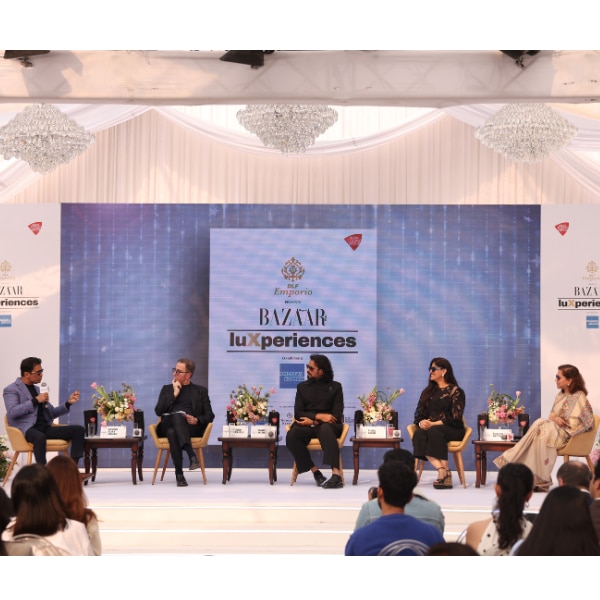
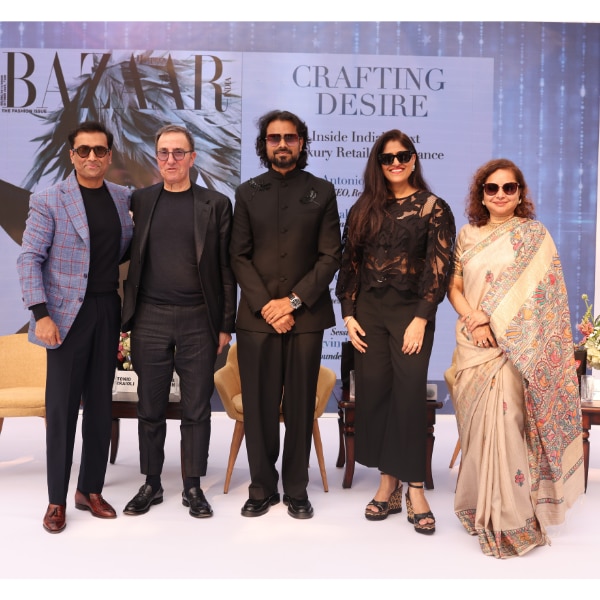
At Bazaar’s LuXperiences session, Crafting Desire: Inside India’s Next Luxury Retail Renaissance, Rahul Mishra, Founder and Creative Director of his eponymous label; Pushpa Bector, Senior Executive Director and Business Head at DLF Retail; Richa Singh, Managing Director at Natural Diamond Council; and Antonio Ferraioli, CEO of luxury footwear brand René Caovilla, came together to unpack what luxury means to the Indian consumer today.
What emerged was not a conversation about expansion alone, but about evolution—of emotion, experience, ethics and identity.
Because if India’s luxury story is accelerating, it is doing so with remarkable self-awareness.
Luxury is no longer just transactional
For Pushpa Bector, Senior Executive Director and Business Head at DLF Retail, the transformation is unfolding inside the store itself.
“So the way we are looking at retail, especially luxury retail, is people are looking for experiences. Transaction is easy. It’s available. When you travel abroad, you can go stand in a line and pick up your LV bag or whatever. But the experience that you get within the country and how we can differentiate is going to be really making the cut,” Bector said.
Access, she emphasised, is no longer the differentiator. Immersion is.
She also pointed to a growing shift in domestic consumption. “If the pricing difference between home country and here is, say, around 10 to 15 per cent, then people are preferring to shop domestically now because experience gives you culture. It gives you a community sense.”
Luxury retail in India, then, must offer more than product. It must offer place and experience.
You don’t simply ‘add luxury to cart’
Richa Singh, Managing Director, Natural Diamond Council, brought the conversation back to emotion.
“I think luxury is all about how it makes you feel,” Singh said. “I feel special when I wear an outfit from Rahul Mishra. It’s not about a price point. It ends up being somewhere on a price point. And you do not add luxury to cart. Can you imagine yourself going and saying, Okay, I’ve added a lehenga to cart? It’s not.”
In a country where jewellery and couture are often tied to milestones and legacy, often passed down by generations, luxury cannot be reduced to convenience.
“Yes, quick commerce has its own space,” she added. “But how it makes you feel is a large part of what we do. Whether it’s storytelling, whether it’s the experience in the mall, whether it’s how the actual finish of the product, the craft is—it’s all about me feeling special.”
The Indian luxury consumer, she implied, is not chasing speed. They are chasing significance.
The rise of the discerning buyer
Antonio Ferraioli, CEO of luxury footwear brand René Caovilla, observed that alongside emotional depth, there is growing discernment.
“Today’s consumer no longer seeks merely an external symbol of success, but rather an object that tells a story, embodies solid values and reflects a sophisticated and global personal identity,” Ferraioli said.
For him, luxury has evolved into something far more cultural. “Luxury has become a cultural language by now,” he noted. “Luxury is no longer just a visible status symbol… It’s no longer so important to display a product worn, but rather to be part of a community of well-informed people, of connoisseurs.”
The Indian buyer is no longer just aspirational. They are informed. And increasingly, they are selective.
Time is the ultimate luxury
It was Rahul Mishra, Founder and Creative Director of his eponymous label, who steered the conversation toward a more philosophical lens.
“In today’s world, time is the biggest luxury,” Mishra said.
In an age of algorithm-driven shopping and accelerating AI, he described handmade craft as standing at a defining moment. “I think it is almost like handmade luxury is at a kind of cusp, where you start seeing everything is getting into the virtual world. AI is going to create online shopping far more faster.”
But rather than seeing technology as competition, Mishra positioned it as a contrast.
“That is where a real opportunity for luxury or retail lies,” he said, drawing an analogy to art in the age of photography. “More people have cameras today, more people are going to take better pictures today… but painters are getting more and more expensive. Artists are more prevalent today in the world. So that same thing is going to happen to luxury also.”
As speed becomes universal, slowness becomes rare.
“Luxury cannot just be about consumption. It has to be about participation,” Mishra added, reframing purchase as patronage.
Sustainability, ethics and the responsibility of growth
Underlying the dialogue was an unspoken but vital thread: responsibility. For Mishra, whose work is deeply rooted in India’s craft ecosystems, participation is not abstract. It sustains livelihoods.
When luxury invests in handmade processes, it protects generational skill. When it prioritises local production, it reduces anonymity in supply chains. And when it values time over speed, it challenges the disposability that defines fast consumption.
In this context, growth without ethics is incomplete. The future of Indian luxury will not simply be measured by expansion, but by how consciously it scales and how intentionally it supports the communities behind the product.
A new definition of luxury
By the end of the session, one thing was clear: India’s luxury renaissance will not be built on imitation.
It will be built on identity.
The Indian consumer is no longer chasing global validation. They are shaping their own standards by prioritising experience over excess, knowledge over noise and meaning over mere acquisition.
Luxury, as the panellists collectively made evident, is evolving from a symbol of status into a reflection of values.
And if time, craft, emotion and participation are the new currencies of desire, then India is not simply participating in the future of luxury. It is defining it.
Also read: Method dressing isn’t new—but it has never been this strategic
ADVERTISEMENT
Must Read

ADVERTISEMENT