Harper’s Bazaar LuXperiences 2026: Inside India’s new code of masculinity
Anaita Shroff Adajania joined designers Amit Aggarwal, Kartik Kumra, and Ritwick Khanna to discuss how vulnerability, craft, and experimentation are reshaping Indian menswear.

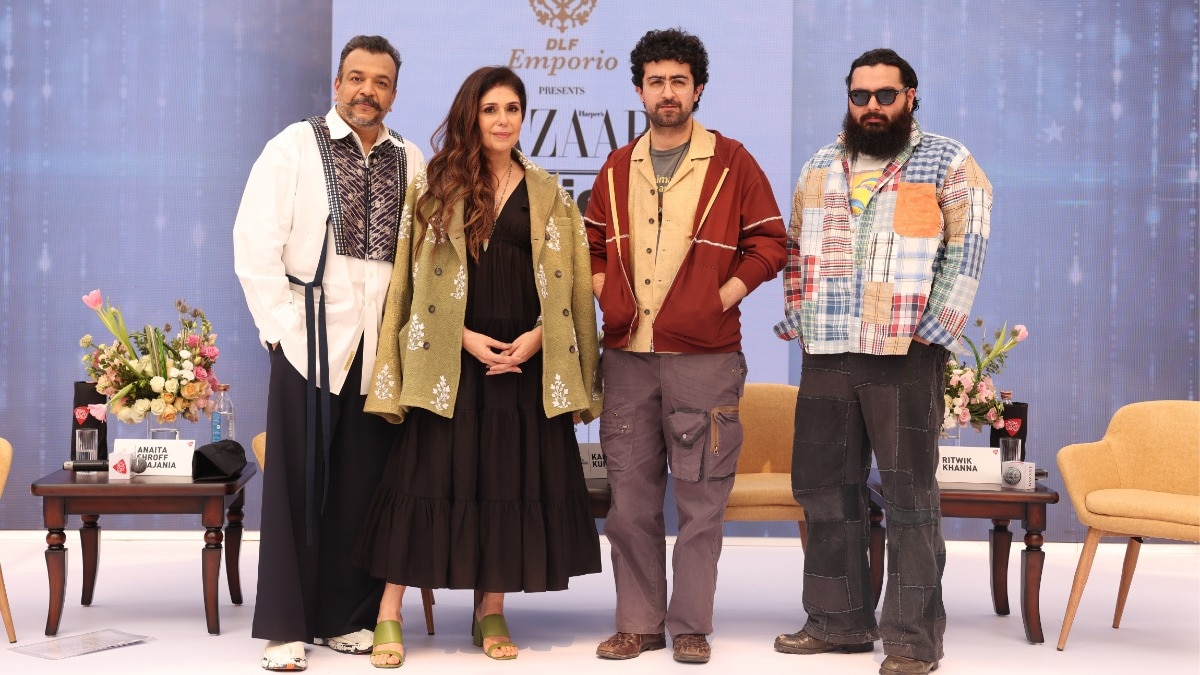
At Harper’s Bazaar LuXperiences 2026, the conversation around menswear was anything but predictable. Titled Tailored Rebellion: The New Era of Menswear in India, the session brought together stylist and creative director Anaita Shroff Adajania and designers Amit Aggarwal, Kartik Kumra, and Ritwick Khanna for a sharp, often candid exploration of masculinity, craft, and experimentation.
Opening the dialogue, Shroff set the tone: for decades, menswear in India revolved around certainty, the suit, the sherwani, the uniform. It was about authority and approval. But today, she observed, something fundamental is shifting. “Masculinity is less fixed,” she noted. “There’s experimentation, there’s vulnerability, and even a softness.” The mood in the room echoed that sentiment: expressive, layered, and refreshingly unafraid.
For Amit Aggarwal, this evolution begins with reframing the man as “a human first, and then a man.” Growing up in the hyper-masculine climate of the ’80s, Aggarwal spoke of navigating rigid expectations while feeling inherently different. That duality, strength fused with softness, now defines his design language. His sculptural silhouettes and engineered textiles may appear futuristic, but they are rooted in emotion. Craft, he argued, must move beyond embellishment. “The progression of craft to give it a new language and form is what designers need to hold responsibility for,” he said, challenging the idea that ornamentation alone defines heritage.
Kartik Kumra approached masculinity through a generational lens. At 26, he described a post-COVID cohort of young men shaped by the internet, some radicalised, others seeking more expansive identities. In that confusion, fashion becomes a site of positioning. His brand leans into a vibrant, thoughtful masculinity that resists both hyper-masculine clichés and empty trend cycles. Storytelling is central. Referencing the rise of streetwear culture and how men began engaging with fashion “like sports,” Kumra emphasised the need to integrate craft into everyday life rather than reserving it for spectacle. A hand-embroidered hoodie, he pointed out, can carry legacy without shouting about it.
Ritwick Khanna’s perspective was deeply introspective. Reflecting on presenting a collection at Mayo College, an all-boys boarding school with strict dress codes, he described challenging uniformity with “dirty red socks, loose ties,” and garments that felt worn yet intentional. Through his label Rkive City, Khanna works with existing garments, deconstructing and rebuilding them into contemporary forms. The idea of natural patina, of clothes that age and carry memory, drives his process. “The process always begins from what already exists,” he explained, merging global textile waste with Indian survival craft to create pieces that feel both sustainable and sharply current.
Together, the trio underscored a powerful shift: Indian men are beginning to invest in everyday heirlooms, not just wedding-day statements. As Khanna noted, the willingness to spend on daily wear rather than a one-time sherwani signals emotional intelligence in consumption.
Tailored Rebellion was not about shock value. It was about evolution... of identity, of craft, of courage. At Harper’s Bazaar LuXperiences 2026, menswear wasn’t merely tailored; it was thoughtfully, deliberately rewired.
Also read: Embellished and embroidered jeans to elevate your off-duty style
Also read: High-fashion headscarves with leading-lady appeal