




ADVERTISEMENT
Inside the Netherlands' major Amrita Sher-Gil retrospective at the Drents Museum
Amrita Sher-Gil gets a landmark retrospective in Europe.

It has been 85 years since Amrita Sher-Gil’s death, yet conversations. The body of work that she built over a span of seven to nine years, continues to command undeniable attention in the art world. For much of the last century, however, those conversations have largely remained confined to the Indian subcontinent.
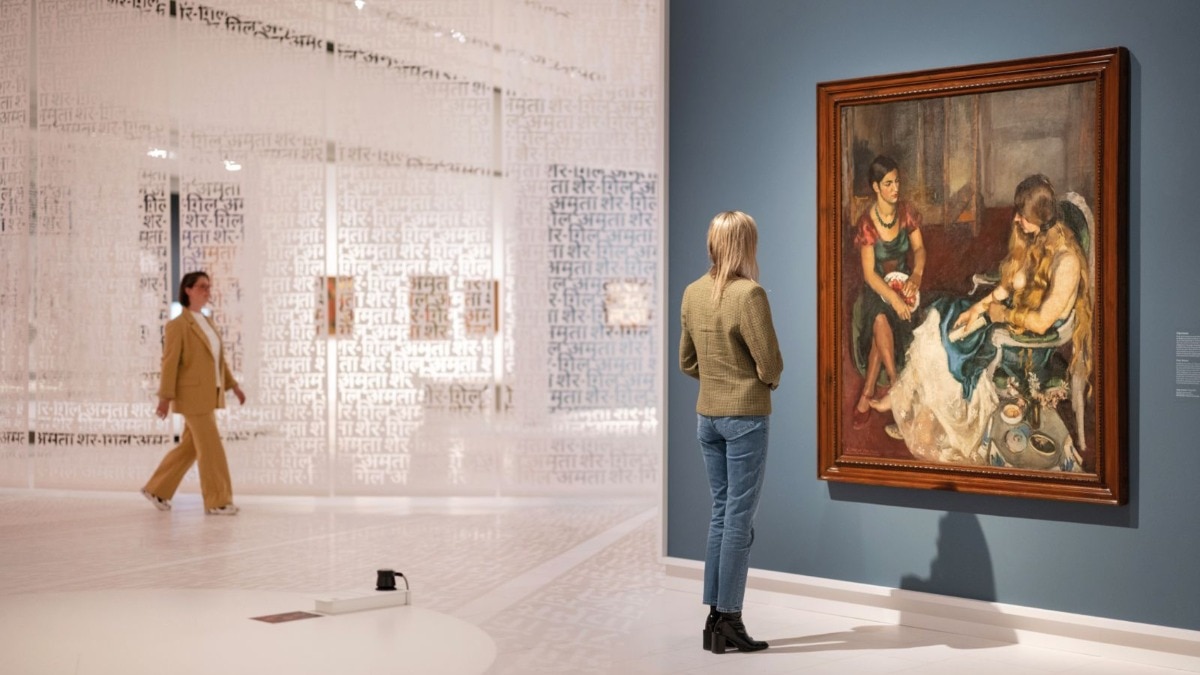
For the first time in 20 years, Drents Museum in Assen, Netherlands, has taken up the task of widening its scope, mounting a landmark retrospective titled, Amrita Sher-Gil: Europe belongs to Picasso, India belongs to me, on the enigmatic modernist painter. It reintroduces Sher-Gil—not as an ‘Indian Frida Kahlo’ or a footnote to European modernism, but as one of modern art’s most radical and emotionally complex figures.
In a close collaboration with the National Gallery of Modern Art, New Delhi, 48 distinct works by the artist (two of which are sketches), have been loaned to the Drents Museum. Along with that, 22 archival photographs from the gallery PHOTOINK (courtesy the Estate of Umrao Sher-Gil and Vivan Sundaram) are also on view.
“As Amrita Sher-Gil is still virtually unknown to the Dutch public, our primary aim is to introduce her as an artist and as a person,” explains curator Annemiek Rens. “At the same time, we want to emphasise her significance for art history, not only in India, but particularly on the international cultural stage. As a bridge between continents, she occupies a unique position in modern art. A position that was not only ahead of its time, but remains highly relevant even today.”
Amrita Sher-Gil: Europe belongs to Picasso, India belongs to me arrives at a moment when global museums are being forced to rethink who gets positioned at the centre of art history. What makes this exhibition particularly important is not just the significance of these works, but what their presence abroad represents today: a reaffirmation of Sher-Gil’s place in the larger global art narrative.
Sher-Gil’s work still feels radical for the way it captured loneliness, female interiority, and the everyday Indian life without spectacle or sentimentality. The individuals she portrays—predominantly Indian women belonging to the 1930s—are exhausted, pensive, lonely, sensual, and profoundly human. Sher-Gil carried with her a keen sense of observation and sympathy, which seeps into the compositions.
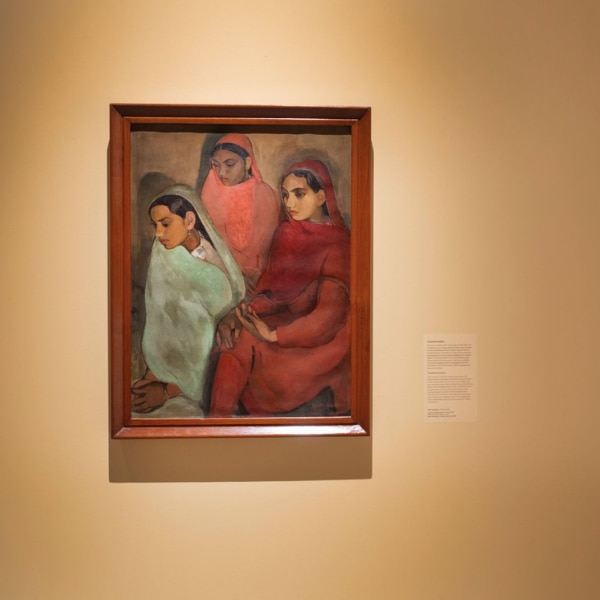
Perhaps one of the most recognisable paintings by her that is also part of the exhibition is Three Girls (1935). It features a slightly melancholic trio of women, swathed in luminous hues of pista green, deep maroon, and orange. Sher-Gil captures something tellingly magnetic. The sitters’ eyes are downcast, looking away from the viewer. Their lips are turned down, as though withholding a secret. Although seated together, each woman appears alone, emotionally withdrawn, lost in thought.
Veteran author Mulk Raj Anand suggested that the women in Three Girls were perhaps absorbed by thoughts of marriage, observing that they seemed “condemned in their early life, to fade away after being given, with dowry, to husbands unknown to them.” In essence, Sher-Gil had managed to map the interiority of female thought.
“The painting was created in early 1935 when Sher-Gil had just returned to India after her studies in Paris,” informs Rens. “She felt connected to the fate of many of her (female) compatriots who led difficult lives in poverty and with few opportunities. With this work, Sher-Gil immediately made a very powerful statement about how she would establish herself as an artist.
Born to Indian and Hungarian parents, Sher-Gil straddled two worlds. Formally trained in art since the age of eight, she studied at the Académie de la Grande Chaumière and the École des Beaux-Arts in Paris, one of the world’s most revered art institutes. And while she did receive acclaim in Paris, Sher- Gil confessed that she was “haunted by an intense longing to return to India, feeling in some strange, inexplicable way, that there lay my destiny as a painter.”
Upon her return to India, her art pivoted—it became a compelling blend of European techniques and South Asian elements, experiences, and colour palette (earthy browns, crimsons, yellows). “It’s fascinating to discover, step by step, how Sher-Gil had an enormous art-historical ‘database’ in her head, drawing on both European history and traditional Indian art, and how she applied this to her own work,” says Rens. “Not by copying, but by incorporating this inspiration into a new style in her own unique way.
One of the reasons why Sher-Gil is considered crucial to the global modernism canon is that she expanded the scope of modernism, pushing it beyond the traditional Euro- American narrative and bringing in South Asian visual imagery. Rens speaks about the “authenticity and stylisation” that emerged through Sher-Gil’s brush, which “set her apart from her contemporaries.”
Also on view are a few oil on canvas self-portraits made by her. In one, painted in 1930, Sher-Gil appears with her black hair, loose and open. Her eyes rise to meet the viewers’, almost in challenge. There is confidence in her posture—a sense of self-assurance. Wrapped in a golden- ochre strapless dress, with bracelets stacked on her wrist and a necklace at her throat, Sher-Gil projects a vivacity that’s in striking contrast to the introspective women in Three Girls. “Through the self-portrait, Sher-Gil seems to make a statement in which she claims her own place in the art world. A place where she is not just one of many artists, but occupies a unique position that is worth getting to know,” suggests Rens, “both as an artist with a vision entirely her own of what modern art should be, and for her significance as a person with an open-minded approach to life and a way of living that goes off the beaten track.”
In Europe, Sher-Gil’s work at the exhibition acquires a different energy, since it is experienced by a Dutch audience. The way she wielded her brush, reminds us that modernism was never confined to European borders, but was redefined again and again through a cross-pollination of ideas and sensibilities across borders. Sher-Gil gave her own identity to the language of modern art, making her original works unforgettable.
This article originally appeared in Harper's Bazaar India's June-July 2026 print issue.
Lead image: Young Girl (1932)
Images: Courtesy Drents Museum
Also read: The rise of South Asian artists and galleries in London's contemporary art scene
Also read: Artist Nieves González wants you to go out and steal horses with your friends
ADVERTISEMENT
Must Read







ADVERTISEMENT