




ADVERTISEMENT
Portrait of a writer: Twinkle Khanna on writing, censorship, and the enduring truth of ‘Mrs Funnybones’
Twinkle Khanna reflects on laughter, fear, freedom, and why Mrs Funnybones still mirrors the Indian woman’s life even after a decade.

No artist worth their mettle can deny the vulnerable anxieties that underwrite the very act of creation. They hum beneath the most mundane acts, easing only in fleeting moments of joy—when the right opening line finally appears on a blank Google doc like crushed cardamom pods scenting a cup of evening chai.
For Twinkle Khanna, a similar sense of foreboding has underlined every flight she has boarded in the past decade. “Till I wrote Welcome to Paradise (2023), I would always wish for the plane to not crash because I had six books to write. It was never about my kids or my family crying,” shares the 52-year-old author, entrepreneur, and talk-show host, as we connect over Zoom from her Mumbai apartment. “Although it wasn’t my sixth book, that anxiety dissipated with WTP. Writing it was the freest and truest I had felt to myself, and only because of that, could I feel as generous as I did working on Mrs. Funnybones Returns (2026)—which was more for my readers than for me.”
Released in 2015 to wide critical and commercial acclaim, Mrs. Funnybones was a collection of non-fiction essays that chronicled everyday life in urban India through the razor-sharp, humorous, and often pathos-inducing observations of a middle-aged, working woman and her colourful familial crew. After nearly a decade, Mrs. Funnybones has finally returned: older, wilder, and wiser.
For a writer who prides herself on restlessness, on learning new forms, and refusing repetition, the decision, Khanna admits, feels almost radical. “For 10 years I put it off but on the tour of my last book, everybody kept talking about Funnybones, what it had meant to them, and the amount of comfort it gave them,” Khanna recollects. “I realised that maybe there was a lot more to it, a certain voice that I have taken for granted, because it comes perhaps a little easily to me. And that’s when we decided that it was time.”
If returning was inevitable, changing things was not. In fact, Khanna was adamant that the experience for the reader had to remain intact. “I was determined that I did not want to change the experience the readers had 10 years ago reading the book for the first time. It was very difficult for me to not shake things up, because that is my nature,” she adds with a laugh. The book draws from hundreds of columns written over a decade—pieces scattered across time, moments, moods, and textures. The challenge was more architectural: to impose a timeline, take fragments from different years and stitch them into what feels like the account of a single day.
“You know, certain things just happen and if I knew then that I was going to be stuck with this moniker for more than a decade, I would have perhaps given it more thought,” Khanna quips with her characteristic deadpan sense of humour. The name, Mrs. Funnybones, she tells me, was born of circumstance, mischief, and mild panic. When Twitter first launched, Khanna joined under her own name and promptly made a few jokes, unfortunately, around the Ramayan.
Following swift familial intervention, Khanna very soon left the platform on grounds of safety concerns. Later, when she began writing her column for The Times of India, an editor insisted she returns to Twitter to amplify her work. Her name, however, was taken by then. Craving anonymity and lightness, she jumped on the opportunity to coin this epithet. “Besides having a slightly twisted perception of the world, I also have bones that I break regularly. I am the real-life version of M Night Shyamalan’s Mr Glass because I have broken every bone in my body. So I decided to take that tragedy and turn it into something comic.”
The physical body, its aching, and ageing inconveniences are a recurring strain of humour in all of Khanna’s works. Wrist pain, for example, makes repeated appearances, a detail I’ve always found oddly validating as a writer bending and typing away at my laptop all day. Khanna laughs and adds, as a gentle reminder, how neck pain features heavily in her work too. “I think I also speak of how every man who turned out to be a headache, started off as a pain in the neck,” she says while taking a sip from her cup of tea. “I think that primarily came while I was writing and my neck was hurting.”
While I spend a solid minute guffawing my way through this acutely poetic, but deeply sentient sentiment, I realise that Khanna’s endurance as one of the country’s most beloved essayists and authors stems from a keenly vulnerable observance of life as it unfolds around her. Her piercing humour feels oddly unrehearsed, marked instead by a thoughtful immediacy that feels urgent and rare in today’s fleeting world. In this regard, Mrs. Funnybones Returns is as much a chronicle of our times as its predecessor—almost accidentally mapping a decade of India’s social and cultural shifts. When Khanna began assembling the columns, she found a repetition of certain themes with stubborn consistency. “It’s been a decade and a lot has changed for women for sure, but it’s only changed for a very small percentage of women. And that also in spheres of education or financial literacy alone,” she says. “When it comes to our social and cultural structure however, I was surprised to find how nothing has changed. It’s exactly the way it was 10 years ago. The working woman then had the same issues that she has now, which was very surprising to me.”
“If I’m going to give you an ANTIBIOTIC SYRUP, I have to FLAVOUR it with some sort of sugar. HUMOUR does that. And I really don’t know how to deal with LIFE if I don’t LAUGH at it.”
Then there is of course the question of freedom—or the lack of it. Khanna notices it when she rereads her own work. Ten years ago, there was a space to speak plainly about politics and to name things directly but that has gradually vanished in the modern day. “I can see that creeping into my work as well, where some things appear more curtailed, as I keep having to resort to clever, subversive techniques.” Despite these acts of creative caution, Khanna remains vehemently uncompromised on the humour that seeps through her pen like life blood. Laughter, she tells me in an almost Mary Poppins-esque fashion, is a powerful tool. Once someone laughs at an issue, they can never quite see it the same way again. “If I’m going to give you an antibiotic syrup, I have to flavour it with some sort of sugar. Humour does that. And I really don’t know how to deal with life if I don’t laugh at it,” she muses.
“When it comes to our SOCIAL and CULTURAL structure however, I was surprised to find how NOTHING has CHANGED. It’s EXACTLY the way it was 10 years ago. The WORKING WOMAN then had the same ISSUES that she has NOW, which was very SURPRISING to me.”
With a life richly spent colouring out of the lines, around the pandemic Khanna made an unexpected decision to return to university. She completed courses at the University of Oxford before enrolling for a master’s at Goldsmiths in London. While the former taught her “scaffolding and structuring”, the latter taught her how to dismantle. “In Goldsmiths, I learned how to dissect other people’s work and so I could dissect my own as well.” She recalls a deep dive into Alice Munro’s navigation of time for her final dissertation that required her to map the author’s stories linearly, and then scramble them. “All those techniques helped me when I had to write my own stories.”
But perhaps her most profound lesson came from displacement. Living outside India, without the easy safety net of community, Khanna experienced difference first-hand. “It was the first time I understood what it means to be displaced,” she says. Being questioned for her accent, her vocabulary, her belonging sharpened her awareness of race and identity. “As a writer, displacement is key to writing really good stories.”
But where most creatives in London regale the world with stories about the Lady Muse who seems to reside in the very air of the Square Mile, Khanna stands out with her (absolutely justified) memories of the city’s recalcitrant pavements. Their wet, unevenness paired with a constant barrage of cyclists she openly detests resulted in a freak accident once, and a fractured elbow. “I really don’t like cyclists. I would spend most of my time screaming at them because they would always be on the cobbled roads,” she admits with sincerity.
Yet the constant negotiation with space, fear, and unfamiliarity, forced her brain to adapt. Before moving, she had undergone an MRI scan that showed age-related white patches in her brain. But after living in London for two years, another scan revealed they had disappeared. “Because I had to learn so many new things not just academically, but also as regard to navigating life again, my neural connections kept building and I was scientifically able to reverse an age-related condition,” she says with a smile.
Her writing process is refreshingly unromantic. “I’m like a squirrel,” she explains. “I go out, collect my nuggets, and then I come back.” And when ideas stall, she spends hours researching on PubMed what ailments her characters suffer from—even if they end up never appearing on the page. “It is like dating someone, I really need to know what they suffer from. Once you know them to that depth, you know how they’ll react.” Physically too, her practice has adapted to age. She no longer writes at a desk because of her neck and for now has found solace in the ample comfort of her couch. When stuck, a rare oddity in her decade-long experience as a writer, she begins to write by hand as a means of lowering the stakes and continues filling her pages till she hits something worthwhile. “The fear of the first sentence being perfect is futile,” she says, words that comfort my fear-addled, deadline-chasing brain in a way similar to how rain soaks up a parched land. “You just need words on the page and then you refine.”
“The TRIUMPH of the human SPIRIT is our POWER to turn PAIN into something BEAUTIFUL. AI can help us edit, and do other analog ACTIVITIES. But does it KNOW what to do with PAIN?”
This idea of refinement inevitably leads us to the question of artificial intelligence, a subject on which I find Khanna refreshingly pragmatic, if cautious. “Like any tool, it can do multiple things. The person who invented the knife probably meant it to be used only for stabbing, but here we are cutting vegetables with it as well,” she says frankly. But more than fearing being replaced by AI, she fears the complacency it breeds amongst us as human beings. “All our ideas come from pain, as much as joy,” she says. “The triumph of the human spirit is our power to turn pain into something beautiful. AI can help us edit, and do other analog activities. But does it know what to do with pain?”
And every day sensations of mundane pain, the kind that we force ourselves to deliberately look past in a bid to concede to the grander scheme of things, Khanna truly has dealt with through her work. As she takes a final sip from her cup of tea, I tell Khanna about the impact her works have had on my own middle-aged mother. Be it her looking back on her father as the only man who had the power to break her heart, or speaking to the forgiving nature of pajamas in a world that scarcely spares a thought about the struggles middle-aged women undergo with their bodies, she continues touching the hearts of a millennial womanhood that makes her readers feel seen.
“I used to DRESS myself the way I would DESIGN a living ROOM. Now I’m PAYING more ATTENTION to FASHION but with poorer RESULTS.”
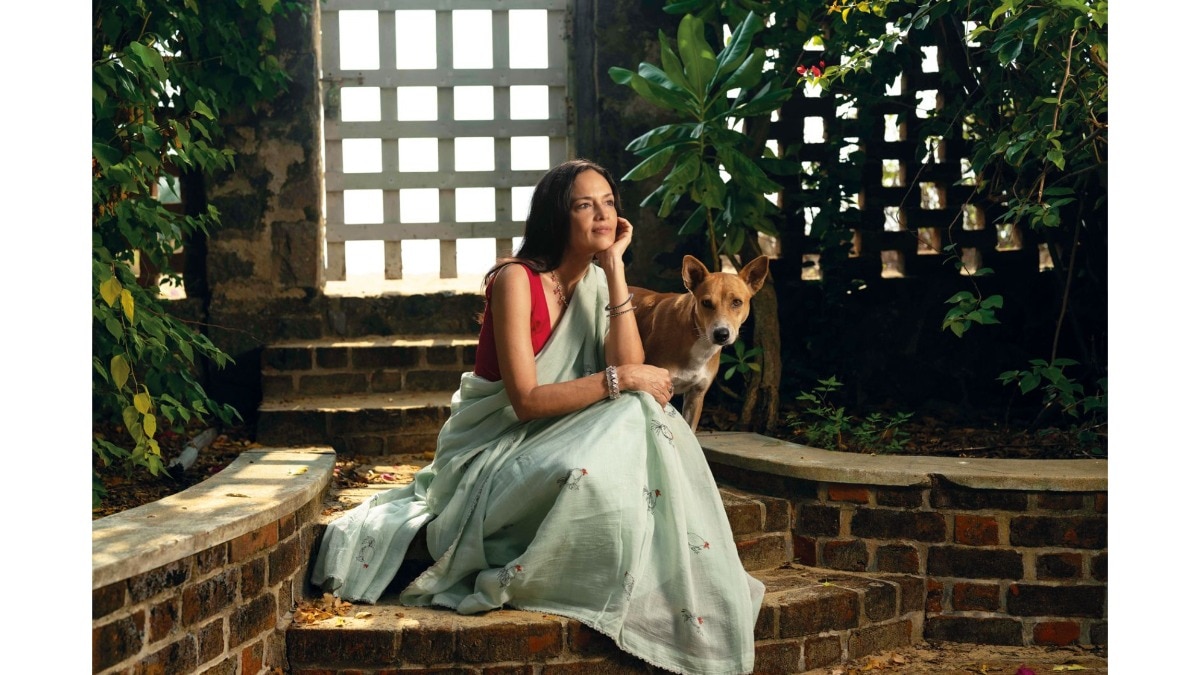
And while on the subject of pajamas, she sternly mentions her next need in life for garments that are “forgiving for the entire body, not just the lower half.” In that light, Khanna declares saris as the most forgiving garment of all today as she admits to embracing her shallow side. “I used to dress myself the way I would design a living room. Now I’m paying more attention to fashion but with poorer results.”
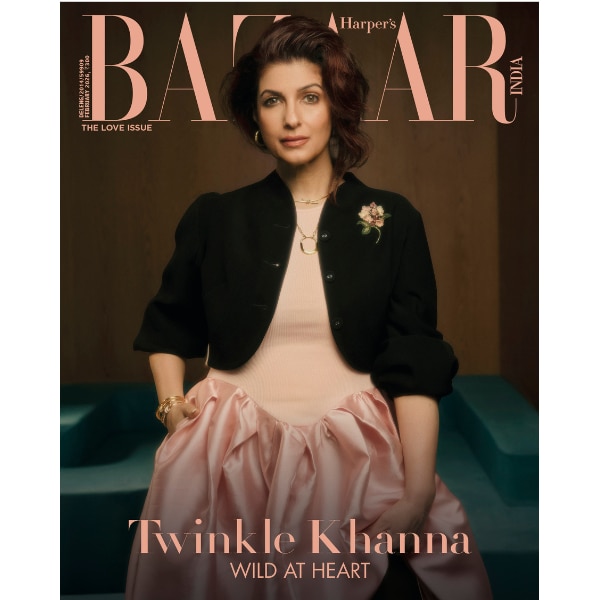
Last year, Khanna also marked 25 years of marriage. “I’ve finally accepted that I can’t change anybody,” she says because differences are meant to be celebrated, not merely tolerated. In honour of the Love Issue whose cover she so stunningly graces, I urge her to finally describe love—as an object, person, or even a scent. “I already have that creature in my life,” she says without taking a single second to pause. “He is furry. Sometimes he smells of vanilla after a bath, and sometimes of tandoori masala after spending time in the kitchen. He barks, but never bites and nobody’s ever loved me as much as he does.”
Love, for Khanna then, becomes an act rooted in great simplicity: to be wanted and seen not for usefulness or performance, but simply for existing.
Editor: Rasna Bhasin (@rasnabhasin)
Interview: Anwesh Banerjee (@anwesh_writes)
Photographer: Nishanth Radhakrishnan (@nishanth.radhakrishnan)
Stylist: Gopalika Virmani (@gopalikavirmani)
Cover Design: Mandeep Singh Khokhar (@mandy_khokhar19)
Make-up and Hair Artist: Namrata Soni (@namratasoni)
Editorial Coordinator: Shalini Kanojia (@shalinikanojia)
Set Design: Janhavi Patwardhan (@artnut_j)
Line Producer: Salim Menon (@lineproducer)
Style Assistant: Grace Soni (@grace_soni)
Artist PR Agency: Communiqué Film (@communiquefilmpr)
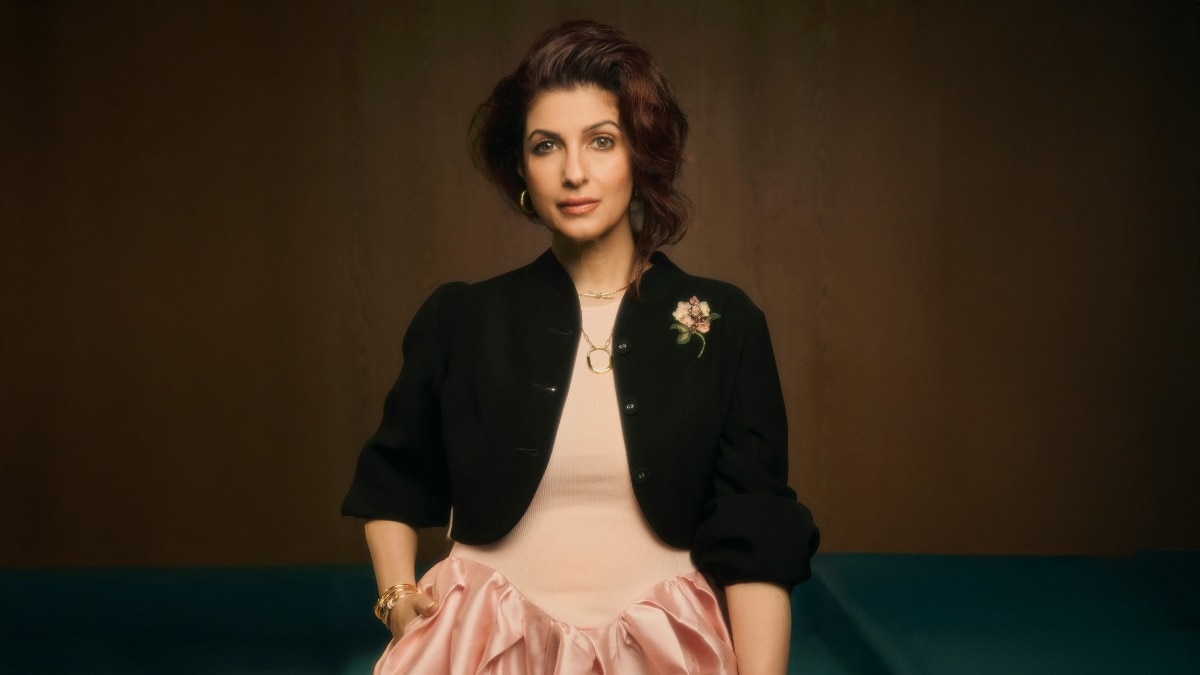
Twinkle is wearing cropped jacket with lantern sleeves and a curved placket with floral brooch; Chorus (@chorusworld); light pink dress with scooped tank top; Marques’ Almeida (@marques_almeida); J’Adior slingback pumps, Dior (@dior); Tiffany Lock earrings; Tiffany Two-Row Knot bracelet; Tiffany Knot bracelet; Tiffany Lock bracelet; Tiffany Lock half diamond pendant; Tiffany Knot necklace, all Tiffany & Co. (@tiffanyandco)
ADVERTISEMENT
Must Read
ADVERTISEMENT