





ADVERTISEMENT
Growing up in public: Ananya Panday on fear, fame, and finally finding her centre
Ananya Panday has witnessed a changing world. It can all seem like a dream, except that she wasn’t always brave enough to believe in it. Between 'Main Hoon Na', Arundhati Roy, and a clarion call for stronger unionisation in Bollywood, the actor comes alive.

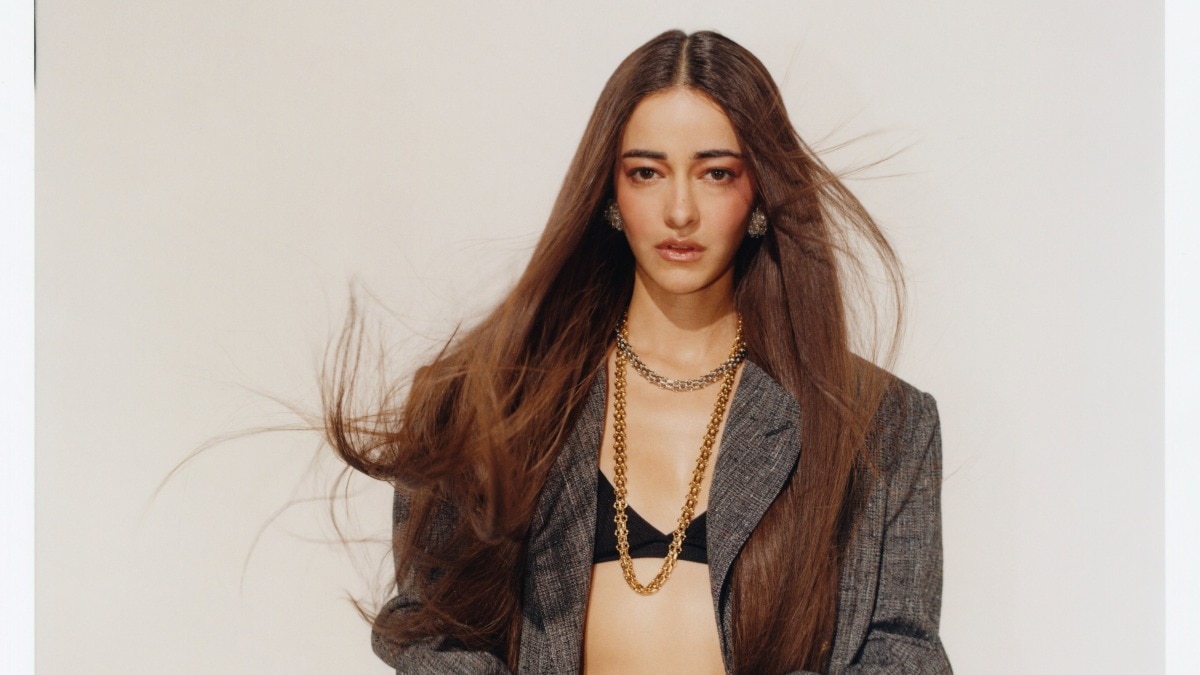
What does it feel like to have your face on a billboard? You are on the Western Express Highway, zipping across the veins of the city. You look out, and there you are. All glossy, your face retouched to a frightening degree. An actor must get used to the exaggerated proportions of their face. It’s the great Indian dream: to have your name appear in a newspaper for your parents to frame the clippings. We like being acknowledged, to be quoted just once.
Ananya Panday, though, has had a slightly more complicated relationship with her image. When she was a child, all the joy in the world followed her. She’d pretend to be a forlorn lover and dance to Devdas songs, and then just as seamlessly switch to the hook steps of Main Hoon Na (2004). Her father would always record her—his hazy, flickering lens attempting to capture all the bursts of joy in his daughter. And then life, the perpetual trickster, showed up, except not with the funniest tricks.
“In my teenage years, I started becoming really, really shy,” Panday tells me. If there were an audition for the school play, she would never be confident enough. If all the girls in her school had a dance performance, she’d always volunteer to be in the back row. “I was so scared of my dream. I’ve always wanted to be an actor, and I was scared about not being good enough.”
How does a child go from being excitedly recorded for her Bollywood hook steps by a doting father to hiding, quite literally, in the shadows only a few years later? As a teacher at Mayo College, a boys’ boarding school, I’ve seen dreams flicker, barely managing to get to the finish line, hunkered down by frustrating notions of masculinity or simply by being too conscious, too careful. But there are plenty that blossom as well, against all odds.
Over the next hour-and-a-half, we will pick apart every strand of Panday’s life. I will discover that she is perhaps one of the biggest advocates for stronger unionisation in Bollywood, not just for privileged actors like her but for those who are invisible behind the lighting gear and camera rigs. We will talk about the staggering metaphors in books and songs, the critical importance of living alone, how the first season of Call Me Bae (2024) led her through a hectic phase in life, and the comfort of her four dogs.
But first, we must try to make sense of how a child, even someone like her, recedes into the background. More importantly, what does it take for that child to grab the spotlight again and crank it up—letting its luminosity flood all the dreary, anxiety-infested rooms in the mind?
TELL ME I’M PRETTY
Last week, my student from Grade 8 was crouched over his line drawing of Satsuki and Mei’s house from Miyazaki’s masterful 1988 anime film My Neighbour Totoro. All the details were faithfully rendered: the lime-green shutters, tiny chairs strewn across the open verandah, even a tiny leaf quivering in the wind stuck under one of the chairs’ legs. Except when he showed it to me, he covered his face with both his hands and mumbled: “Don’t say anything, sir. I know it’s terrible.”
Panday, contrasting this incident with her own sense of withdrawal as a teenager, has a simple diagnosis of it. “I think I was scared of what other people would say. That’s mainly it. Even the boy you’re talking about, he was okay showing it to you, but didn’t want other people to know,” she says. “It is the fear of judgment. Sometimes when you want something so badly, you build it up so much in your head that you start thinking, what if I can’t do it or what if I’m not good enough?”
She adds that you start overthinking and bog yourself down. Over the years, she has realised no one else actually cares. “Like if I did this dance in the front row, what if people said, ‘Oh my God, she can never be a Bollywood actress because she can’t dance?’ Or what if I messed up an audition in school and people said, ‘How does she think she’s going to be an actor? She couldn’t even get this audition?’”
The doctrine of not caring, though, comes with a few caveats. She never wants to become oblivious to feedback. It’s something of a sanity-preservation technique when it is about not worrying about the fleeting opinions of others. But when it turns to apathy, it’s no longer fun and games. Bollywood, the world that nourished Panday and coloured her days, is at a turning point. Never before has a movie industry’s very survival been brought into question. Theatres run empty, and all hopes are pinned on that one film that will inject life again.
“One thing I would change about Bollywood is that whenever a film does well, everyone wants to make that same film. I’d like to change that mentality of repeating what’s successful as a formula,” she says.
There is, however, something more fundamental she’d like to change as well: shining a light on those Bollywood does not see, does not want to see. In all the conversations about work-life balance for actors, which is undoubtedly a reasonable ask, what about those who don’t have an option? The dressers on the set, the light men, the art production crew?
“We need some sense of unionisation or structure. The turnaround time on shoots is sometimes not fair, especially for the crew. If we finish shooting at 6 pm and start again at 6 am, that means the crew has to come at 4 am and reach home at 10 pm,” she explains. “There’s no time for them to rest. Yes, acting is expressive, and you can’t always put art in a strict time frame, but the health of the crew matters.”
She pauses and adds one more change: transparency when it comes to payment. “That’s it. I won’t explain it further,” she smiles.
CENTRE OF GRAVITY
The joy returned when she became an actor. She now feels exactly how she did as a child. Her sweatshirt says Paradise Lounge. The clock hits 7 pm, and it’s snack time. The last few days have been the equivalent of running on a treadmill that cannot be shut off: waking up at five in the morning, driving to Lonavala, shooting for 12 hours, giving it her all till the last minute before the natural light disappears behind the glowering Sahyadris. Once back home in Mumbai, she once again had to get ready for an awards show, returning home at 2 in the morning, only to wake up again at 5 for a drive to Kamshet, on the outskirts of Mumbai.
“So, on a day off, I wake up as late as possible, around 11 or 12. I might work out, or maybe not. Then I like to read the newspaper every day. I do my meditation and prayers. I need one or two hours just by myself, reading a book, watching a movie and playing with my dogs.”
Her dogs help her steady the days. Astro, a golden retriever. Riot, a maltipoo. And two mini long-haired dachshunds named Lemon and Honey. Around them, she is never really lonely. They are needed because she’s had a different way of looking at relationships and human companionship.
“I used to be someone who couldn’t be alone at all. I’d be scared to sit alone for even 10 minutes. I always needed someone around me, my partner, my parents, my friends,” she admits. “But when I started living alone, even though I’m in the same building as my parents, that little bit of space changed everything. Building your own environment and doing things your own way shifted my love for space. I just love being alone now.”
The centrality that has come with living alone, the space that also allows her to read more, often two books at a time, watch more, and play with her dogs, has also shifted her fundamental understanding of a romantic relationship.
“In past relationships, I’d want the other person to shine more than me,” she pauses, almost as if she were letting it all play in the eye of her mind. “At the cost of putting myself down or making myself smaller, I’d change myself a lot, become more like the other person. I wish I’d learned earlier not to let someone change me or affect me so much. I felt like I had to be less of something, and that’s something I wish I had realised sooner.”
A FINE BALANCE
At the end of the day, Panday tends to her obsessions and dreams, nurses them. She tracks her sleep latency and deep sleep cycles with an Oura Ring, wishes she could sing, and hopes she is flexible enough to do a full backbend. She is awed by metaphors, the way they move us, such as when Arundhati Roy compares Anjum to a tree, a trans character in the 2017 novel The Ministry of Utmost Happiness that Panday is currently reading. Or the many metaphors burning in Charli XCX’s Chains of Love, which is currently on repeat.
On set, though, all bets are off. With Vikramaditya Motwane’s 2024 Netflix film CTRL, Panday let herself be relentlessly vulnerable on screen: posing with filters, barely any make-up on, and for long stretches in the film, her face illuminated only by the blue, unsparing light of the phone or laptop screen.
“We almost had to treat the shooting of CTRL like a theatre performance,” she says. “I remember on the first day of shooting, we had already finished 17 pages. There was a lot of liberty and a lot of freedom to just feel. And there was never a second thought in my mind about vanity or how I was going to look. Because after holding a phone for even 15 minutes, your hand starts hurting, and slowly the double chin also starts showing.”
With Call Me Bae, the experience was cathartic. That was the first time Panday realised that the blurry lines between real and reel life can be worked to the actor’s advantage. If she wanted to have a breakdown, she need not have it in a room but right there in front of the camera. Even the inverse could work, when an actor has no choice but to be happy because the role demands it.
“During the first season, there was a very hectic thing going on in my life,” she says. “Almost every day, I was crying. But when I got on set, Bae literally saved me. I was so happy and positive there. I couldn’t help but think about anything else. Because for five hours you’re just talking to a fridge, you know? How can you not be happy? You don’t have a choice. You just train your mind to become happy.”
Yet Panday is unafraid of being vulnerable. She’s all too aware of the impermanence of fame, of not taking things for granted. “I definitely still have some sense of imposter syndrome. If I hear my name out loud, like someone saying ‘Ananya Panday’ or introducing me somewhere, for a second, I kind of disassociate and I can’t fully respond to it,” she admits.
While she tries her best to understand the inner workings of fame and its trappings, she is fully conscious that she cannot get used to it. But there is an armour that will always save her. At 27, she knows something her teenage self did not: most of the time, no one is watching you that closely. Only you are.
Editor-in-Chief: Rasna Bhasin (@rasnabhasin)
Photographer: Rid Burman (@ridburman)
Stylist: Priyanka Kapadia (@priyankakapadia)
Interview: Arman Khan (@arman.gif)
Cover Design: Mandeep Singh Khokhar (@mandy_khokhar19)
Make-up Artist: Tanvi Chemburkar (@tanvichemburkar)
Hair Artist: Mike Dasir (@mikedasir), at Anima Creatives (@animacreatives)
Editorial Coordinator: Shalini Kanojia (@shalinikanojia)
Line Producer: Salim Memon (@lineproducer)
Style Assistants: Iram Halai (@iram_halai), Divya Bavalia (@divyabavalia)
Artwork Installation: Doyel Joshi and Neil Ghose Balser of HowAreYouFeeling.Studio (@howareyoufeeling.studio) - “Self-Portrait”, 2026 — film cranes draped in fabric
Artist Reputation Management: Hype PR (@hypenq_pr)
Ananya is wearing a multicoloured viscose twill jacket in shades of poppy red, black, and copper; a top in poppy red and black viscose twill; black wool and silk briefs; and a multicoloured accessory in metal and glass from the Spring/Summer 2026 show, Chanel (@chanel).
ADVERTISEMENT
Must Read
ADVERTISEMENT