




ADVERTISEMENT
The history of Shikargah, the hunting motif woven into Banarasi silk
Shikargah remains bridal couture’s most coveted motif, a mark of status stitched into brocade for centuries. But ask what the pattern is really depicting, or who has quietly gone missing from it, and almost no one agrees.

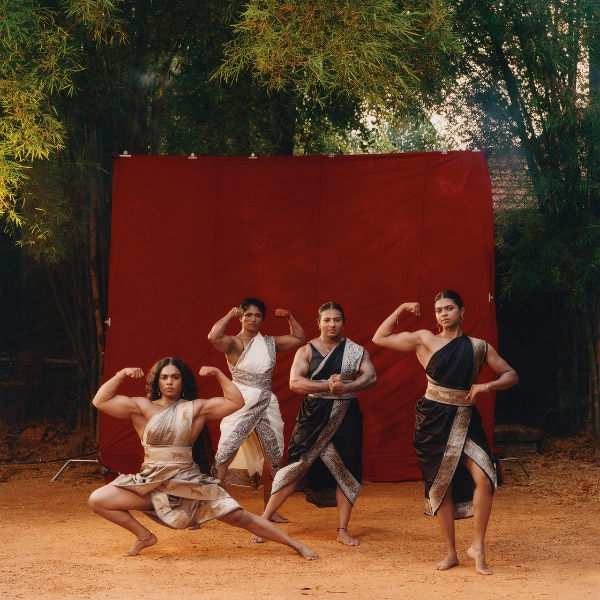
A woman stands on packed earth, fist cocked throw a shadow. A medal swings from her neck. Behind her, a wall of deep red fabric fills the frame. She is wrapped in a cream Banarasi weave, animals and foliage worked into the silk, one end knotted at her waist. This is one of the images from Tilfi’s ‘Becoming’, photographed by Keerthana Kunnath in Kerala.
The campaign brings together bodybuilders Kavitha, Chitra, Jannath, and Bisha in handwoven Banarasi saris dense with animal imagery. No hunter or any human figure features in the textiles, though the older Shikargah tradition was rooted in exactly that—the royal hunt, animals and hunters reflecting the values of their time, says Co-founder Aditi Chand. ‘Becoming’ doesn’t correct that history; it relocates it. “It gave us a way of looking at Shikargah without having to change what it is,” she says. Off a bride, the same weave signals status conferred by birth or occasion. On these four women, Chand says, “It’s strength as something you work towards and inhabit yourself.” Everyone recognises a Shikargah on sight. Almost no one agrees on what it actually shows, or what it means now that the hunt has disappeared.
A MOTIF WITHOUT A HUNTER
Shikargah comes from shikar, meaning hunting. In Silk Brocades (Roli Books, 2003), textile historian Yashodhara Agrawal describes the fabric worn by Ulysses in Homer’s Odyssey, with fighting hounds and spotted fawns, as one of the earliest hunting-scene patterns, or Shikargah. She traces figured textiles of birds and beasts across Persia, Central Asia, and India, with Persian and Sasanian traditions producing their own versions with animals, birds, and human figures.
The book suggests that some early figured textiles vanished either because of restrictions on depicting living creatures under Islamic scripture, or because migrating weavers took their designs to new regions, where the patterns acquired different names.
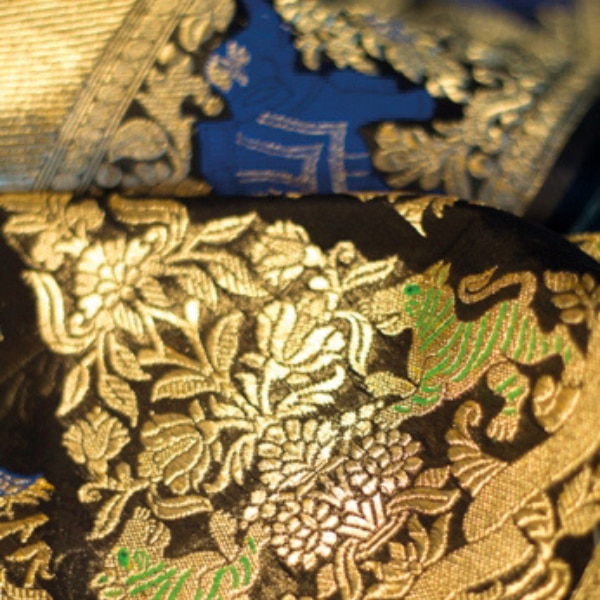
The Safavid revival of 1499 brought hunting imagery back. Persian brocades shaped Mughal textiles next, where taste itself kept shifting: Jahangir favoured figural imagery, his son Shah Jahan preferred florals. By the late 19th century, the Persian Shikargah, with trees, creepers, animals, and occasionally a human figure, had become a Varanasi speciality. In these forests of silk, the hunter began to fade.
BANARAS: A MOTIF OF ANIMALS
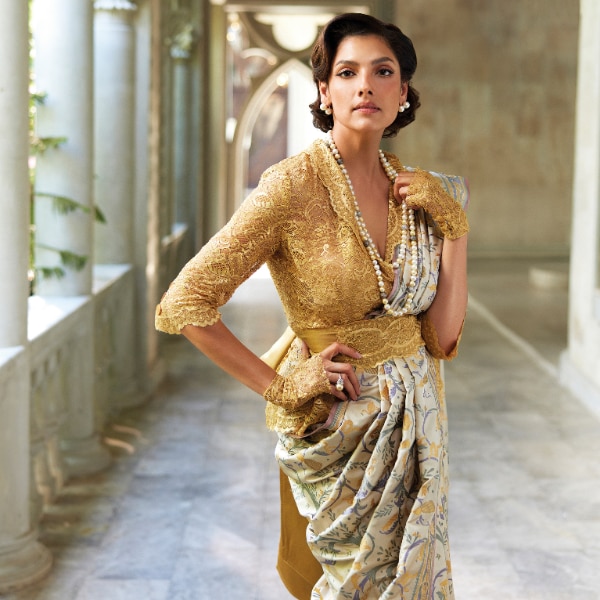
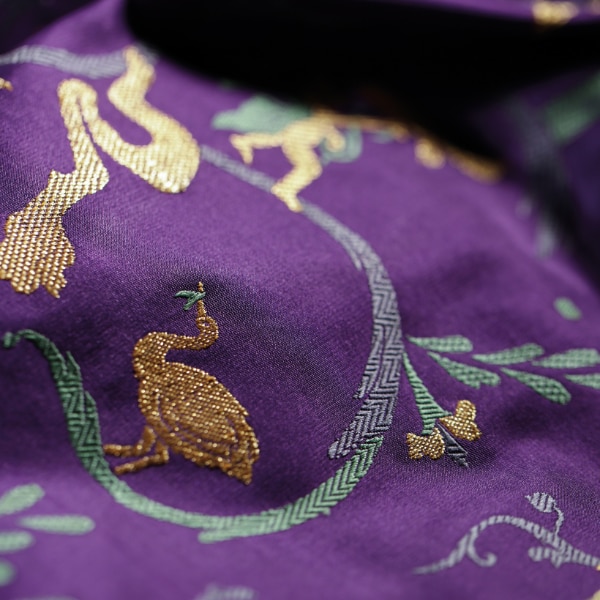
Swati Agarwal, Co-founder of Swati & Sunaina Gold, built her first Shikargah in 2015 around a hierarchy of animals: the elephant for strength, the cheetah for agility, the peacock for beauty, the heron for stealth, tracking a hunter’s own rise from a novice’s first kill, the deer, to his hardest, the leopard. “There was a very clear demarcation. This pattern was to be worn by nobles only, because they were the ones who hunted,” she says. The human figure rarely survived that history intact. A mahout might appear without a face, a rider reduced to a hat and nothing more, and most of the time just forest and animal. Weaving one well is unforgiving work: get the proportions wrong, and “the deer can’t be taller than the elephant.” Most buyers today aren’t weighing any of this. Of a 100 customers, Agarwal estimates, 99 recognise the name on sight. Fewer than 10 ever ask why those particular animals are there.
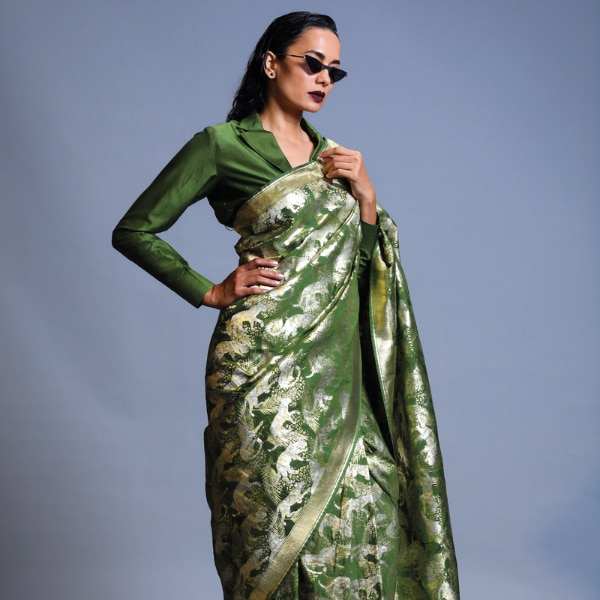
Shikargah’s journey doesn’t stop at Banaras. In tracing its path, Swati & Sunaina’s 2024-2026 Varanasi to Versailles explores the motif’s encounters with Persian, Tibetan, and French textile histories. Their research led back to Lyon, revived under Louis XIV after Indian chintz nearly destroyed France’s textile industry, and to the invention of the Jacquard loom, which revolutionised handloom patterning in India.
In a French woven textile, the brand found a pattern with animals, Cupid and snakes. “It’s not Toile de Jouy,” Agarwal says. Those figures went straight into their own Shikargah, worked in kadhuwa, jamdani, rangkaat, gyasar, tanchoi and dampach, alongside other French forms reworked in Banarasi hands: Rococo flowers as koniya, Baroque bouquets as butas, and lace rebuilt in zari. Their reverse rangkaat pushed the animals smaller still, tucked inside coloured circles, so you need a second look to find them.
DESIGN, NOT JUST CRAFT
Hemang Agrawal, Creative Director of the Surekha Group in Varanasi, shifts the conversation from heritage to process. “Shikargah is just a design ideology,” he says, “a part of the vocabulary of the larger Banaras design.” What determines whether a sari is artisanal, he says, is the yarn, loom, and technique, not the motif. “Just the term Shikargah in my book does not make it a great or a bad sari.”
Older Shikargahs were often woven in kadwa (or kadhuwa), a slower, more painstaking handloom technique. Hunting began as a survival activity before becoming a display of status, with princes and later British officers depicted with weapons and hunted animals. “We are well past that age…You don’t see hunting scenes as often, but the term has stuck. The phonetics are so nice, we’ve probably latched onto it more than many other terms,” he says. Of everything made under the name, he credits Rajesh Pratap Singh’s Welcome to the Jungle collection with genuinely reinventing the form.
His Jeev collection, a forest-green and gold brocade sherwani, lehenga, and sari dense with animal imagery, has no hunter anywhere in it, which by his own definition makes it, technically, not Shikargah at all.
WHEN THE HUNTING GROUND CHANGES
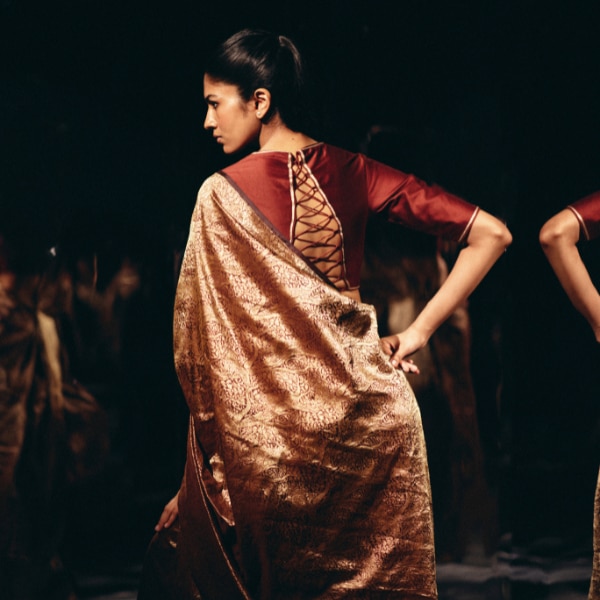
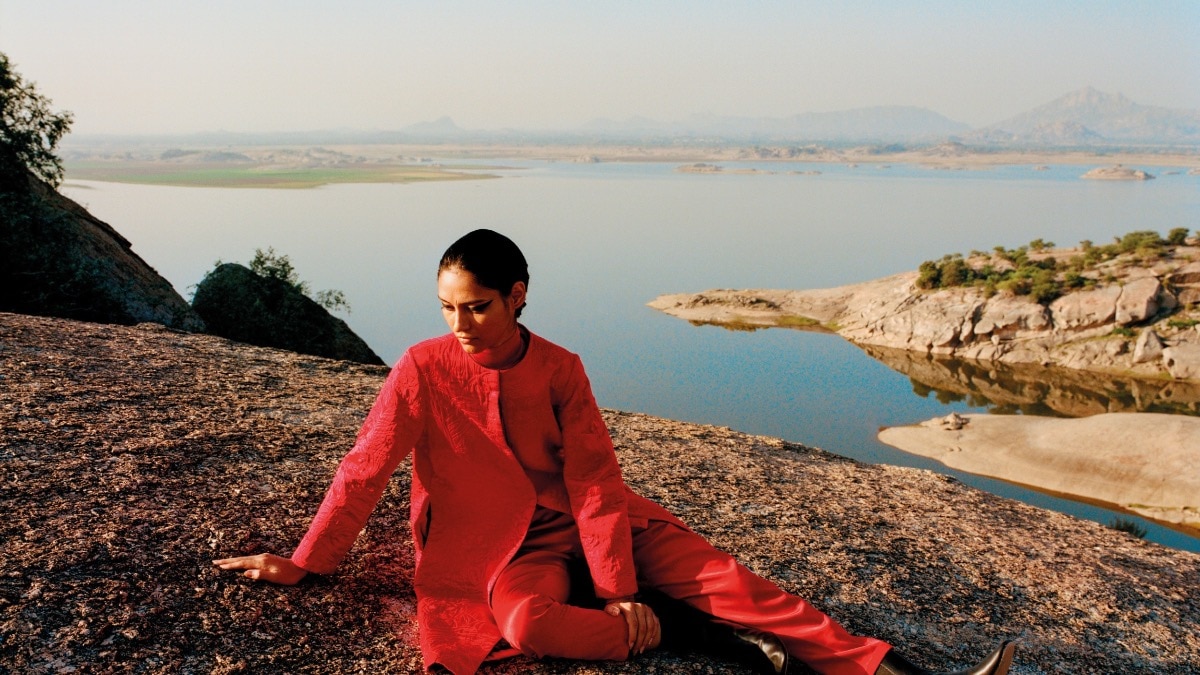
Sanjay Garg of Raw Mango developed Sher Bagh with Anjali and Jaisal Singh of SUJÁN for Fall/Winter 2021. “A Shikargah is a place,” Garg says, before it’s ever a picture, and textile traditions once simply reflected what happened there, “hunters encircling the prey, long royal processions with the emperor riding on a palanquin.”
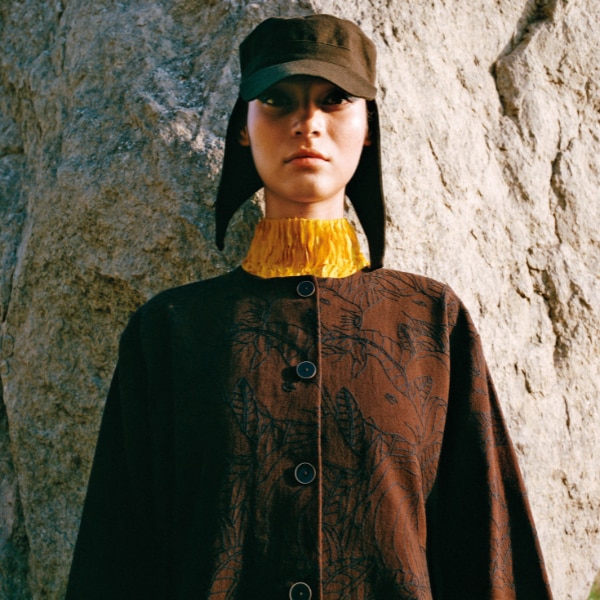
The Royal Bengal tiger of SUJÁN’s Ranthambore property, where Garg spent time developing the collection, became the collection’s central figure. “In Sher Bagh, we revisit this with the human as one of the 11 animals. Instead of fear and aggression, the creations speak to themes of co-existence,” he says.
The collection took three years to develop, on a par with how the label always works. Some Banaras weavers initially resisted the animal imagery on religious grounds, though he notes the same community had worked with shikargah before, during the British period, when hunting scenes were a recurring inspiration. “We didn’t remove the hunter. Generations of
conservationists led that change. We simply shone a light on it.” His simplest example is a landscape that has undergone the same transformation: “Jim Corbett National Park used to be a shikargah. Today it’s a tiger reserve.”
Asked why the motif still carries such charge, Garg points partly to scarcity. “We are more enamoured with the natural world today because it keeps shrinking. We don’t see forests anymore. Maybe people miss them.
”Agrawal says without a hunter, it isn’t really Shikargah at all, just flora and fauna carrying the name. Garg found the hunter and wrote him out on purpose. Agarwal sees the animal itself as the point, hunter or not. Chand leaves the question hanging: what, then, is left of the hunt?
Lead image: A model in an ensemble from the Sher Bagh collection by Raw Mango
Images: Courtesy the brands
This article originally appeared in Harper's Bazaar India's October 2026 print issue.
Also read: The rise of the micro celebrity: Why influence is no longer about millions of followers
Also read: Anavila’s first home collection is a tribute to the village that shaped her
ADVERTISEMENT
Must Read




ADVERTISEMENT