





ADVERTISEMENT
Clinical conscience: What Aminu Wellness gets right about Indian skin and clinical skincare
Aminu Wellness co-founder Prachi Bhandari on moving beyond harsh actives to a more precise, contextual, and intelligent approach to skincare.

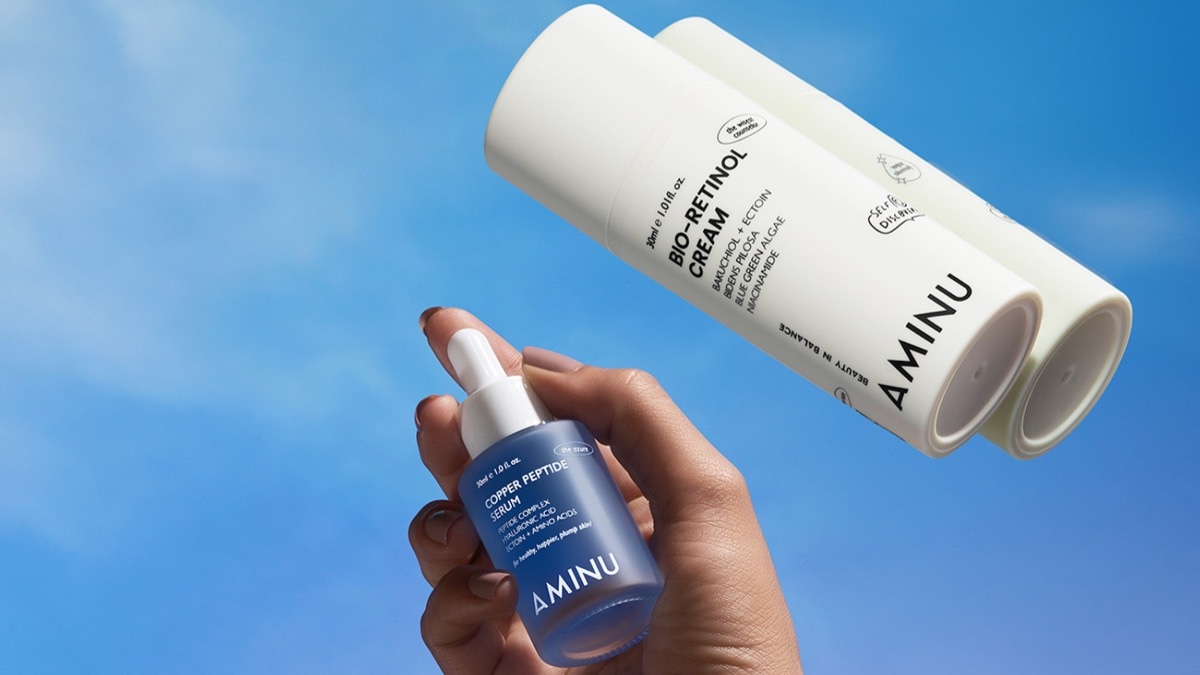
For a long time, I’ve viewed the beauty industry as a series of loud, competing monologues, always telling us to “fight” our age, “correct” our flaws, and “strip away” our imperfections. We’ve been taught to read our skin through damage, deficiency, and decline, then handed a routine that asks us to fight all three at once. But in a market crowded with performative formulas and increasingly hostile claims, Prachi Bhandari, Co-founder, Aminu Wellness, makes the case for a different kind of clinical—one that is more rigorous, more contextual, and more alive. “Indian skin isn’t a skin type. It’s a life system,” she remarks.
A DIFFERENT LANGUAGE
What distinguishes Aminu first is not only what it formulates, but how it speaks. The bottles have the spare, clinical restraint one expects from a high-performance skincare line, yet the names resist that usual austerity: The Wisest Counsellor moisturiser, or Your Eyes Remind Me of Stars eye serum.
“A lot of clinical language is authority performance,” Bhandari says. “It signals rigour by erasing intimacy.” Her point is not that science should be softened into sentiment, but “a formula doesn’t live in a lab,” she says. “It lives on a bathroom shelf next to your toothbrush and your bad habits.” The literary name arrives only once the product has proved itself in real conditions: stability, compatibility, irritation risk, Indian weather, and the realities of repeated use. “Numbers tell you what it is,” she says. “Names tell you what it’s for.” In her words, the future of clinical skincare is not colder, but “clearer, more accountable, and strangely more intimate.”
THE BURDEN OF THE ‘STRONG STUFF’
That same clarity shapes the way she speaks about formulation. If the skincare market has one enduring obsession, it is escalation: higher percentages, stronger actives, and a relentless promise of faster results. Bhandari is sceptical of what she calls “the strong stuff,” and with reason. Her critique is not anti-active. It is anti-burden. “Skin experiences a formula like a full environment,” she says. Labels isolate ingredients; skin does not. It responds to the total architecture of a formula. “Past a point, you’re not buying more results, you’re buying more inflammation,” she says. For melanin-rich Fitzpatrick IV and V skin, that inflammation can leave behind exactly the kind of uneven tone consumers were trying to avoid.
Aminu’s answer is its NeoSynergy platform and the principle of biocompatible blending: choosing ingredients for how they behave together, then setting them at the most synergistic point rather than the highest tolerable one. “Excess isn’t luxury, precision is luxury,” Bhandari explains.
BUILT FOR INDIAN LIFE
Bhandari’s insistence on context becomes even more persuasive when she speaks about Indian skin specifically. The point is not merely that the climate is hotter. It is that the full rhythm of Indian life places distinct demands on the skin: “sun to AC, sweat to over-cleansing, pollution to late nights, hard water to screen-heavy days.” Add the biology of melanin-rich skin, where even low-grade irritation can show up as stubborn uneven tone, and the challenge becomes far more complex than simply importing globally popular actives.
That is why Aminu’s global sourcing feels purposeful rather than decorative. The brand draws from ingredients and technologies across more than 40 countries, yet Bhandari’s real work lies in re-engineering them for Indian conditions: keeping formulas stable through heat and humidity, preventing oxidation, balancing pH and solubility, and ensuring textures remain elegant rather than oppressive in sweat. As she puts it, Aminu is built on “global intelligence, engineered for Indian life.”

THE QUIET WORK OF RESILIENCE
If there is one idea Bhandari returns to most convincingly, it is that modern skin is tired in quieter ways than the beauty industry tends to admit. She dismisses “urban fatigue” as a polite term for something more serious: chronic, subclinical inflammation caused by pollution, heat, oxidative stress, and continual barrier disruption. The damage is cumulative. It gathers slowly, she says, until one day it is no longer invisible. “Repair is a rescue story,” Bhandari says. “Strengthening is compound interest.”
In that sense, Aminu’s real proposition is larger than skincare. It is about refusing the industry’s oldest habits: the worship of intensity, the seduction of excess, the ease of borrowed language. Bhandari is building something quieter than that, and more exacting too—a brand that treats Indian skin as a serious site of knowledge rather than an afterthought to global beauty.
For readers with only 15 minutes before a major event, her prescription is characteristically disciplined: cleanse, apply the Nordic Mud Mask for five minutes, then follow with the Radiance Face Oil—plus the VitC Body Oil for the body. But the larger point of Aminu lies beyond a quick fix. “We’re the largest population on earth and we are still, largely, operating on borrowed data,” she says. What interests her now is not simply the next ingredient or the next launch, but the possibility of asking better questions. And perhaps that is the sharpest measure of Aminu’s intelligence: it is not trying to overpower the skin, only to understand it more precisely.
Lead image: The brand
Also read: From Simply Nam, Kiro to Kay Beauty, 7 inclusive brands that work across Indian skin tones
Also read: How gel-based skincare is finding its place in lightweight, high-performance beauty
ADVERTISEMENT
Must Read










ADVERTISEMENT